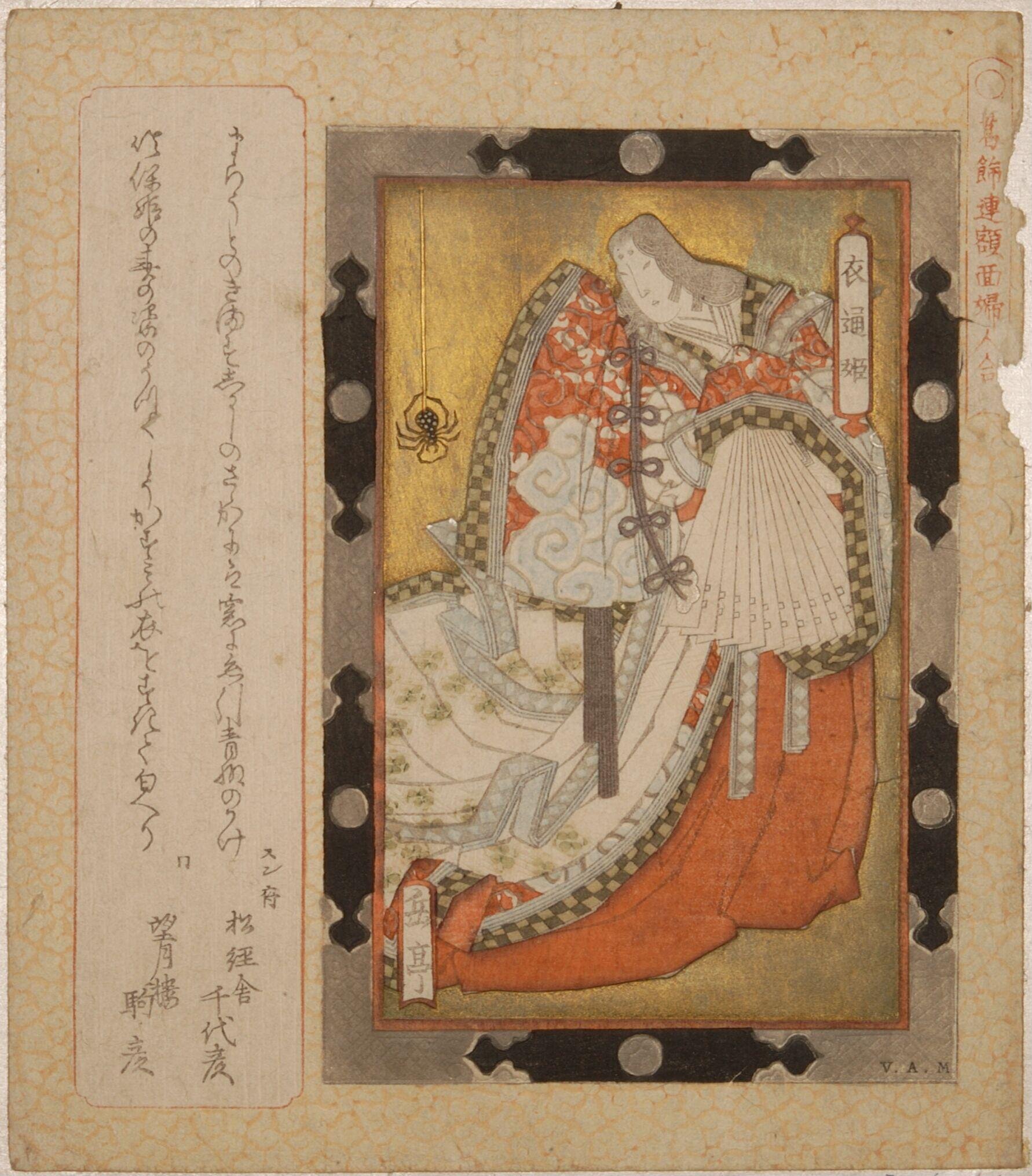
Princess Sotoori (Sotoori hime)
- Date:
- ca. 1822
- Medium:
- Source:
- Victoria and Albert Museum
Description
Princess Sotoori (Sotoori hime), in the Victoria and Albert Museum, is Yashima Gakutei's homage to one of the most luminous figures of early Japanese poetry. Sotoori hime was a consort of Emperor Ingyo in the legendary period covered by the Nihon shoki and Kojiki, remembered both for her surpassing beauty, said to glow through her robes, and for her composition of waka. In later Japanese tradition she was sometimes counted among the so-called Three Gods of Poetry, alongside Kakinomoto no Hitomaro and Yamabe no Akahito, and she became a touchstone for any subsequent celebration of women's literary accomplishment. By choosing her as a subject, Gakutei taps directly into this prestigious lineage. Yashima Gakutei was a leading designer in the Hokusai school, trained under Totoya Hokkei and influenced by Katsushika Hokusai. His pictures of legendary poets, including those produced for kyoka anthologies such as the Harusame shu, depended on conventions of Heian-style costume and gesture to evoke a remote courtly world. In Princess Sotoori he employs those conventions to suggest both her physical radiance and her literary calling, balancing decorative richness with a sense of reverent calm. The Victoria and Albert Museum's holding adds a non-American institutional dimension to Gakutei's surviving body of work, complementing the deep collections at the Metropolitan Museum of Art and elsewhere. Surimono and related luxury prints featuring poets such as Sotoori hime flattered the literary ambitions of kyoka circles that commissioned them, drawing a direct line between classical waka and modern comic verse. The V&A's preservation of this Yashima Gakutei design ensures that his contribution to the iconography of female poetic genius, carried out within the Hokusai school, remains accessible to international audiences.
More Prints by Yashima Gakutei


Frequently Asked Questions
Princess Sotoori (Sotoori hime) was created by Yashima Gakutei (八島岳亭) in ca. 1822.