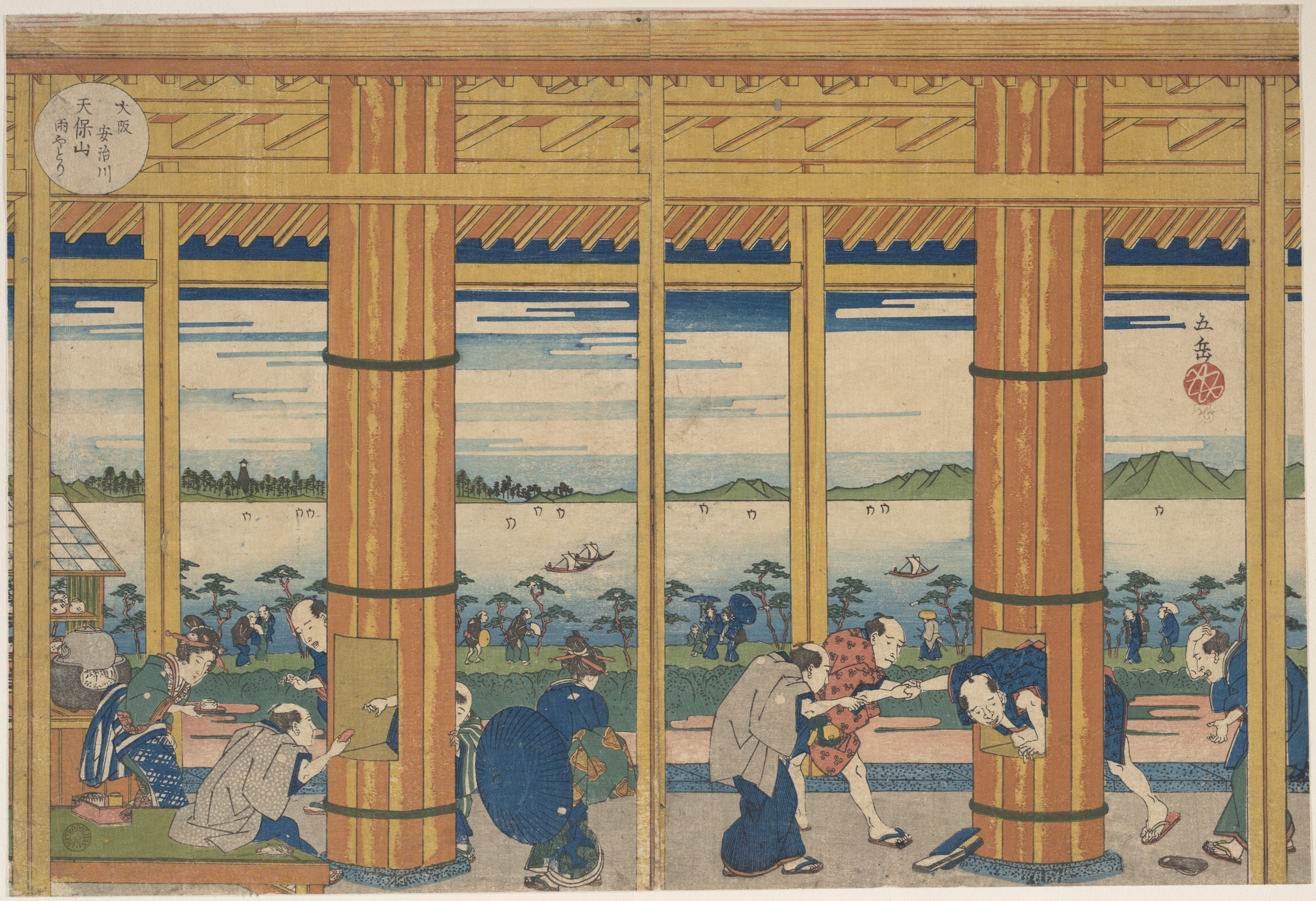
Shower-Shelter on the Shore of Tempozan Bay
- Date:
- 1838
- Medium:
- Woodblock print; ink and color on paper
- Source:
- Metropolitan Museum of Art
Description
Shower-Shelter on the Shore of Tempozan Bay, in the Metropolitan Museum of Art, is one of Yashima Gakutei's late landscape prints celebrating the modern attractions of Osaka. Tempozan was an artificial hill in Osaka Bay, completed in the 1830s from earth dredged during river-improvement works, and it quickly became a popular site for excursions, festivals, and views over the harbor. Gakutei's print shows visitors taking shelter from a sudden rain shower on the shore of the bay, the storm's intervention transforming an outing into a vivid pictorial event. The image belongs to a series in which Gakutei devoted his characteristic compositional refinement to the celebration of Tempozan as a distinctly modern Osaka attraction. Yashima Gakutei was a senior figure within the Hokusai school, trained under Totoya Hokkei and indebted to Katsushika Hokusai. By the later 1830s he had become one of the most respected printmakers in Osaka, and the Tempozan project allowed him to translate his expertise in surimono and book design into a series of larger landscape prints. Hokusai's own Thirty-Six Views of Mount Fuji and Hiroshige's stations-of-the-Tokaido series had reshaped expectations for what landscape prints could achieve, and Gakutei's Tempozan designs participate in that wider transformation by offering a distinctly Osaka-centered vision. Shower scenes were a favorite device of nineteenth-century landscape printmakers because they allowed the abrupt introduction of motion, drama, and human reaction into otherwise serene compositions. Figures hurry, parasols open, garments lift, and the architecture of the shore becomes a stage for collective response. The Metropolitan Museum of Art's preservation of this Yashima Gakutei design records one of his most lively contributions to the Osaka landscape tradition.
More Prints by Yashima Gakutei


Frequently Asked Questions
Shower-Shelter on the Shore of Tempozan Bay was created by Yashima Gakutei (八島岳亭) in 1838.