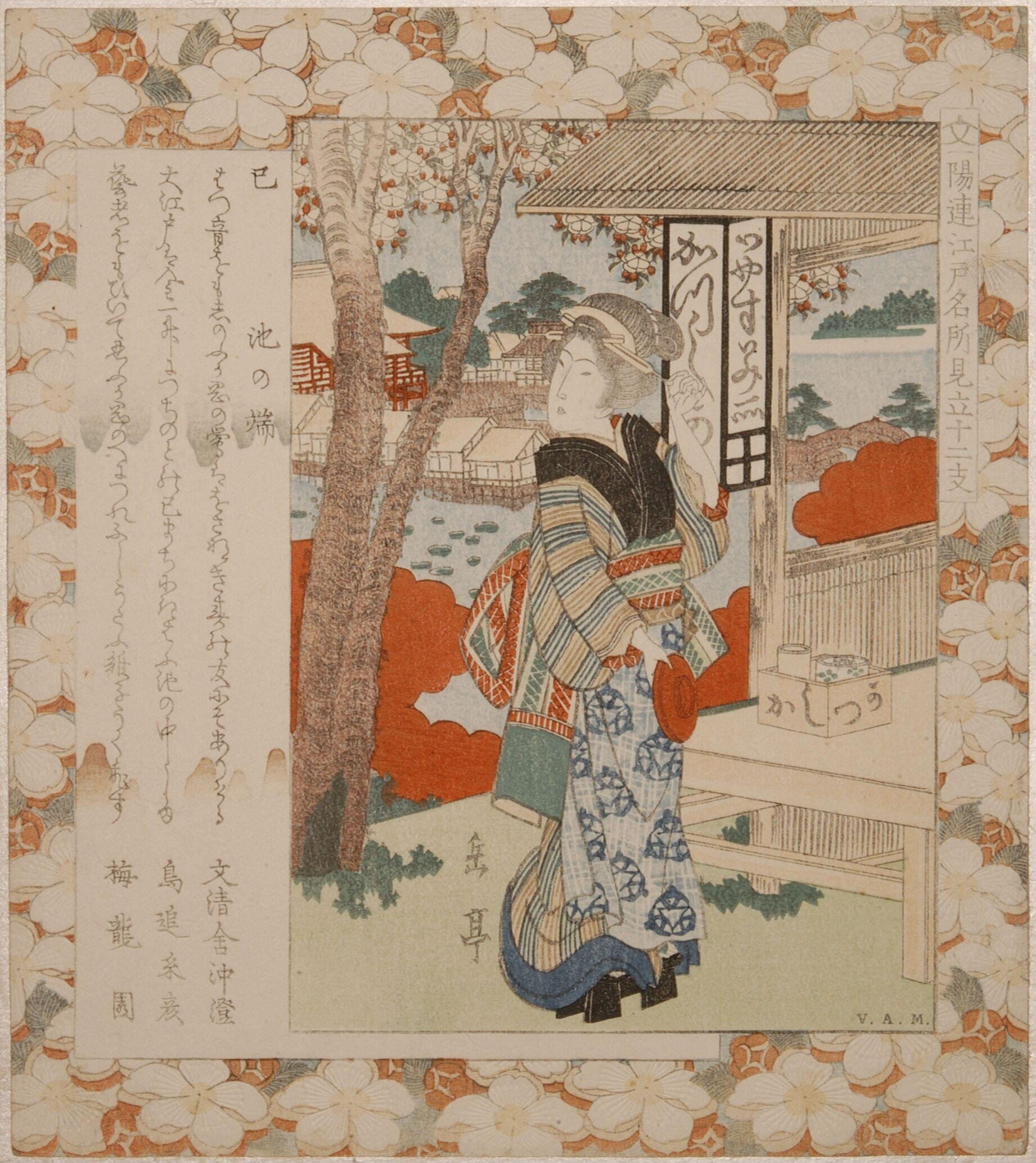
Snake (Mi)
- Date:
- ca. 1826
- Medium:
- Source:
- Victoria and Albert Museum
Description
Yashima Gakutei designed Snake (Mi) in 1826 as the sixth animal in his complete zodiac surimono cycle. The Victoria and Albert Museum preserves the print among the museum's holdings of the artist's calendrical designs.
The snake coils tightly in the composition, scales rendered with careful overprinting that suggests their iridescent texture without overwhelming the clarity of the silhouette. Gakutei often paired the snake with attributes drawn from religious and folkloric tradition: white snakes are associated with the goddess Benzaiten and bring good fortune, and motifs like rocks, water, or sacred plants frequently surround zodiac snake imagery. Whatever the supporting elements, the animal itself is the focal point, its compact body and lifted head conveying the alert, mysterious character that East Asian tradition has long attributed to serpents.
Gakutei trained in the Hokusai school under Totoya Hokkei. Katsushika Hokusai's interest in serpents — appearing in his Manga sketches and in narrative prints — provided his pupils with a vocabulary for handling the reptile's intricate form. Gakutei applies that lineage of observation here, rendering scales as a rhythmic pattern that becomes part of the print's decorative texture.
Zodiac sets like this one were ideal commissions for kyōka poetry clubs, particularly around the New Year of the corresponding sign. The surimono format invited gauffrage, refined registration, and occasional metallic pigments, all of which suit the snake's gleaming surface. The Victoria and Albert Museum's impression demonstrates how Yashima Gakutei used Hokusai school design discipline and surimono craftsmanship to convert a potentially difficult subject — a serpent in compact coil — into a refined image of zodiacal symbolism well-suited to the literary tastes of Edo's poetry circles.
More Prints by Yashima Gakutei


Frequently Asked Questions
Snake (Mi) was created by Yashima Gakutei (八島岳亭) in ca. 1826.