
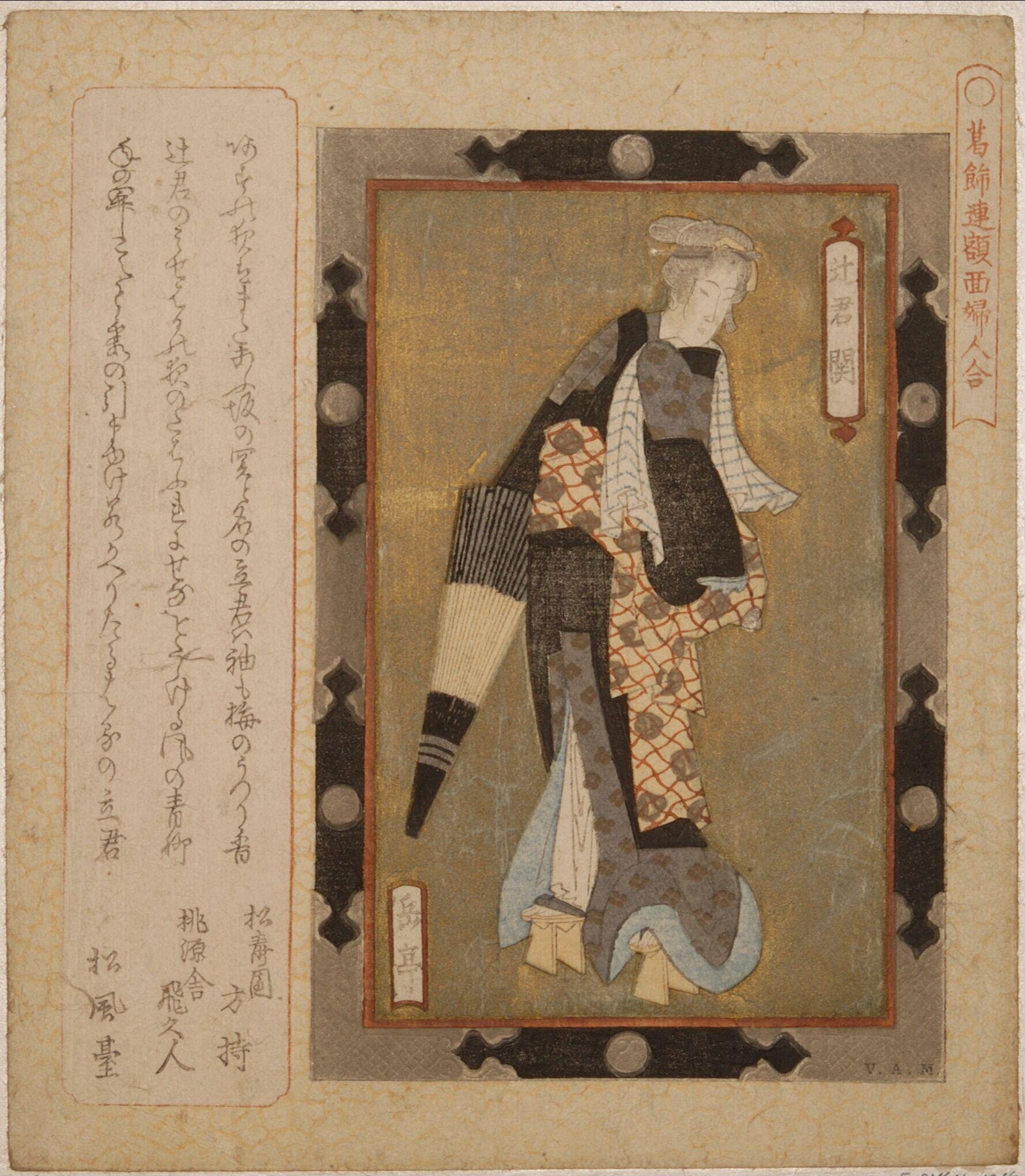
Tamamo no Mae and the Archer Miura Kuranosuke
- Date:
- 1835
- Medium:
- Woodblock print (surimono); ink and color on paper
- Source:
- Metropolitan Museum of Art
Description
Tamamo no Mae and the Archer Miura Kuranosuke, in the Metropolitan Museum of Art, presents Yashima Gakutei's vision of one of the most celebrated supernatural tales in Japanese folklore. Tamamo no Mae was the beautiful courtesan said to have served Emperor Toba in the twelfth century. Her radiance concealed a darker secret: she was in fact a nine-tailed fox spirit whose presence at court spread illness and misfortune. When her true nature was revealed, she fled and was pursued by warriors, among them Miura Kuranosuke, whose arrow finally brought her down. Gakutei's print combines the fox-woman and her pursuer, dramatizing the moment of confrontation between human heroism and supernatural beauty. Yashima Gakutei worked within the Hokusai school, training under Totoya Hokkei and shaped by the design language of Katsushika Hokusai. Both teachers and pupil had a deep interest in supernatural and historical narrative, and Tamamo no Mae was a subject they returned to repeatedly. By the early nineteenth century the story had been retold in puppet theater, kabuki, and popular fiction, providing Gakutei with multiple sources of imagery upon which to draw. In his design, Tamamo no Mae's elegance, conveyed through fine costume detail, contrasts with the focused, controlled action of the archer. Stories of this kind also appealed to kyoka poetry circles, whose verses played freely with classical references and supernatural conceits. A print combining a famous beauty, a heroic warrior, and a mythic confrontation provided rich material for poetic response. The Metropolitan Museum of Art's record secures Yashima Gakutei's place in the long Japanese tradition of pictorial storytelling around Tamamo no Mae, carried forward within the visual idiom of the Hokusai school.
More Prints by Yashima Gakutei


Frequently Asked Questions
Tamamo no Mae and the Archer Miura Kuranosuke was created by Yashima Gakutei (八島岳亭) in 1835.