
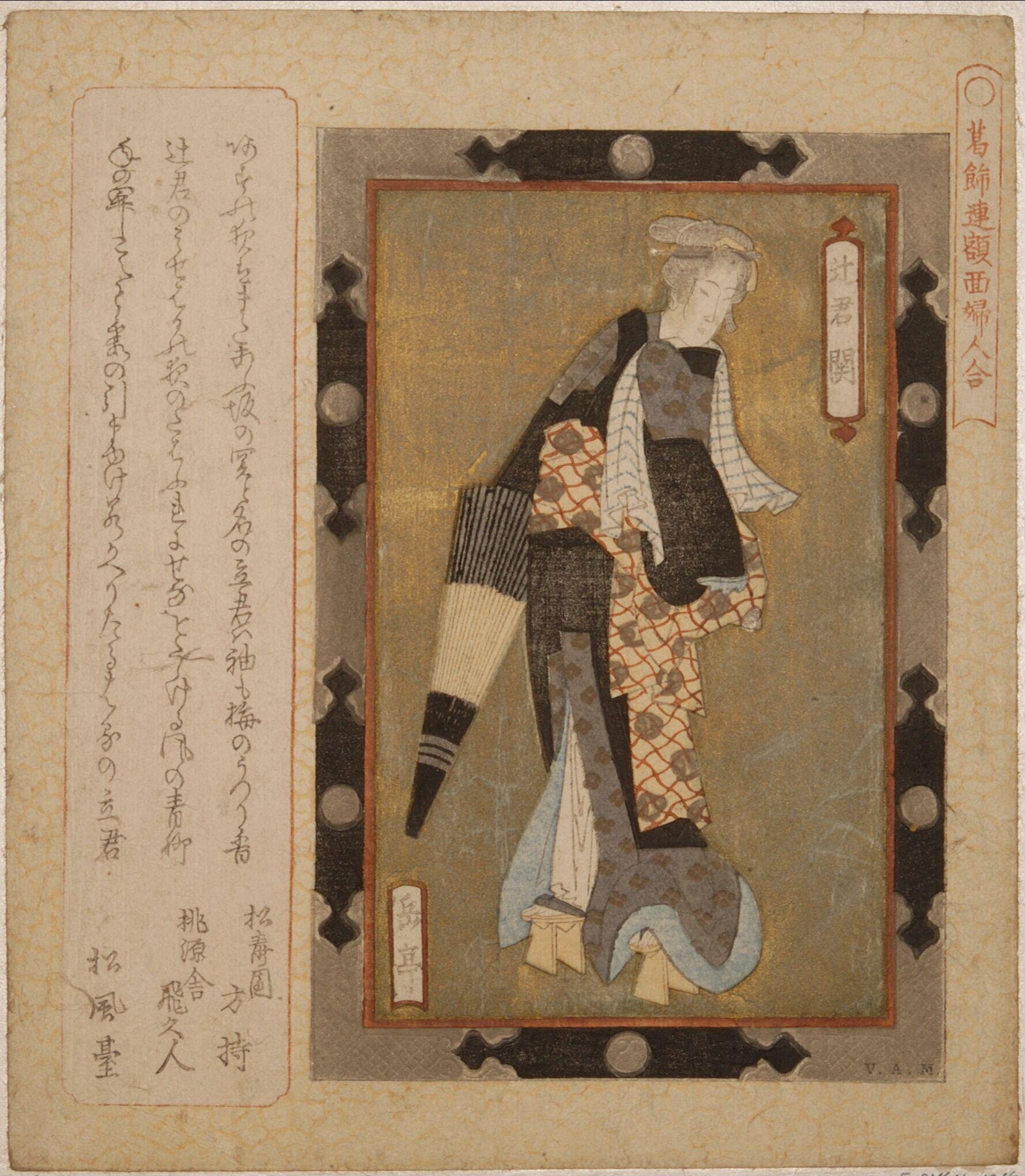
The Filial Son of Kamakura from the Collection of Stone and Sand (Kamakura koshi, Shasekishu), from the series "Twenty-four Japanese Paragons of Filial Piety for the Honcho Circle (Honchoren Honcho nijushiko)"
- Date:
- c. 1821
- Medium:
- Color woodblock print; shikishiban, surimono
- Source:
- Art Institute of Chicago
Description
Drawn from the Shasekishu, the thirteenth-century Collection of Stone and Sand by the Buddhist monk Muju, this surimono shikishiban from Gakutei's Honchoren Honcho nijushiko series depicts the Filial Son of Kamakura, one of the Japanese exemplars chosen to replace the Chinese figures of the original Confucian Twenty-four Paragons of Filial Piety. Held by the Art Institute of Chicago and dated to around 1821, the print represents the meticulous textual scholarship underlying Gakutei's series, which drew exemplars from sources ranging from the Nihongi to the Taiheiki to medieval Buddhist tale collections, demonstrating the depth of literary culture sustaining the Honchoren commissions. The shikishiban format presents the figure against a quiet ground enriched with metallic pigments, and the surrounding inscription space would have carried kyoka verse from the circle's poets responding to the moral lesson the figure embodies. Gakutei's draftsmanship here combines historical costume study with the surimono tradition's compressed compositional language, producing an image that functions simultaneously as moral exemplum and aesthetic object.
More Prints by Yashima Gakutei


Frequently Asked Questions
The Filial Son of Kamakura from the Collection of Stone and Sand (Kamakura koshi, Shasekishu), from the series "Twenty-four Japanese Paragons of Filial Piety for the Honcho Circle (Honchoren Honcho nijushiko)" was created by Yashima Gakutei (八島岳亭) in c. 1821.