
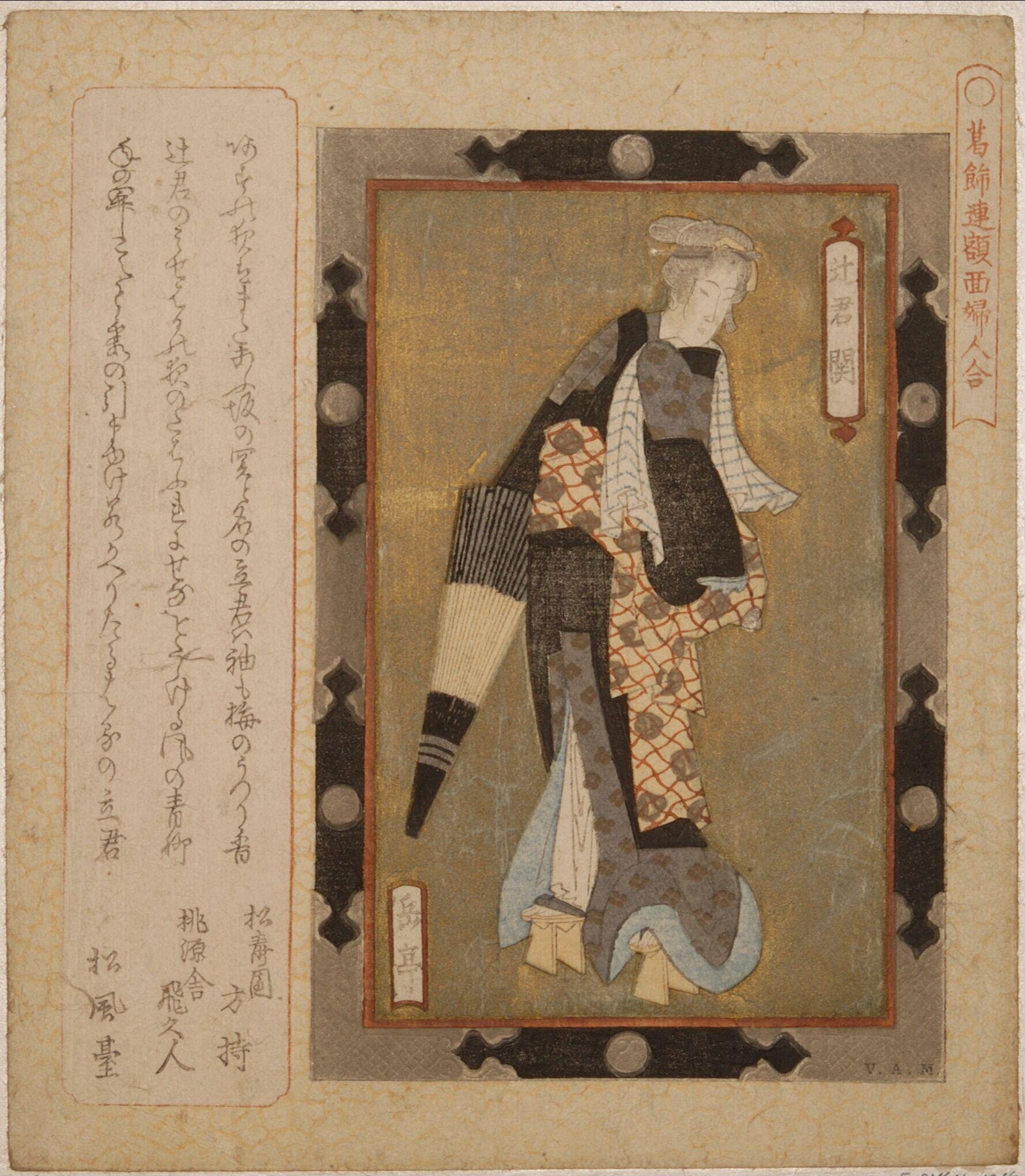
The Filial Son of Yoro from the Ten Moral Lessons (Yoro koshi, Jikkinsho), from the series "Twenty-four Japanese Paragons of Filial Piety for the Honcho Circle (Honchoren Honcho nijushiko)"
- Date:
- c. 1821
- Medium:
- Color woodblock print; shikishiban, surimono
- Source:
- Art Institute of Chicago
Description
From the Honchoren Honcho nijushiko, Gakutei's surimono series of Twenty-four Japanese Paragons of Filial Piety adapted for the Honcho poetry circle, this print depicts the Filial Son of Yoro, drawn from the Jikkinsho, a thirteenth-century collection of ten moral lessons. The original Chinese Twenty-four Paragons of Filial Piety was a canonical Confucian text, and Gakutei's series ingeniously substitutes Japanese exemplars drawn from Japanese sources, transforming a Chinese moral tradition into a celebration of native literary heritage. Held by the Art Institute of Chicago and dated to around 1821, the shikishiban surimono uses the privately-commissioned format to elevate moral didacticism into refined visual literature, with each impression circulating among Honchoren kyoka poets who could inscribe verse responding to the legend depicted. The Yoro story, set in the mountains where a son was said to have drawn miraculous sake from a spring to comfort his aged father, was among the best-known filial tales in Japan and a perfect subject for poetic elaboration.
More Prints by Yashima Gakutei


Frequently Asked Questions
The Filial Son of Yoro from the Ten Moral Lessons (Yoro koshi, Jikkinsho), from the series "Twenty-four Japanese Paragons of Filial Piety for the Honcho Circle (Honchoren Honcho nijushiko)" was created by Yashima Gakutei (八島岳亭) in c. 1821.