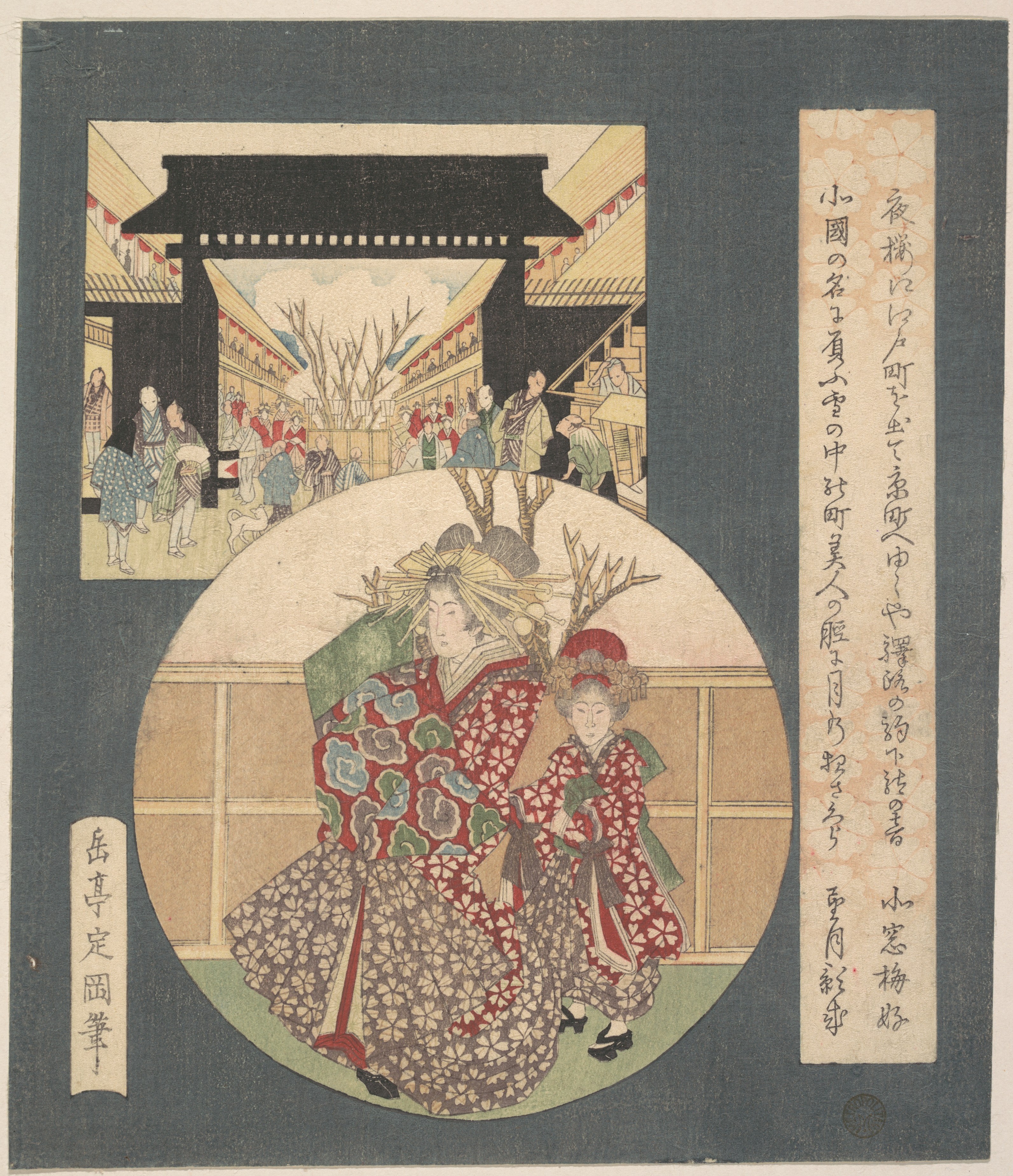
The Gate of the Yoshiwara
- Date:
- ca. 1820
- Medium:
- Woodblock print (surimono); ink and color on paper
- Source:
- Metropolitan Museum of Art
Description
The Gate of the Yoshiwara, recorded in the Metropolitan Museum of Art, is a Yashima Gakutei print that engages with one of the most charged spaces of Edo-period urban life. The Yoshiwara, the licensed pleasure quarter located on the outskirts of Edo, was approached through a famous gate (Omon) that marked the threshold between the city's regulated daily life and the quarter's separate world of entertainment, fashion, and ritualized desire. Gakutei's image focuses on this entrance, treating it both as architecture and as symbol, an opening that defined the social and visual geography of an entire neighborhood. As a designer trained in the Hokusai school under Totoya Hokkei, Gakutei was alert to the kinds of cityscape subjects that flourished in the Edo period. His surimono and book illustrations often combined refined figural drawing with attention to architectural setting, and a subject like the Yoshiwara gate would have allowed him to display both. The work also offers an example of how privately commissioned prints could complement the more famous Yoshiwara imagery of artists such as Utamaro and Eishi, who concentrated on courtesans and interior scenes. By centering the gateway itself, Gakutei provides a different kind of access point to the district, one that emphasizes its boundary character rather than its interior life. Surimono of this kind were prized by kyoka poetry circles, whose verses often turned on the contrast between the everyday world and the elaborate fictions of the licensed quarter. The Metropolitan Museum of Art's record secures the print's place in the documentary history of Edo urban imagery and of the Hokusai school's range of subjects.
More Prints by Yashima Gakutei


Frequently Asked Questions
The Gate of the Yoshiwara was created by Yashima Gakutei (八島岳亭) in ca. 1820.