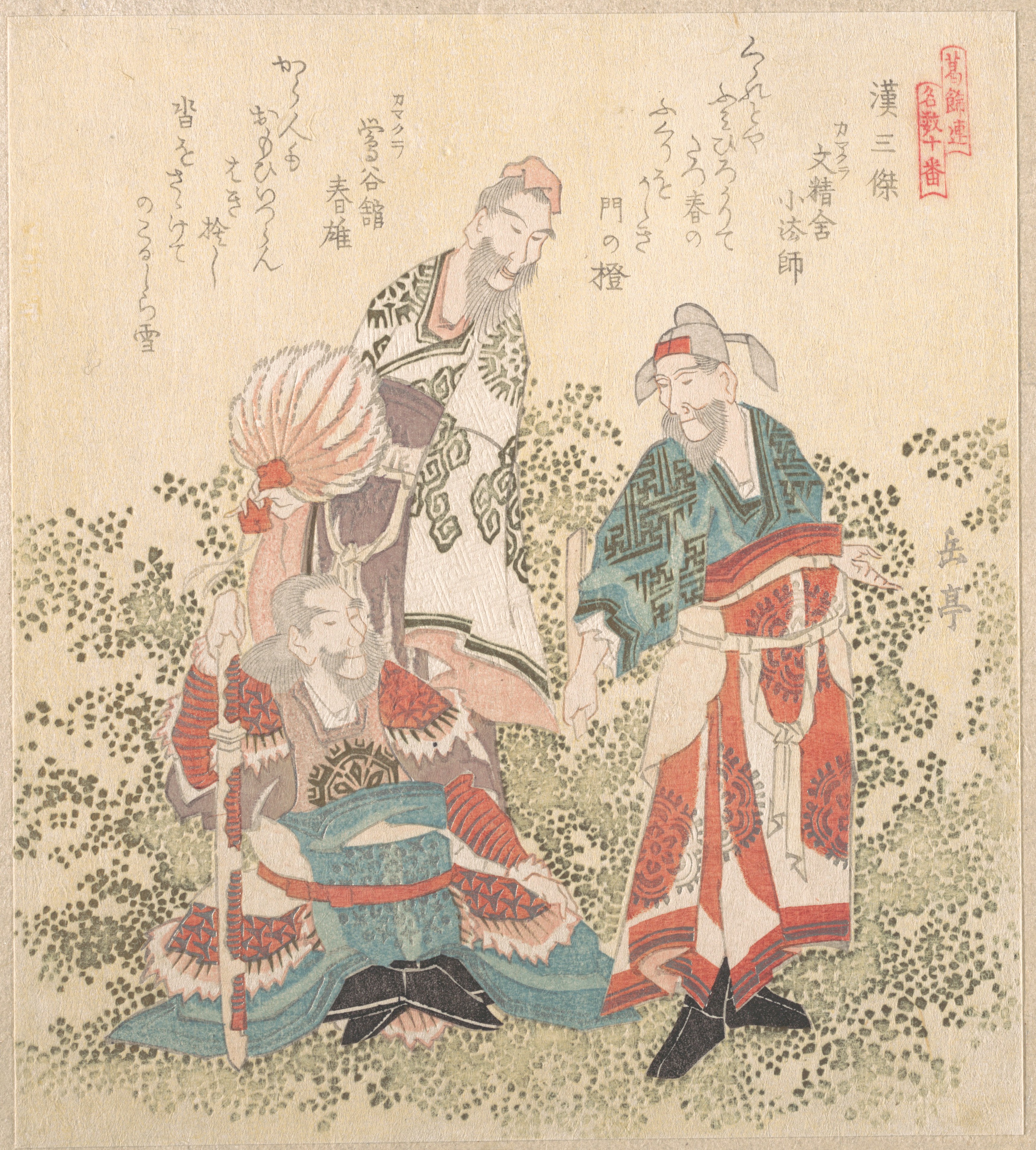
Three Great Wise Men of the Han Dynasty
- Date:
- 19th century
- Medium:
- Woodblock print (surimono); ink and color on paper
- Source:
- Metropolitan Museum of Art
Description
Three Great Wise Men of the Han Dynasty, by Yashima Gakutei, is held by the Metropolitan Museum of Art and reflects the strong current of Chinese historical and philosophical reference that ran through nineteenth-century Japanese print culture. The three great wise men, often identified as Zhang Liang, Xiao He, and Han Xin, the strategists and ministers who helped Liu Bang found the Han dynasty in the third century BCE, were celebrated in East Asian Confucian and historical literature as exemplars of statesmanship and counsel. Educated Edo and Osaka audiences encountered them through Chinese histories such as the Shiji and through Japanese popularizations. Yashima Gakutei, trained in the Hokusai school under Katsushika Hokusai and active among the Edo and Osaka kyoka surimono workshops, brought to such subjects the learned sensibility that distinguished his career from designers focused on actor and beauty prints. As a surimono designer, he worked within a format that prized literate subject matter, deluxe materials, and small private editions; this design likely accompanied kyoka verses that linked the historical theme to a contemporary occasion. The Hokusai school's combination of structural rigor and decorative refinement is evident in the careful balance of figures, attributes, and inscribed text. The Metropolitan Museum's holdings of Gakutei's Chinese-themed surimono allow scholars to trace how the genre served as a vehicle for cross-cultural reference within the relatively private context of kyoka exchange, supplementing his better-known Tenpozan landscapes and his Suikoden warrior series within a coherent body of work.
More Prints by Yashima Gakutei


Frequently Asked Questions
Three Great Wise Men of the Han Dynasty was created by Yashima Gakutei (八島岳亭) in 19th century.