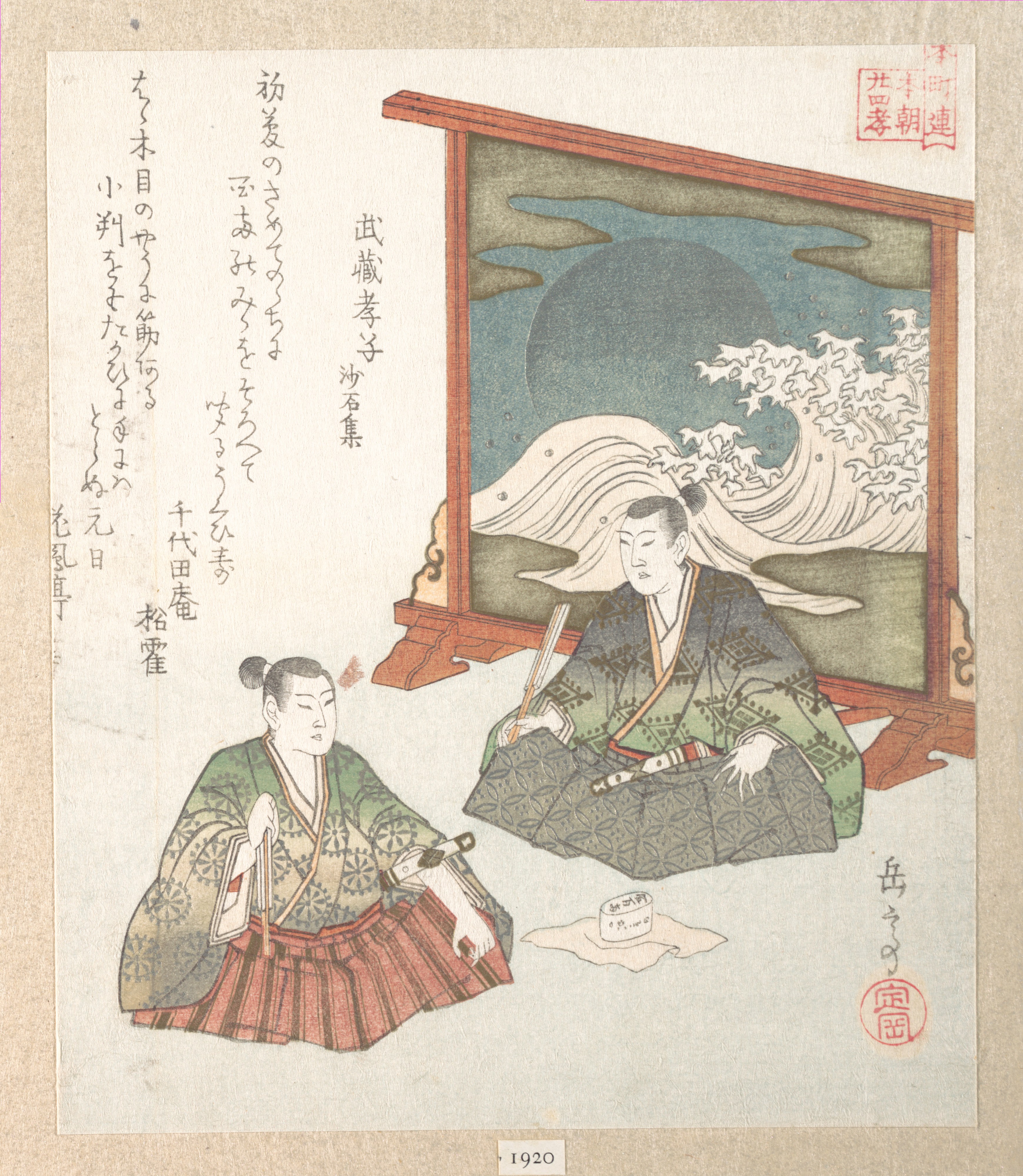
Two Boys and a Screen
- Date:
- early 19th century
- Medium:
- Woodblock print (surimono); ink and color on paper
- Source:
- Metropolitan Museum of Art
Description
Yashima Gakutei's Two Boys and a Screen, in the Metropolitan Museum of Art's collection, captures a domestic scene of childhood play. Two boys are arranged in conversation or activity around a folding screen, an object that often appears in Edo-period prints as both a piece of practical furniture and a symbolic frame separating areas of a room. The screen's presence offers Gakutei an opportunity to demonstrate his fondness for surface within surface, the play of pattern, and the careful management of negative space that distinguishes his small-format prints. Trained in the Hokusai school under Totoya Hokkei and clearly indebted to Katsushika Hokusai's design sensibility, Yashima Gakutei brought to subjects of this kind a deliberate, almost calligraphic ordering of figure and ground. The composition rewards slow looking: the rhythm of the boys' postures, the geometry of the screen, and the inclusion of any incidental accessories all participate in a tightly coordinated design. Children appear frequently in surimono prints, sometimes engaged in seasonal games or holding emblematic objects, and they often function as auspicious figures, since their presence signals continuity, prosperity, and good fortune for the household. Surimono of this type were privately commissioned by kyoka poetry circles, printed in limited numbers, and frequently embellished with metallic inks and embossing. They were designed to circulate among a small audience of educated buyers who would have appreciated both the technical refinement and the literary or sentimental content. The Metropolitan Museum of Art's record of Two Boys and a Screen preserves a characteristic Gakutei design that combines warmth of subject with the structural rigor inherited from the Hokusai school.
More Prints by Yashima Gakutei


Frequently Asked Questions
Two Boys and a Screen was created by Yashima Gakutei (八島岳亭) in early 19th century.