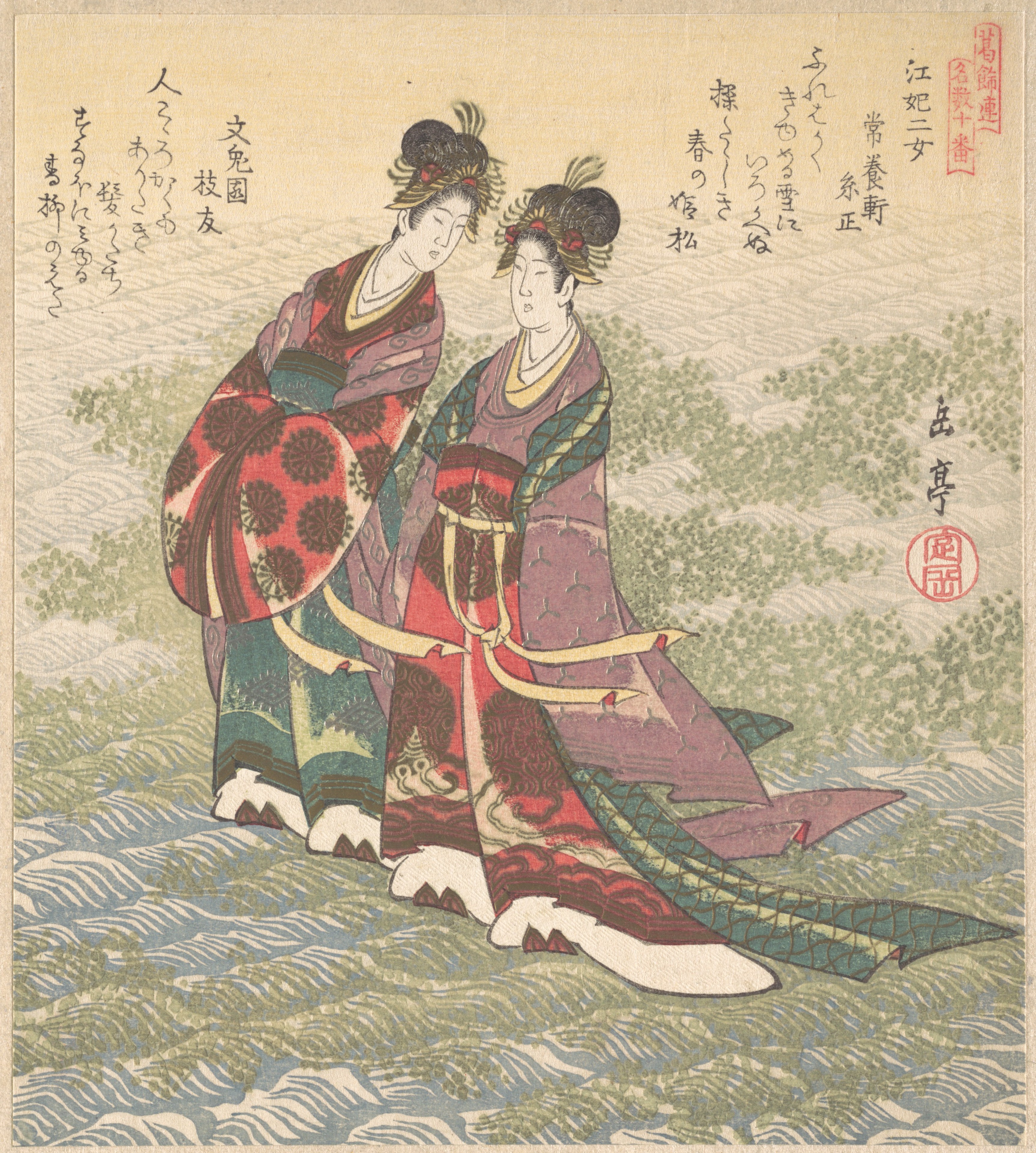
Two Ladies Walking on the Water
- Date:
- 19th century
- Medium:
- Woodblock print (surimono); ink and color on paper
- Source:
- Metropolitan Museum of Art
Description
Two Ladies Walking on the Water, by Yashima Gakutei, is held by the Metropolitan Museum of Art and engages a recurring Buddhist and East Asian visual conceit in which sacred or legendary female figures traverse water on lotus blossoms or by miraculous step. Such imagery in nineteenth-century Japanese print culture often draws on stories of Kannon, the Tenjin scholar-deity, or Chinese xian (immortal) traditions in which figures step lightly over rivers and lakes. As a designer trained in the Hokusai school under Katsushika Hokusai and a leading specialist in the privately commissioned deluxe print format, Gakutei devoted much of his career to surimono produced for Edo and Osaka kyoka poetry circles. The format favored allusive subject matter that the inscribed verses could elaborate or pun upon, and a pair of ladies walking on the water lends itself to multiple poetic interpretations, from sacred narrative to lighthearted urban fantasy. The Hokusai school's discipline of figural design is visible in the carefully layered robes, the contrast of postures, and the rhythmic interval between the two figures. Surimono printing techniques, including bokashi gradations across the water, metallic touches, and embossed accents, would have given the small sheet a tactile richness rarely matched in commercial ukiyo-e. The Metropolitan's holdings of Gakutei's surimono allow scholars to study his treatment of female figures in the surimono idiom and to compare his work with that of other Hokusai-school designers such as Totoya Hokkei and Ryūryūkyo Shinsai.
More Prints by Yashima Gakutei


Frequently Asked Questions
Two Ladies Walking on the Water was created by Yashima Gakutei (八島岳亭) in 19th century.