
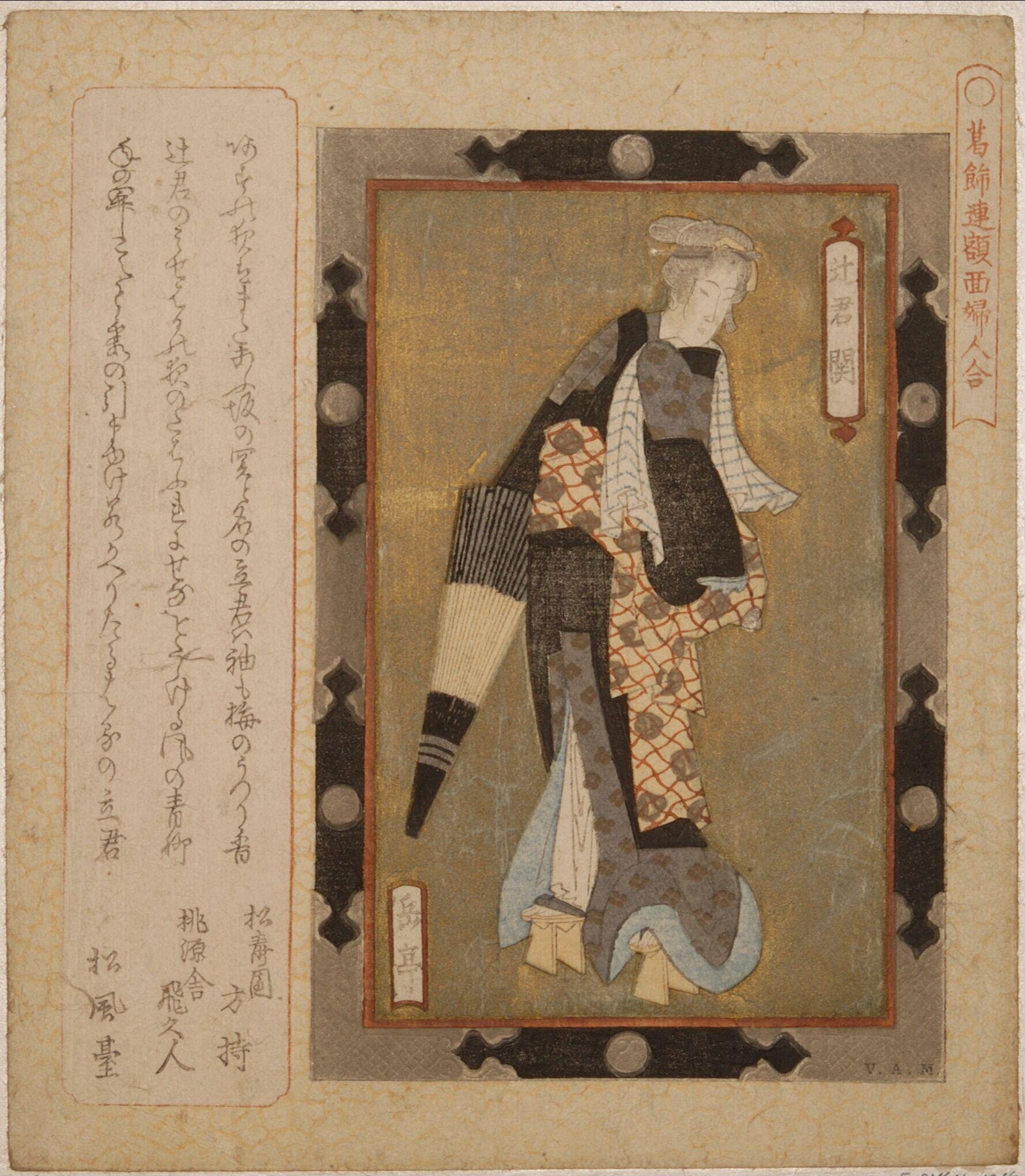
Two Princesses of the River (Kohi nijo), from the series "A Set of Ten Famous Numbers for the Katsushika Circle (Katsushikaren meisu juban)"
- Date:
- c. 1828
- Medium:
- Color woodblock print; shikishiban, surimono
- Source:
- Art Institute of Chicago
Description
Two Princesses of the River (Kohi nijo), a 1823 surimono in the Art Institute of Chicago, belongs to Yashima Gakutei's series A Set of Ten Famous Numbers for the Katsushika Circle (Katsushikaren meisu juban). The two princesses of the title are the legendary Chinese figures Ehuang and Nuying, the consorts of the sage-emperor Shun who, on hearing of his death, wept tears that stained the bamboos beside the Xiang river and then drowned themselves to follow him. They became canonical emblems of marital devotion in East Asian literary tradition, and their bamboo-staining tears generated a whole iconography of mottled bamboo and riverine sorrow. As the two of the series, they fit the conceit perfectly: famously a pair, famously linked to a river. Yashima Gakutei, working within the Hokusai school under Katsushika Hokusai, treats the subject with the dignified Chinese-style line that surimono on legendary themes called for, balancing the two figures against careful reserves of white paper for the printed kyoka verses. The Katsushika circle's poets would have used the image to write knowingly about loss, fidelity, or the tactility of bamboo. The print's deluxe surimono techniques - mineral pigments, karazuri embossing, and burnished metallic powders - register the genre's commitment to handheld richness. As a Yashima Gakutei kyoka-e in the Hokusai school manner, Two Princesses of the River is a model of literary surimono.
More Prints by Yashima Gakutei


Frequently Asked Questions
Two Princesses of the River (Kohi nijo), from the series "A Set of Ten Famous Numbers for the Katsushika Circle (Katsushikaren meisu juban)" was created by Yashima Gakutei (八島岳亭) in c. 1828.