
Woman with Shamisen and Cat
- Date:
- c. 1820s
- Medium:
- Color woodblock print; shikishiban, surimono
- Source:
- Art Institute of Chicago
Description
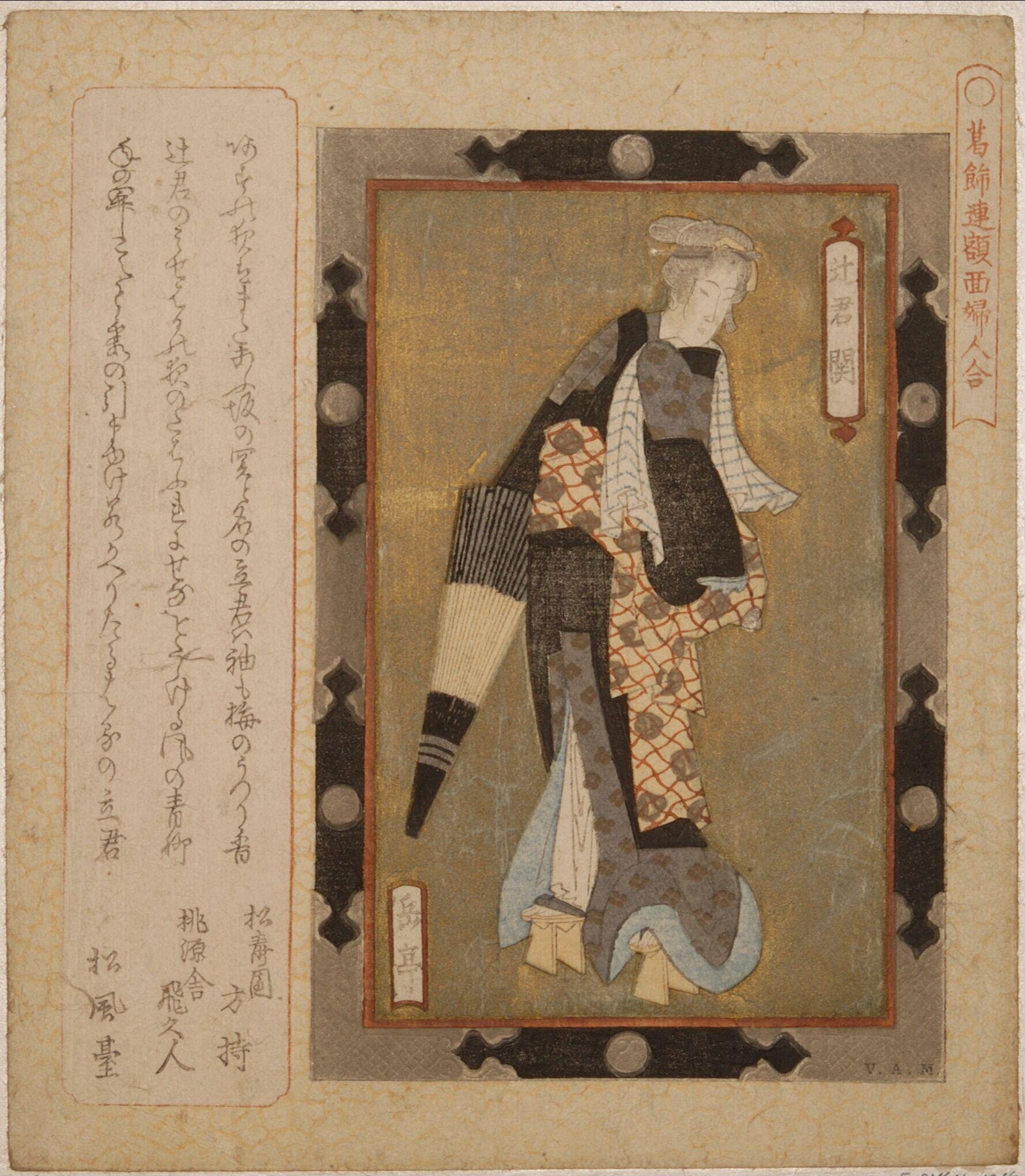
Woman with Shamisen and Cat, dated to about 1820 and held by the Art Institute of Chicago, is a surimono by Yashima Gakutei in which the Hokusai school's bijin-ga vocabulary is reshaped for the kyoka-e audience. Where commercial ukiyo-e bijin prints aimed at the broadest possible market, surimono like this one were privately commissioned by poetry circles and produced in small editions on thick paper, with metallic pigments and karazuri embossing reserved for the most refined effects. The image pairs a woman holding a shamisen with a cat at her side, a domestic vignette saturated with literary echoes: the shamisen evokes the entertainment quarters and the songs of the kabuki stage, while the cat carries its own thicket of poetic and folk associations. Gakutei composes the figure with the elongated grace characteristic of his teacher Katsushika Hokusai and his peers in the Hokusai school, but he tempers the look with the cooler, more refined palette that surimono collectors preferred. The poems that would originally have been printed beside the figure are the real subject; the picture is the visual gloss that makes a club member smile when the verses are read aloud. Studying the sheet today means reconstructing that lost conversation, but the formal pleasures still register: the curve of the instrument against the kimono pattern, the cat's compact silhouette, the careful registration of color blocks. For Yashima Gakutei, working at the height of his surimono practice, prints like this were exercises in saying a great deal within a single sheet.
More Prints by Yashima Gakutei


Frequently Asked Questions
Woman with Shamisen and Cat was created by Yashima Gakutei (八島岳亭) in c. 1820s.