Ginza (銀座)
12 prints by 9 artists
About Ginza
Ginza is a district in central Tokyo, lying between the Tsukiji area to the east, the Yurakucho and Shimbashi districts to the west, and the Kyobashi district to the north, in present-day Chuo Ward. The neighborhood takes its name from the silver coin mint, gin-za, that the Tokugawa shogunate established in the area in 1612, relocated from Sunpu under the early shogunate's monetary consolidation, and it served through the Edo period as one of the principal mercantile districts of the city, with major drapers, merchants, and craft workshops occupying the streets between Kyobashi and Shinbashi. The defining transformation came after the Great Ginza Fire of 1872, which destroyed the wooden Edo-period district, when the Meiji government, under the direction of the British engineer and architect Thomas Waters, commissioned the rebuilding of the district in brick in a Western neoclassical idiom, creating what was called Ginza Renga-gai, or Ginza Brick Town, the first large-scale planned Western-style urban district in Japan. The brick buildings, gas lamps, raised sidewalks, willow trees along the avenues, and horse-drawn streetcars of late nineteenth-century Ginza made the district a primary subject of the kaika-e enlightenment-picture genre and a symbol of the Meiji program of bunmei kaika (civilization and enlightenment). The Ginza brick avenues were among the first Tokyo addresses to be lit by gas in 1874 and electrically lit in 1882. For Japanese printmaking Ginza is most closely associated with the Meiji-period kaika-e of Utagawa Hiroshige III, Hashimoto Chikanobu, Inoue Yasuji, Kobayashi Kiyochika, and the broader Utagawa school working in the 1870s and 1880s. These prints record the new architectural and infrastructural forms of the modernizing capital, with the Ginza brick avenues figuring prominently alongside Nihonbashi, Tsukiji foreign settlement, and the new railway stations including Shinbashi. Hiroshige III in particular produced multiple Ginza sheets in his enlightenment-print series including views of the streetcars and gas lamps, and Kiyochika treated the district in his early career night views before turning to the broader Tokyo subject matter of his Tokyo meisho sets, with the celebrated Kiyochika compositions of Ginza by night under gaslight figuring among the finest examples of his kosenga (light-ray pictures) atmospheric practice. Inoue Yasuji and Hashimoto Chikanobu produced further Ginza views in the late Meiji decades. Most of the original Renga-gai brick buildings were destroyed in the 1923 Great Kanto Earthquake and the firebombing of 1945, but Ginza retained its identity as the city's principal shopping and entertainment district through the twentieth century, with the Wako department store, the Matsuya, the Mitsukoshi, and the Hattori Clock Tower (now the Wako clock tower) serving as landmarks of the rebuilt district. Shin-hanga and sosaku-hanga artists treated the district in their Tokyo sets, with Kawase Hasui producing rain and night views of the streets, including evening compositions in which streetcars and pedestrians move across rain-slick avenues, and the One Hundred Views of New Tokyo (Shin Tokyo hyakkei) project of 1928-1932 included Ginza compositions in its survey of the reconstructed metropolis. Tsuchiya Koitsu produced his own Ginza night views in the 1930s. The visual character of Ginza in prints is built on long perspectival avenues, gas or electric lamps, streetcars on the central rails, pedestrians in mixed Western and Japanese dress in the Meiji period, willow trees along the central boulevard, and rain-slick or snow-covered pavement in the shin-hanga period. Contemporary Ginza preserves no visible trace of the brick avenues, but the district remains one of the principal commercial centers of Tokyo, with the Wako department store and the Sukiyabashi crossings continuing to function as landmarks, reached via the Ginza, Marunouchi, and Hibiya lines of the Tokyo Metro.
Prints Depicting Ginza (12)

Bar Bacchus in Ginza, from the series Pictures of Ginza, First Series
January 1929
Color lithograph

Bar Sourire, no. 3 from the series Pictures of Ginza, Second Series
1929
Color lithograph

Black night-Ginza (One Hundred Views of Tokyo, Message to the 21st Century 東京百景 21世紀へのメッセジ)
1989-99
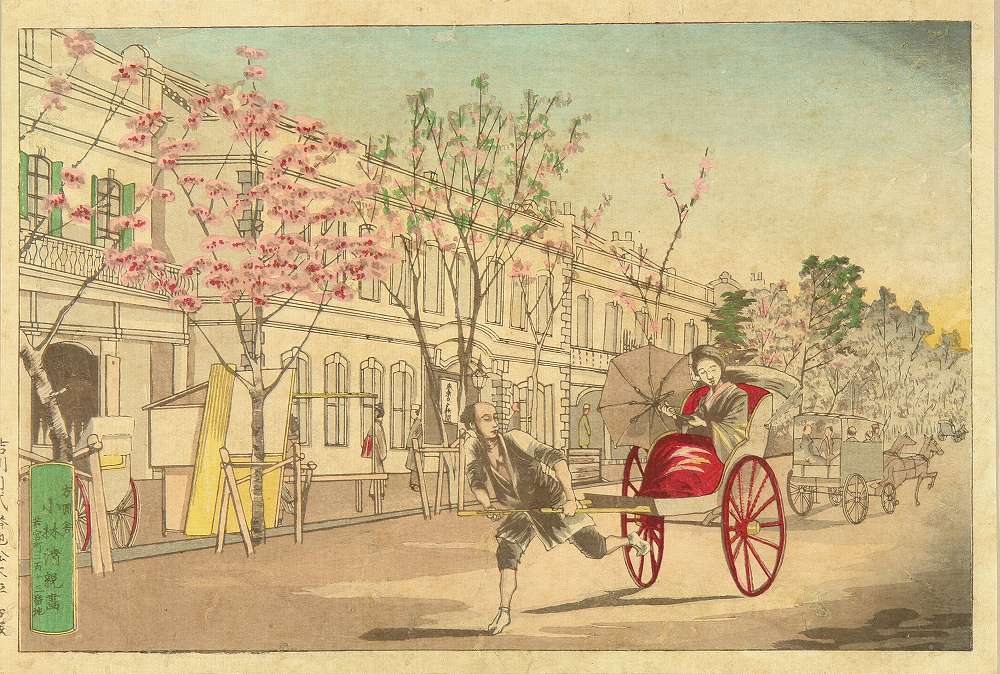
Building of Tokyo Daily Newspaper, Ginza, Tokyo, 1876
Woodblock print

Ginza at Night, from the series Recollections of Tokyo
1945
Color woodblock print
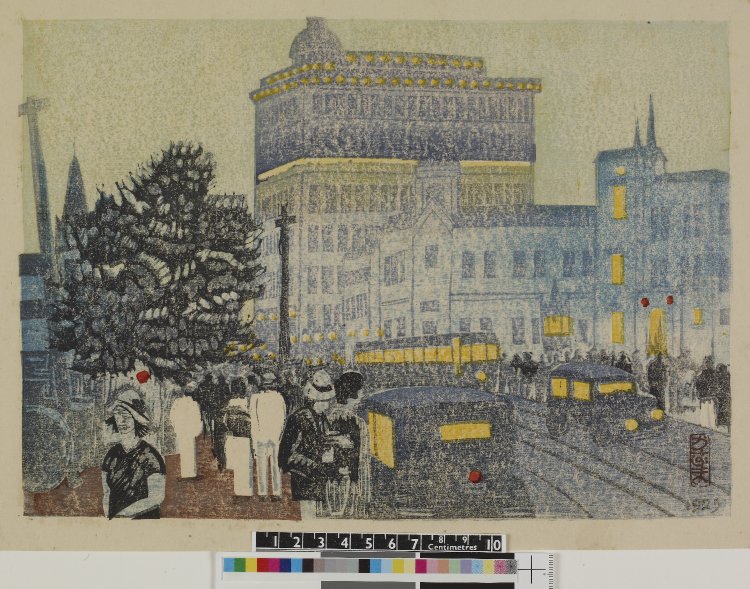
Ginza by Night
Woodblock print

Ginza Fantasy (One Hundred Views of Tokyo, Message to the 21st Century 東京百景 21世紀へのメッセジ)
1989-99
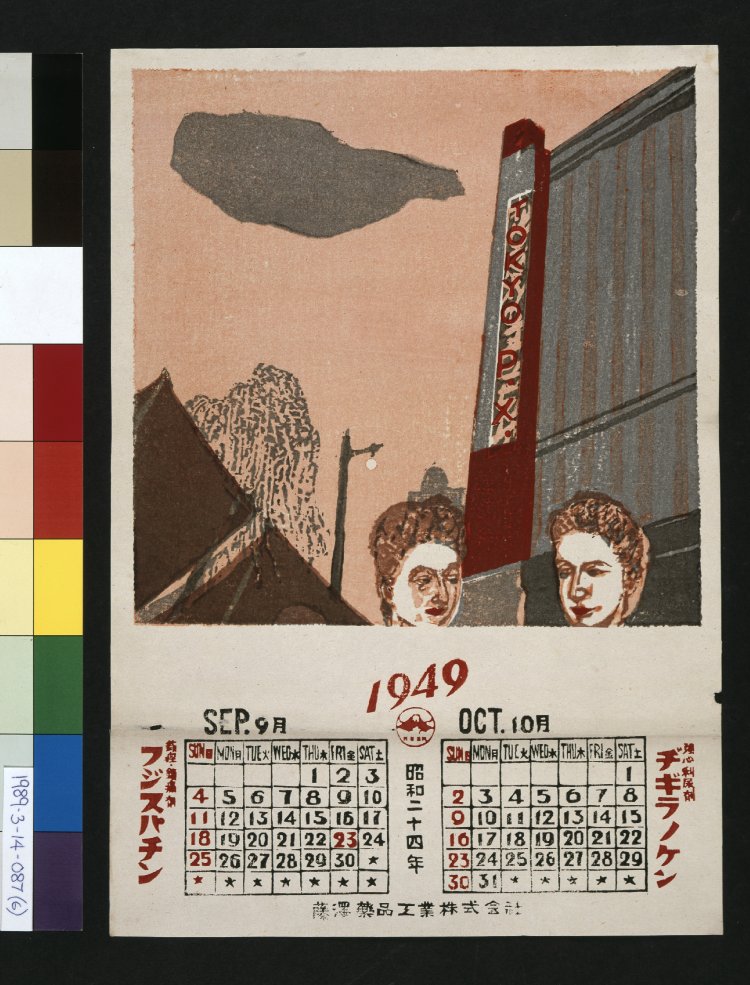
Ginza no tasogare-doki (Dusk in Ginza) / Fujisawa mokuhan karendaa (Fujisawa Woodblock Print Calendar, 1949)
Woodblock print
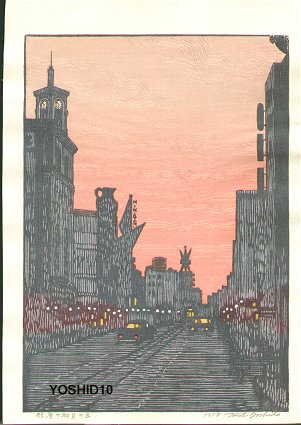
Morning of New Year's Day in Ginza
Woodblock print
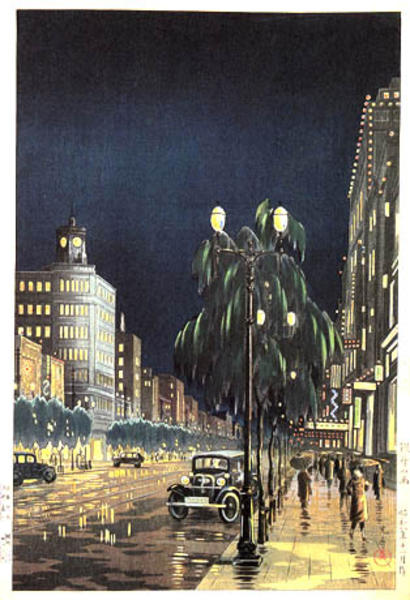
Rainy Evening at Ginza
Woodblock print

Spring's 4-Chome Ginza (One Hundred Views of Tokyo, Message to the 21st Century 東京百景 21世紀へのメッセジ)
1989-99
Color woodblock print

View of Kabuki Theater from Matsuya (Ginza Matsuya yori Kabukiza), no. 3 from the series "Pictures of Ginza, First Series (Gashu Ginza dai isshu)"
1928
Color lithograph
Artists Who Depicted Ginza (9)




Frequently Asked Questions
Ginza is a district in central Tokyo, lying between the Tsukiji area to the east, the Yurakucho and Shimbashi districts to the west, and the Kyobashi district to the north, in present-day Chuo Ward. The neighborhood takes its name from the silver coin mint, gin-za, that the Tokugawa shogunate established in the area in 1612, relocated from Sunpu under the early shogunate's monetary consolidation, and it served through the Edo period as one of the principal mercantile districts of the city, with major drapers, merchants, and craft workshops occupying the streets between Kyobashi and Shinbashi. The defining transformation came after the Great Ginza Fire of 1872, which destroyed the wooden Edo-period district, when the Meiji government, under the direction of the British engineer and architect Thomas Waters, commissioned the rebuilding of the district in brick in a Western neoclassical idiom, creating what was called Ginza Renga-gai, or Ginza Brick Town, the first large-scale planned Western-style urban district in Japan. The brick buildings, gas lamps, raised sidewalks, willow trees along the avenues, and horse-drawn streetcars of late nineteenth-century Ginza made the district a primary subject of the kaika-e enlightenment-picture genre and a symbol of the Meiji program of bunmei kaika (civilization and enlightenment). The Ginza brick avenues were among the first Tokyo addresses to be lit by gas in 1874 and electrically lit in 1882. For Japanese printmaking Ginza is most closely associated with the Meiji-period kaika-e of Utagawa Hiroshige III, Hashimoto Chikanobu, Inoue Yasuji, Kobayashi Kiyochika, and the broader Utagawa school working in the 1870s and 1880s. These prints record the new architectural and infrastructural forms of the modernizing capital, with the Ginza brick avenues figuring prominently alongside Nihonbashi, Tsukiji foreign settlement, and the new railway stations including Shinbashi. Hiroshige III in particular produced multiple Ginza sheets in his enlightenment-print series including views of the streetcars and gas lamps, and Kiyochika treated the district in his early career night views before turning to the broader Tokyo subject matter of his Tokyo meisho sets, with the celebrated Kiyochika compositions of Ginza by night under gaslight figuring among the finest examples of his kosenga (light-ray pictures) atmospheric practice. Inoue Yasuji and Hashimoto Chikanobu produced further Ginza views in the late Meiji decades. Most of the original Renga-gai brick buildings were destroyed in the 1923 Great Kanto Earthquake and the firebombing of 1945, but Ginza retained its identity as the city's principal shopping and entertainment district through the twentieth century, with the Wako department store, the Matsuya, the Mitsukoshi, and the Hattori Clock Tower (now the Wako clock tower) serving as landmarks of the rebuilt district. Shin-hanga and sosaku-hanga artists treated the district in their Tokyo sets, with Kawase Hasui producing rain and night views of the streets, including evening compositions in which streetcars and pedestrians move across rain-slick avenues, and the One Hundred Views of New Tokyo (Shin Tokyo hyakkei) project of 1928-1932 included Ginza compositions in its survey of the reconstructed metropolis. Tsuchiya Koitsu produced his own Ginza night views in the 1930s. The visual character of Ginza in prints is built on long perspectival avenues, gas or electric lamps, streetcars on the central rails, pedestrians in mixed Western and Japanese dress in the Meiji period, willow trees along the central boulevard, and rain-slick or snow-covered pavement in the shin-hanga period. Contemporary Ginza preserves no visible trace of the brick avenues, but the district remains one of the principal commercial centers of Tokyo, with the Wako department store and the Sukiyabashi crossings continuing to function as landmarks, reached via the Ginza, Marunouchi, and Hibiya lines of the Tokyo Metro.
Hanga catalogues 12 prints depicting Ginza (銀座), by 9 different artists.
Amano Kunihiro, Kobayashi Kiyochika, and Oda Kazuma are among the 9 artists who depicted Ginza in our collection.
Want to rate prints from Ginza?
Sign up to start rating