Traditional Mokuhanga
c. 1600–present
About Traditional Mokuhanga
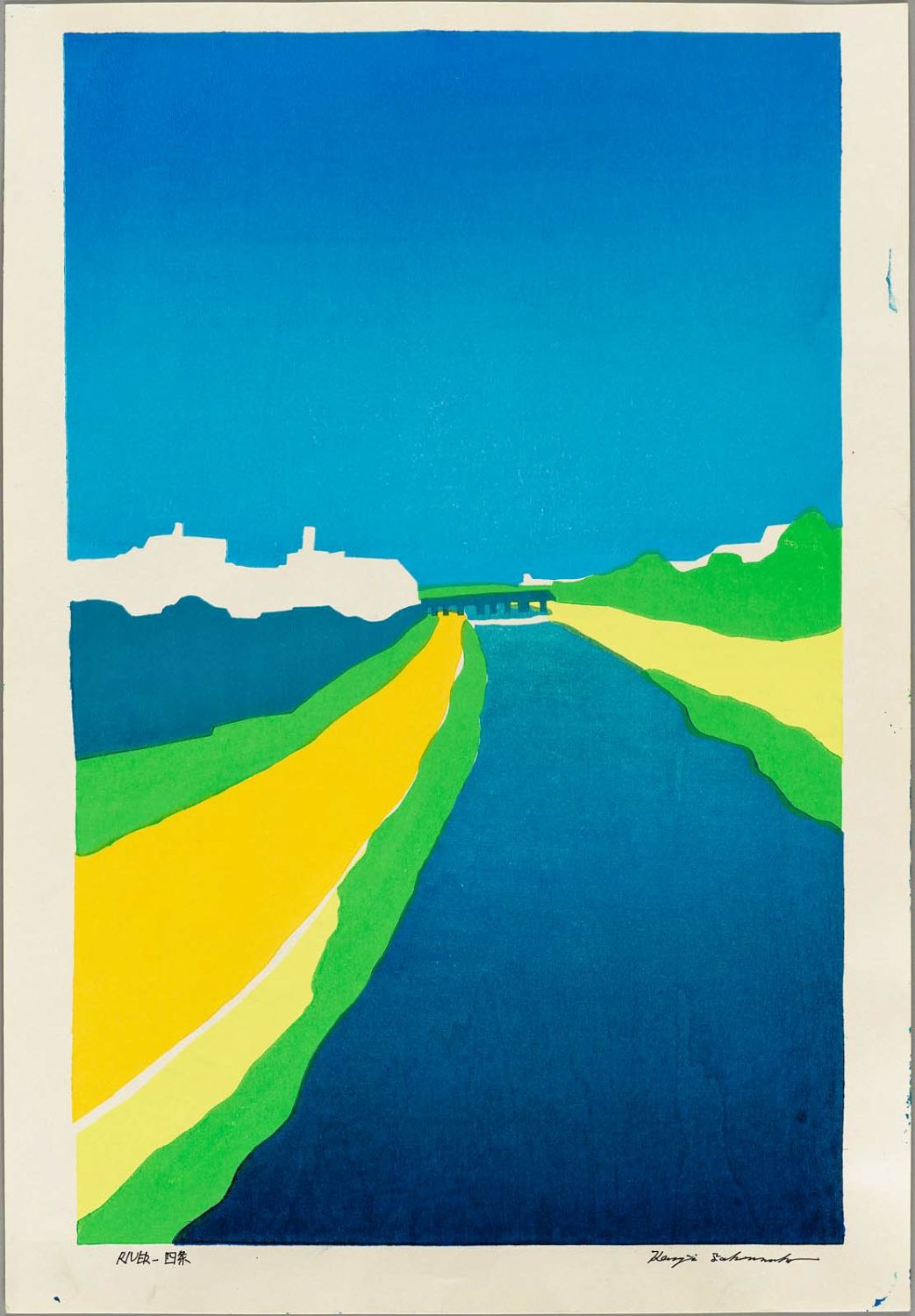
Traditional mokuhanga (木版画) is the family of Japanese water-based woodblock printing techniques whose lineage stretches from the eighth century to the present and which underlies, in turn, the Buddhist printed text, the multi-colored Edo ukiyo-e print, the early-twentieth-century shin-hanga revival, and the international contemporary mokuhanga community of the twenty-first century. The earliest documented Japanese woodblock printing belongs to the Hyakumantō Darani ("One Million Pagoda Charms"), commissioned by the Empress Shōtoku between 764 and 770 and completed around 770: roughly a million miniature wooden pagodas were filled with woodblock-printed Buddhist dhāraṇī (prayer-spells) on washi paper and distributed to temples across Japan, making the project the earliest reliably dateable printed text to survive anywhere in the world, predating Gutenberg's movable type by some seven centuries (https://en.wikipedia.org/wiki/Hyakumant%C5%8D_Darani). For most of the next eight hundred years woodblock printing in Japan remained the medium of Buddhist sutras, mandalas, and didactic religious images produced inside temples, and only in the late sixteenth and seventeenth centuries did it spread to secular publishing — first to illustrated books and then, with the urbanization of Edo (modern Tokyo) into a city of more than a million people, to the single-sheet ukiyo-e ("pictures of the floating world") prints that the rest of the world now most associates with the technique (https://en.wikipedia.org/wiki/Woodblock_printing_in_Japan). The mature Edo system codified what is still known as the traditional mokuhanga workflow. Production was rigorously divided among four roles: the artist (eshi), who supplied a design drawing; the carver (horishi), who cut a separate cherrywood block (often planks of yamazakura) for the keyline and for each color area; the printer (surishi), who hand-pressed dampened washi paper onto inked blocks; and the publisher (hanmoto), who commissioned, financed, and distributed the editions and who legally owned the blocks (https://en.wikipedia.org/wiki/Woodblock_printing_in_Japan). The materials and tools that distinguish the tradition are likewise specific: water-based pigments mixed with rice paste (nori) for body, allowing colors to soak into and not just sit on top of the paper; absorbent kōzo-based washi (mulberry-fiber Japanese paper); registration marks called kentō, carved as a corner and edge guide into each block to align successive impressions in perfect register; the baren, a round hand-burnisher built around a coiled cord of twisted bamboo leaves enclosed in a paper disk and wrapped in a single dampened bamboo sheath, which the printer rubs across the back of the paper to transfer ink; and the gradient-shading technique known as bokashi, in which pigment is applied unevenly to the block and wiped or feathered before printing to produce graded skies, water, and atmospheric effects (https://en.wikipedia.org/wiki/Woodblock_printing_in_Japan). The Edo system reached its color-printing apex in the multi-block nishiki-e ("brocade pictures") of the late eighteenth century, developed by artists including Suzuki Harunobu, and remained the dominant Japanese print mode through the careers of Hokusai, Hiroshige, and Kuniyoshi. Although ukiyo-e workshop production declined sharply after the Meiji Restoration of 1868 in the face of photography and Western printing technologies, the traditional studio system never disappeared: in the early twentieth century the publisher Watanabe Shōzaburō self-consciously revived it under the banner of shin-hanga ("new prints"), commissioning designs from artists such as Kawase Hasui and Hiroshi Yoshida and routing them through teams of carvers and printers trained in the Edo manner (https://en.wikipedia.org/wiki/Woodblock_printing_in_Japan). In the postwar period this artisan lineage has been preserved by Tokyo workshops including the Adachi Institute of Woodblock Prints and the Kyoto-based Takezasado, which continue to print using historical materials and methods (https://en.wikipedia.org/wiki/Woodblock_printing_in_Japan). Since the 2010s an international contemporary mokuhanga revival has carried the technique well beyond Japan: the triennial International Mokuhanga Conference, inaugurated in 2011 in Kyoto and Awaji, gathers artists and researchers from dozens of countries who learn directly from Japanese craftspeople, study washi-making at the Awagami mills in Tokushima, and explore both traditional applications and new directions for water-based woodblock practice in a global contemporary context (https://mokuhanga.jp/en/).
Traditional Mokuhanga Artists (4)

Frequently Asked Questions
Traditional mokuhanga (木版画) is the family of Japanese water-based woodblock printing techniques whose lineage stretches from the eighth century to the present and which underlies, in turn, the Buddhist printed text, the multi-colored Edo ukiyo-e print, the early-twentieth-century shin-hanga revival, and the international contemporary mokuhanga community of the twenty-first century. The earliest documented Japanese woodblock printing belongs to the Hyakumantō Darani ("One Million Pagoda Charms"), commissioned by the Empress Shōtoku between 764 and 770 and completed around 770: roughly a million miniature wooden pagodas were filled with woodblock-printed Buddhist dhāraṇī (prayer-spells) on washi paper and distributed to temples across Japan, making the project the earliest reliably dateable printed text to survive anywhere in the world, predating Gutenberg's movable type by some seven centuries (https://en.wikipedia.org/wiki/Hyakumant%C5%8D_Darani). For most of the next eight hundred years woodblock printing in Japan remained the medium of Buddhist sutras, mandalas, and didactic religious images produced inside temples, and only in the late sixteenth and seventeenth centuries did it spread to secular publishing — first to illustrated books and then, with the urbanization of Edo (modern Tokyo) into a city of more than a million people, to the single-sheet ukiyo-e ("pictures of the floating world") prints that the rest of the world now most associates with the technique (https://en.wikipedia.org/wiki/Woodblock_printing_in_Japan). The mature Edo system codified what is still known as the traditional mokuhanga workflow. Production was rigorously divided among four roles: the artist (eshi), who supplied a design drawing; the carver (horishi), who cut a separate cherrywood block (often planks of yamazakura) for the keyline and for each color area; the printer (surishi), who hand-pressed dampened washi paper onto inked blocks; and the publisher (hanmoto), who commissioned, financed, and distributed the editions and who legally owned the blocks (https://en.wikipedia.org/wiki/Woodblock_printing_in_Japan). The materials and tools that distinguish the tradition are likewise specific: water-based pigments mixed with rice paste (nori) for body, allowing colors to soak into and not just sit on top of the paper; absorbent kōzo-based washi (mulberry-fiber Japanese paper); registration marks called kentō, carved as a corner and edge guide into each block to align successive impressions in perfect register; the baren, a round hand-burnisher built around a coiled cord of twisted bamboo leaves enclosed in a paper disk and wrapped in a single dampened bamboo sheath, which the printer rubs across the back of the paper to transfer ink; and the gradient-shading technique known as bokashi, in which pigment is applied unevenly to the block and wiped or feathered before printing to produce graded skies, water, and atmospheric effects (https://en.wikipedia.org/wiki/Woodblock_printing_in_Japan). The Edo system reached its color-printing apex in the multi-block nishiki-e ("brocade pictures") of the late eighteenth century, developed by artists including Suzuki Harunobu, and remained the dominant Japanese print mode through the careers of Hokusai, Hiroshige, and Kuniyoshi. Although ukiyo-e workshop production declined sharply after the Meiji Restoration of 1868 in the face of photography and Western printing technologies, the traditional studio system never disappeared: in the early twentieth century the publisher Watanabe Shōzaburō self-consciously revived it under the banner of shin-hanga ("new prints"), commissioning designs from artists such as Kawase Hasui and Hiroshi Yoshida and routing them through teams of carvers and printers trained in the Edo manner (https://en.wikipedia.org/wiki/Woodblock_printing_in_Japan). In the postwar period this artisan lineage has been preserved by Tokyo workshops including the Adachi Institute of Woodblock Prints and the Kyoto-based Takezasado, which continue to print using historical materials and methods (https://en.wikipedia.org/wiki/Woodblock_printing_in_Japan). Since the 2010s an international contemporary mokuhanga revival has carried the technique well beyond Japan: the triennial International Mokuhanga Conference, inaugurated in 2011 in Kyoto and Awaji, gathers artists and researchers from dozens of countries who learn directly from Japanese craftspeople, study washi-making at the Awagami mills in Tokushima, and explore both traditional applications and new directions for water-based woodblock practice in a global contemporary context (https://mokuhanga.jp/en/).
The Traditional Mokuhanga movement was active from approximately 1600 to the present day.
Notable Traditional Mokuhanga artists include Kyoko Hirai, Yukiko Takahashi, Shoichi Kitamura, Kenji Takenaka.
Traditional mokuhanga (木版画) is the family of Japanese water-based woodblock printing techniques whose lineage stretches from the eighth century to the present and which underlies, in turn, the Buddhist printed text, the multi-colored Edo ukiyo-e print, the early-twentieth-century shin-hanga revival, and the international contemporary mokuhanga community of the twenty-first century. The earliest documented Japanese woodblock printing belongs to the Hyakumantō Darani ("One Million Pagoda Charms"), commissioned by the Empress Shōtoku between 764 and 770 and completed around 770: roughly a million miniature wooden pagodas were filled with woodblock-printed Buddhist dhāraṇī (prayer-spells) on washi paper and distributed to temples across Japan, making the project the earliest reliably dateable printed text to survive anywhere in the world, predating Gutenberg's movable type by some seven centuries (https://en.wikipedia.org/wiki/Hyakumant%C5%8D_Darani). For most of the next eight hundred years woodblock printing in Japan remained the medium of Buddhist sutras, mandalas, and didactic religious images produced inside temples, and only in the late sixteenth and seventeenth centuries did it spread to secular publishing — first to illustrated books and then, with the urbanization of Edo (modern Tokyo) into a city of more than a million people, to the single-sheet ukiyo-e ("pictures of the floating world") prints that the rest of the world now most associates with the technique (https://en.wikipedia.org/wiki/Woodblock_printing_in_Japan). The mature Edo system codified what is still known as the traditional mokuhanga workflow. Production was rigorously divided among four roles: the artist (eshi), who supplied a design drawing; the carver (horishi), who cut a separate cherrywood block (often planks of yamazakura) for the keyline and for each color area; the printer (surishi), who hand-pressed dampened washi paper onto inked blocks; and the publisher (hanmoto), who commissioned, financed, and distributed the editions and who legally owned the blocks (https://en.wikipedia.org/wiki/Woodblock_printing_in_Japan). The materials and tools that distinguish the tradition are likewise specific: water-based pigments mixed with rice paste (nori) for body, allowing colors to soak into and not just sit on top of the paper; absorbent kōzo-based washi (mulberry-fiber Japanese paper); registration marks called kentō, carved as a corner and edge guide into each block to align successive impressions in perfect register; the baren, a round hand-burnisher built around a coiled cord of twisted bamboo leaves enclosed in a paper disk and wrapped in a single dampened bamboo sheath, which the printer rubs across the back of the paper to transfer ink; and the gradient-shading technique known as bokashi, in which pigment is applied unevenly to the block and wiped or feathered before printing to produce graded skies, water, and atmospheric effects (https://en.wikipedia.org/wiki/Woodblock_printing_in_Japan). The Edo system reached its color-printing apex in the multi-block nishiki-e ("brocade pictures") of the late eighteenth century, developed by artists including Suzuki Harunobu, and remained the dominant Japanese print mode through the careers of Hokusai, Hiroshige, and Kuniyoshi. Although ukiyo-e workshop production declined sharply after the Meiji Restoration of 1868 in the face of photography and Western printing technologies, the traditional studio system never disappeared: in the early twentieth century the publisher Watanabe Shōzaburō self-consciously revived it under the banner of shin-hanga ("new prints"), commissioning designs from artists such as Kawase Hasui and Hiroshi Yoshida and routing them through teams of carvers and printers trained in the Edo manner (https://en.wikipedia.org/wiki/Woodblock_printing_in_Japan). In the postwar period this artisan lineage has been preserved by Tokyo workshops including the Adachi Institute of Woodblock Prints and the Kyoto-based Takezasado, which continue to print using historical materials and methods (https://en.wikipedia.org/wiki/Woodblock_printing_in_Japan). Since the 2010s an international contemporary mokuhanga revival has carried the technique well beyond Japan: the triennial International Mokuhanga Conference, inaugurated in 2011 in Kyoto and Awaji, gathers artists and researchers from dozens of countries who learn directly from Japanese craftspeople, study washi-making at the Awagami mills in Tokushima, and explore both traditional applications and new directions for water-based woodblock practice in a global contemporary context (https://mokuhanga.jp/en/).
Related Movements
Want to rate Traditional Mokuhanga prints?
Sign up to start rating