Temples & Shrines Prints (980)
Temples and shrines are among the most enduring subjects in Japanese printmaking, reflecting the central role of Buddhist temples and Shinto shrines in Japanese cultural life. These sacred structures, often set within landscapes of exceptional natural beauty, offered printmakers subjects that combined architectural precision with atmospheric grandeur. The meisho-e (famous places) tradition naturally featured prominent religious sites — Sensoji temple in Asakusa, Kiyomizu-dera in Kyoto, the Itsukushima shrine at Miyajima — alongside natural landmarks. Hiroshige's prints of temple precincts in rain, snow, and moonlight established visual conventions that shin-hanga artists would later refine. The torii gate, pagoda silhouette, and temple approach flanked by lanterns became iconic compositional elements. Kawase Hasui made temple and shrine subjects a specialty, producing atmospheric views of sacred sites across Japan that captured the interplay of architecture, nature, and light at specific times of day and seasons. His prints of snow-covered temple roofs and rain-washed shrine paths are among the most recognized images in twentieth-century Japanese art. The subject remains popular with contemporary moku-hanga artists, who continue to find fresh perspectives on Japan's architectural heritage.
Artists Known for Temples & Shrines




Autumn moon over Ishiyama temple
Mokuhanga (Japanese woodblock)

Three-tiered pagoda
Mokuhanga (Japanese woodblock)

Old garden of Tokushima temple
Mokuhanga (Japanese woodblock)

Kiyomizu temple, Kyoto
Mokuhanga (Japanese woodblock)

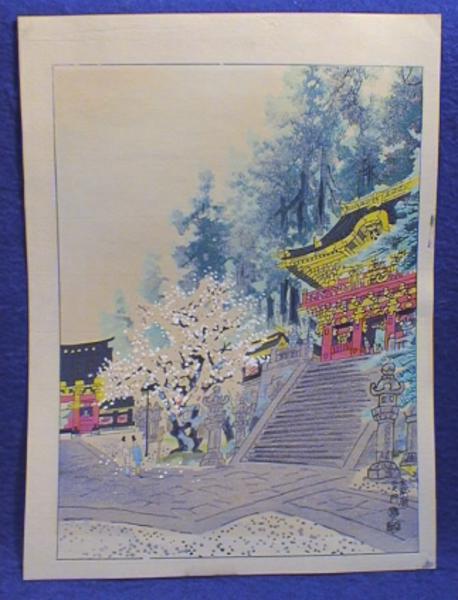
Spring dusk at Tôshô shrine, Ueno
Mokuhanga (Japanese woodblock)

Meguro Fudô temple
Mokuhanga (Japanese woodblock)

Bamboo at Shisendo Temple, Kyoto
Mokuhanga (Japanese woodblock)

Garden of Daitoku temple
Mokuhanga (Japanese woodblock)

Garden of Tenryu temple
Mokuhanga (Japanese woodblock)

Boats and torii, Mt Fuji in the distance
Mokuhanga (Japanese woodblock)

Pagoda in Itakura
Mokuhanga (Japanese woodblock)

Yakumo Bridge at Nagata Shrine in Kobe (Kobe Nagata-jinja Yakumobashi), from the series "Collection of Views of Japan II, Kansai Edition (Nihon fukei shu II Kansai hen)"
1930
Color woodblock print; oban

Kasuga Shrine, Nara, from the series "Collection of Scenic Views of Japan II, Kansai Edition" (Nihon fukei shu II Kansai hen, Nara Kasuga taisha)
April 1933
Color woodblock print

Gozanoishi Shrine at Lake Tazawa, from the series "Souvenirs of Travel, Third Series" (Tabi miyage dai sanshu, Tazawako Gozanoishi)
1926
Color woodblock print

The Hours of Worldly Beauties (Fûzoku bijin dokei): The Hour of the Horse (Noon) - Shrine Maiden (Uma no koku - miko)

Benten Shrine and Inokashira Pond (Inokashira no ike Benten no yashiro), from the series "One Hundred Famous Views of Edo (Meisho Edo hyakkei)"
1856
Color woodblock print; oban

Sazai Hall of the Five Hundred Rakan Temple (Gohyaku Rakan Sazaido), from the series “One Hundred Famous Views of Edo (Meisho Edo hyakkei)”
1857
Color woodblock print; oban

View of Nihonbashi Tori-itchome (Nihonbashi Tori-itchome ryakuzu), from the series "One Hundred Famous Views of Edo (Meisho Edo hyakkei)"
1858
Color woodblock print; oban

Interior of Asakusa Kannon Temple (Asakusa Kannon no naidô), Shôwa period, dated 1932

Honganji Temple at Asakusa in Edo (Toto Asakusa Honganji), from the series "Thirty-six Views of Mount Fuji (Fugaku sanjurokkei)"
c. 1830/33
Color woodblock print; oban
Related Subjects
Frequently Asked Questions
Temples and shrines are among the most enduring subjects in Japanese printmaking, reflecting the central role of Buddhist temples and Shinto shrines in Japanese cultural life. These sacred structures, often set within landscapes of exceptional natural beauty, offered printmakers subjects that combined architectural precision with atmospheric grandeur.
Kawase Hasui, Utagawa Hiroshige, and Kotozuka Eiichi are among the artists most associated with temples & shrines in our collection. Browse the full list of artists who explored this subject above.
Hanga currently catalogues 980 prints tagged with temples & shrines, spanning ukiyo-e, shin-hanga, and sōsaku-hanga traditions where applicable.