
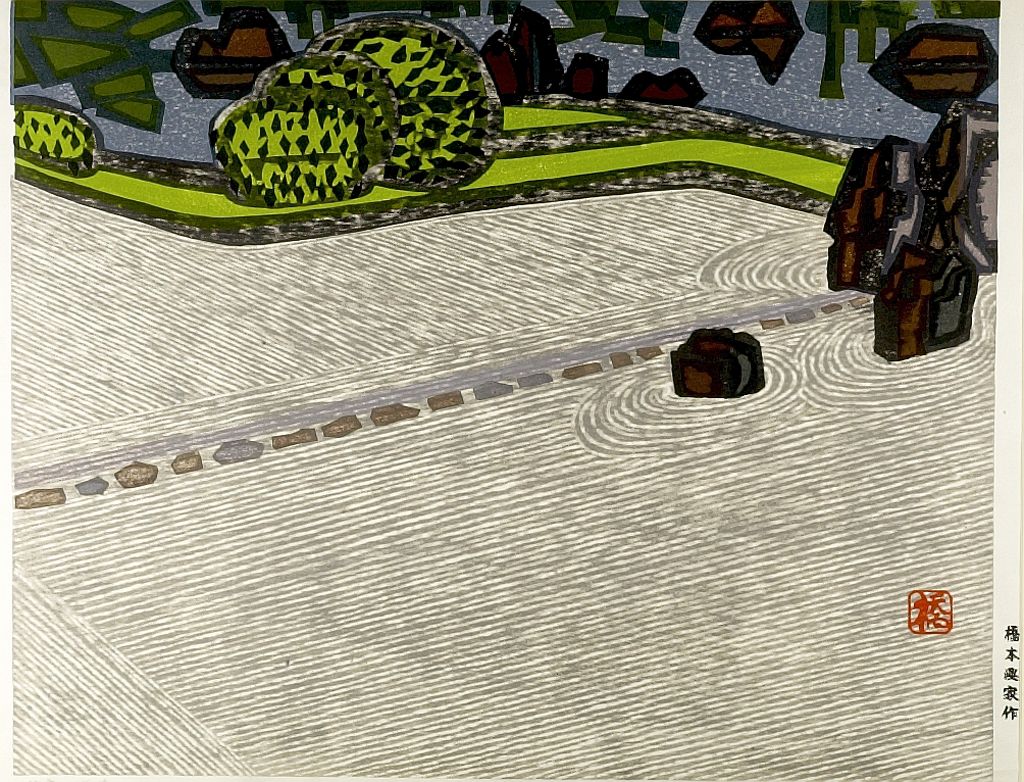
Garden of Tenryu temple
- Medium:
- Mokuhanga (Japanese woodblock)
- Image courtesy of
- Saru Gallery
Description
Tenryū-ji sits at the base of Arashiyama in western Kyoto and is the head temple of the Tenryū branch of Rinzai Zen. Its Sōgen-chi pond garden, attributed to the fourteenth-century monk Musō Soseki, is among the earliest surviving examples of the chisen-kaiyū-shiki pond-with-circuit tradition and uses the wooded slopes of Arashiyama as shakkei, or borrowed scenery. Hashimoto's print likely takes the pond as its central motif, with rocks at the far shore and the dark wooded ridge behind serving as the upper register. Unlike the karesansui at Daitoku-ji, Tenryū-ji's water-garden allowed him to work with reflection — a register he handled by mirroring carved shapes at reduced saturation across the pond's surface. The print belongs to his sustained engagement with Kyoto's principal Zen monasteries; together with his Ginkaku-ji and Daitoku-ji subjects, the Tenryū-ji garden situates Hashimoto's sosaku-hanga practice within the postwar effort to translate Japan's classical landscape vocabulary into a modern, single-author print medium.
More Prints by Okiie Hashimoto

More Temples & Shrines Prints

Fushimi Inari Temple
伏見稲荷
Woodblock print

The Compound of the Tenman Shrine at Kameido in the Snow (Kameido Tenmangu keidai no yuki), from the series "Famous Places in the Eastern Capital (Toto meisho)"
c. 1832/38
Color woodblock print; oban
Temple with lanterns
Woodblock print

A Section of the Byodo Temple at Uji (Uji Byodoin no ichibu), from the series "Souvenirs of Travel, Second Series (Tabi miyage dai nishu)"
Uji Byodoin no ichibu
1921
Color woodblock print; oban
Featured in Collections
Curated cross-cuts that include this print.
Frequently Asked Questions
Garden of Tenryu temple was created by Okiie Hashimoto (橋本興家).
Garden of Tenryu temple depicts temples & shrines and gardens.