
Garden of Daitoku temple
- Medium:
- Mokuhanga (Japanese woodblock)
- Image courtesy of
- Saru Gallery
Description
Daitoku-ji is a major Rinzai Zen monastery in northern Kyoto, comprising more than twenty sub-temples of which several — Daisen-in, Ryōgen-in, Kōtō-in — are known for karesansui dry-landscape gardens. Hashimoto's print does not specify which tatchū, but plausible subjects include Daisen-in's compressed dry garden or Kōtō-in's moss-and-bamboo approach. A Daitoku-ji garden print plays to Hashimoto's compositional strengths: severe rectilinear architecture — the white plaster wall, the dark wood veranda — framing a measured arrangement of raked gravel, placed stones, and trimmed shrubs. The format favors flat blocks of color rather than gradations: a creamy ground for the gravel, a near-black for the temple woodwork, and one or two greens for the moss and shrubbery. Daitoku-ji is one of three Zen-garden subjects Hashimoto returned to alongside Tenryū-ji and Ryōan-ji, and the prints together form a postwar sosaku-hanga reading of the karesansui canon — frontal, austere, and unsentimental in comparison with shin-hanga garden views of the same period.
More Prints by Okiie Hashimoto

More Temples & Shrines Prints
Fushimi Inari Temple
伏見稲荷
Woodblock print

The Compound of the Tenman Shrine at Kameido in the Snow (Kameido Tenmangu keidai no yuki), from the series "Famous Places in the Eastern Capital (Toto meisho)"
c. 1832/38
Color woodblock print; oban
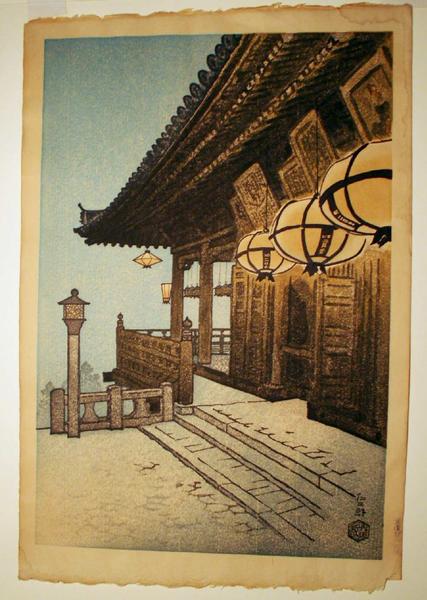
Temple with lanterns
Woodblock print

A Section of the Byodo Temple at Uji (Uji Byodoin no ichibu), from the series "Souvenirs of Travel, Second Series (Tabi miyage dai nishu)"
Uji Byodoin no ichibu
1921
Color woodblock print; oban
Featured in Collections
Curated cross-cuts that include this print.
Frequently Asked Questions
Garden of Daitoku temple was created by Okiie Hashimoto (橋本興家).
Garden of Daitoku temple depicts temples & shrines and gardens.