
Bridge in Grez-sur-Loing
by Asai Chu
- Date:
- 1902
- Medium:
- Oil on canvas
Description
Bridge in Grez-sur-Loing, painted by Asai Chu in 1902, is one of the central works of the artist's two-year residence in France and a touchstone for understanding how a leading Meiji yoga (Western-style) painter responded to the historic landscape that had shaped his own teacher's vision. Asai's months at Grez-sur-Loing, a small village on the Loing river south of the Forest of Fontainebleau, placed him within the very Barbizon-school territory whose ethos Antonio Fontanesi had introduced to him at the Kobu Bijutsu Gakko (Technical Fine Art School) in Tokyo in the late 1870s. The medieval stone bridge over the Loing — already a celebrated motif among Scandinavian, British, and Japanese painters who congregated at Grez — gave Asai an ideal armature: a horizontal masonry structure spanning a quiet body of water, with banks of trees and village rooflines beyond. He organizes the picture around the strong horizontal of the bridge and the reflective surface of the river, applying broad, slightly broken brushwork in muted greens, water-greys, and warm stone tones that recall the tonal sobriety of mid-century French rural painting. The canvas is preserved in the Artizon Museum (formerly the Bridgestone Museum of Art) and reproduced through Wikimedia Commons via the Google Art Project (https://commons.wikimedia.org/wiki/File:Asai_Chu_-_Bridge_in_Grez-sur-Loing_-_Google_Art_Project.jpg). For students of Meiji yoga, Bridge in Grez-sur-Loing is invaluable: by 1902 Asai was at the peak of his powers as a Meiji Bijutsukai (Meiji Art Society) leader and pre-1907 master, and the picture shows him working confidently within the very Ile-de-France motif tradition that had informed Fontanesi a generation earlier. It is also a reminder of how cosmopolitan the Meiji yoga project was. Within five years of completing this canvas Asai would be dead, but the Grez bridge and Loing river paintings he carried home would feed directly into the Kansai Bijutsu-in workshop and the curriculum he developed at the Kyoto Higher Technical Painting School.
More Prints by Asai Chu


More Landscapes Prints

Lake Kugushi in Wakasa Province (Wakasa Kugushiko), from the series Souvenirs of Travel I (Tabi miyage dai isshu)"
Wakasa Kugushiko
1920
Color woodblock print; oban
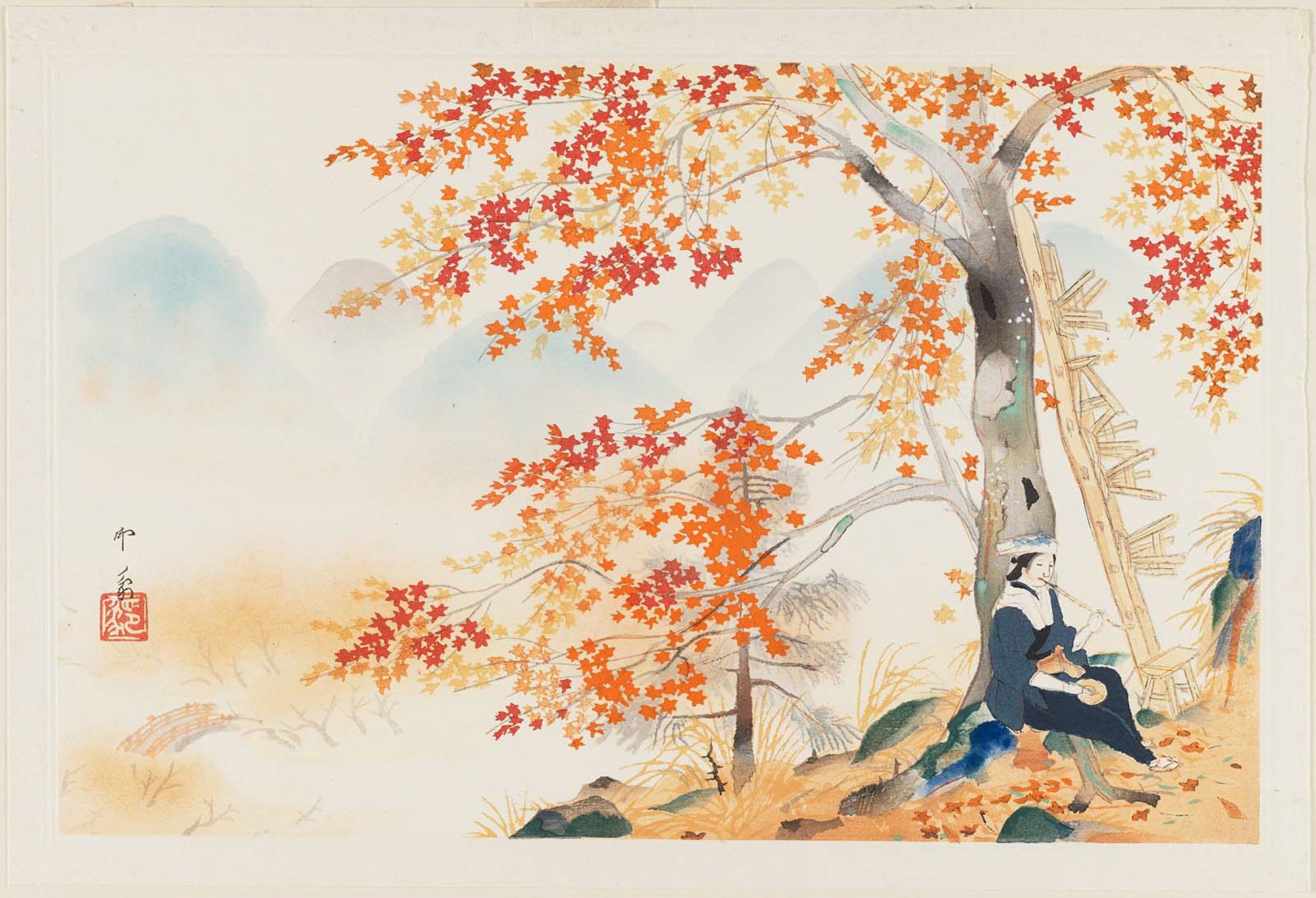
Autumn Maple Leaves at Takao, from the album Eight Views of Kyoto (Kyôto hakkei)
Woodblock print

The Beach at Kaiganji in Sanuki Province (Sanuki Kaiganji no hama), from the series "Collection of Views of Japan II, Kansai Edition (Nihon fukei shu II Kansai hen)"
1934
Color woodblock print; oban

Tea Kettle, section of a sheet from the series "Mirror of Stone Rubbings of Views of the Provinces" (Kohon meihitsu ishizuri kagami)
n.d.
Woodblock print; ishizuri-e, section of harimaze sheet
Featured in Collections
Curated cross-cuts that include this print.
Frequently Asked Questions
Bridge in Grez-sur-Loing was created by Asai Chu (浅井忠) in 1902.
Bridge in Grez-sur-Loing depicts landscapes.