
Washing Place in Grez-sur-Loing
by Asai Chu
- Date:
- 1901
- Medium:
- Oil on canvas
Description
Washing Place in Grez-sur-Loing, painted by Asai Chu in 1901, dates from the artist's transformative two-year residence in France and stands as one of the clearest documents of how a leading Meiji yoga (Western-style) painter encountered the actual landscape of Barbizon-school practice. Asai had already spent more than two decades as a foundational figure in Japanese Western-style painting after his training under Antonio Fontanesi at the Kobu Bijutsu Gakko (Technical Fine Art School) in Tokyo in the late 1870s, and by the time he reached the artists' colony of Grez-sur-Loing on the southern edge of the Forest of Fontainebleau, he had been a co-founder of the Meiji Bijutsukai (Meiji Art Society) and a leading voice for plein-air naturalism within Japan's second wave of yoga. The Washing Place subject — village women laundering at a riverside lavoir along the Loing — was a stock motif of late nineteenth-century French rural painting, and Asai approaches it with the muted tonal palette and unforced compositional structure inherited directly from Fontanesi's Barbizon lineage. Soft greens, river greys, and the dusty whites of laundry and stone are organized around the architecture of the washhouse and the gentle horizontal of the water, with figures registered as quiet anchoring presences rather than narrative protagonists. The picture is preserved in the Artizon Museum (formerly the Bridgestone Museum of Art) and made available through Wikimedia Commons via the Google Art Project (https://commons.wikimedia.org/wiki/File:Asai_Chu_-_Washing_Place_in_Grez-sur-Loing_-_Google_Art_Project.jpg). For students of Meiji yoga, Washing Place in Grez-sur-Loing functions as something close to a treatise: it shows Asai matching his earlier Japanese village studies to the very European motifs that had informed his teacher's aesthetic, confirming the deep continuity between Fontanesi's Tokyo studio and the riverside motifs of the Ile-de-France. Completed only six years before the artist's death in 1907, it also marks a peak of his late style, in which long experience of Japanese light and water was reconciled with direct observation of the Loing valley.
More Prints by Asai Chu


More Landscapes Prints

Lake Kugushi in Wakasa Province (Wakasa Kugushiko), from the series Souvenirs of Travel I (Tabi miyage dai isshu)"
Wakasa Kugushiko
1920
Color woodblock print; oban
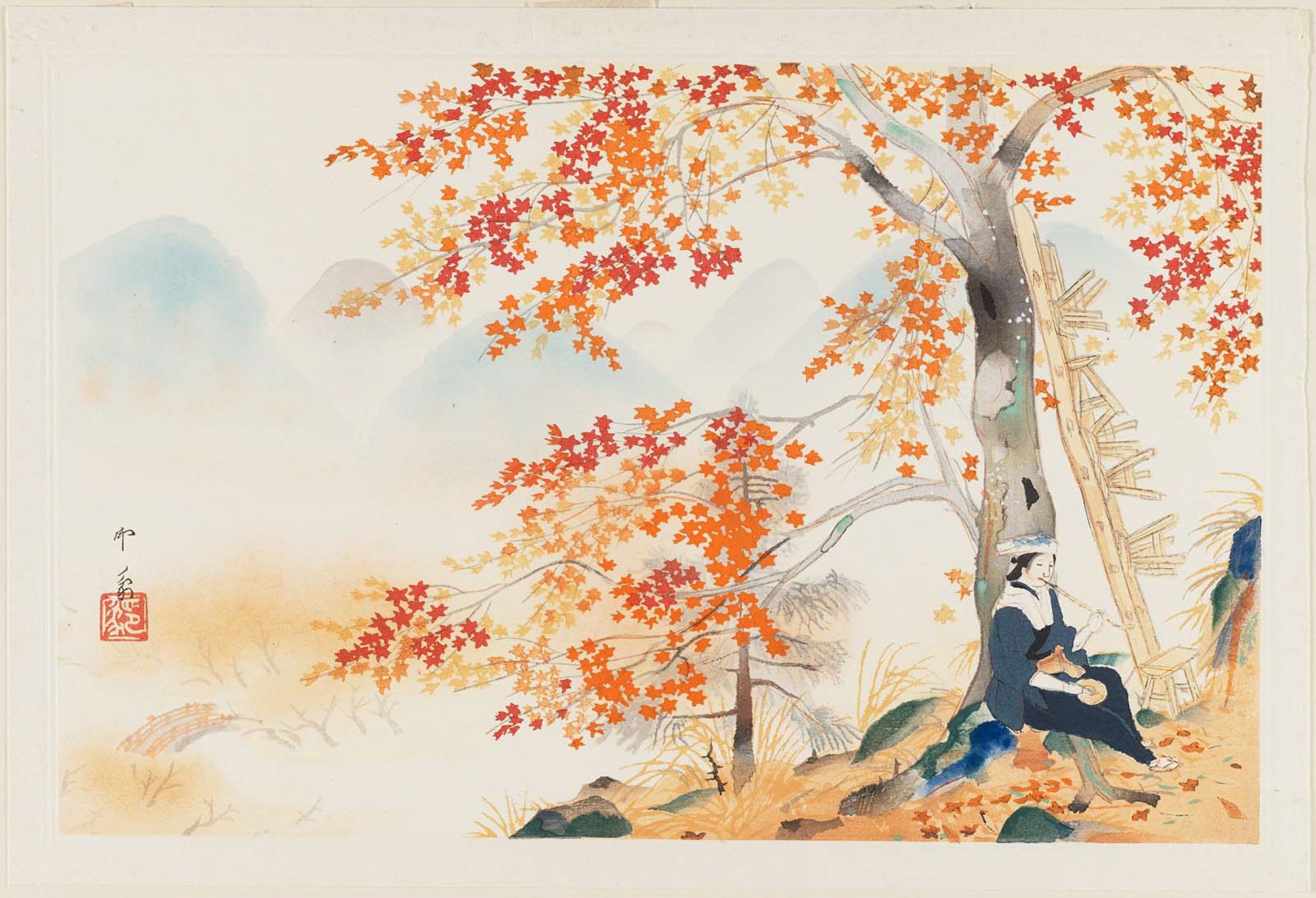
Autumn Maple Leaves at Takao, from the album Eight Views of Kyoto (Kyôto hakkei)
Woodblock print

The Beach at Kaiganji in Sanuki Province (Sanuki Kaiganji no hama), from the series "Collection of Views of Japan II, Kansai Edition (Nihon fukei shu II Kansai hen)"
1934
Color woodblock print; oban

Tea Kettle, section of a sheet from the series "Mirror of Stone Rubbings of Views of the Provinces" (Kohon meihitsu ishizuri kagami)
n.d.
Woodblock print; ishizuri-e, section of harimaze sheet
Featured in Collections
Curated cross-cuts that include this print.
Frequently Asked Questions
Washing Place in Grez-sur-Loing was created by Asai Chu (浅井忠) in 1901.
Washing Place in Grez-sur-Loing depicts landscapes.