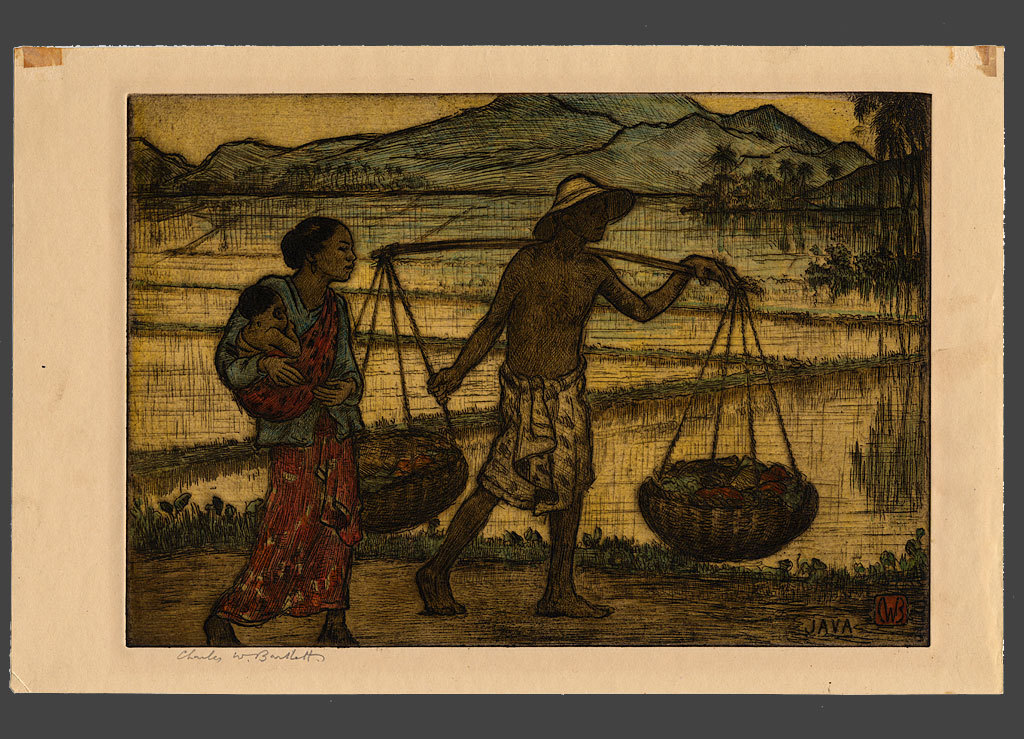
Java
- Date:
- c. 1933
- Medium:
- Etching
- Source:
- Art of Japan
Description
Java, created around 1933, depicts a scene from the Indonesian island where Bartlett traveled among the volcanic landscapes, rice terraces, and ancient temple complexes that make Java one of the most visually rich islands in Southeast Asia. This work, rendered as an etching rather than a woodblock print, shows Bartlett working in a Western printmaking technique alongside his better-known Japanese-method works.
The etching medium, which uses acid-bitten lines on a metal plate rather than carved wood, produces a finer, more continuous line quality than woodblock cutting allows. Bartlett's choice of this technique for his Javanese subject may reflect the particular visual qualities he wished to capture: the intricate carved stone surfaces of Borobudur or Prambanan, the delicate fronds of tropical vegetation, or the fine detail of Javanese textile patterns. The late date of around 1933 places this among Bartlett's mature works, produced from his settled base in Hawaii.
More Prints by Charles W. Bartlett

Featured in Collections
Curated cross-cuts that include this print.
Frequently Asked Questions
Java was created by Charles W. Bartlett in c. 1933.
Java uses Etching, on etching.