
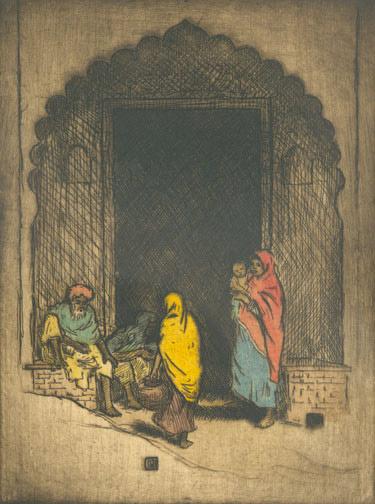
Amritsar 1916
- Date:
- 1916
- Medium:
- Drawing
- Source:
- robynbuntin
Description
Amritsar 1916 records Bartlett's encounter with the sacred Sikh city in Punjab, home to the Harmandir Sahib, the Golden Temple, which sits at the center of a reflecting pool known as the Amrit Sarovar, from which the city takes its name. This drawing captures Bartlett's direct observational response to the city before the images were translated into the more formal woodblock medium.
The 1916 date places this work during Bartlett's extensive Indian travels, which produced some of the most geographically adventurous images in the history of artists working with Japanese printmaking techniques. As a drawing, this piece reveals Bartlett's working process: the on-site sketches and studies that would later inform his carefully composed woodblock prints. The immediacy of drawing, with its capacity to record fleeting impressions of light, movement, and architectural detail, provided the raw material from which Bartlett would construct his more deliberate printed compositions.
More Prints by Charles W. Bartlett
More Temples & Shrines Prints
Fushimi Inari Temple
伏見稲荷
Woodblock print

The Compound of the Tenman Shrine at Kameido in the Snow (Kameido Tenmangu keidai no yuki), from the series "Famous Places in the Eastern Capital (Toto meisho)"
c. 1832/38
Color woodblock print; oban
Temple with lanterns
Woodblock print

A Section of the Byodo Temple at Uji (Uji Byodoin no ichibu), from the series "Souvenirs of Travel, Second Series (Tabi miyage dai nishu)"
Uji Byodoin no ichibu
1921
Color woodblock print; oban
Featured in Collections
Curated cross-cuts that include this print.
Frequently Asked Questions
Amritsar 1916 was created by Charles W. Bartlett in 1916.
Amritsar 1916 depicts temples & shrines, architecture, and travel scenes.