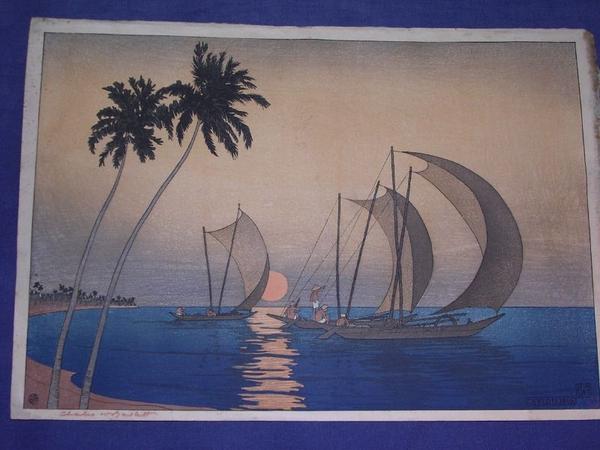
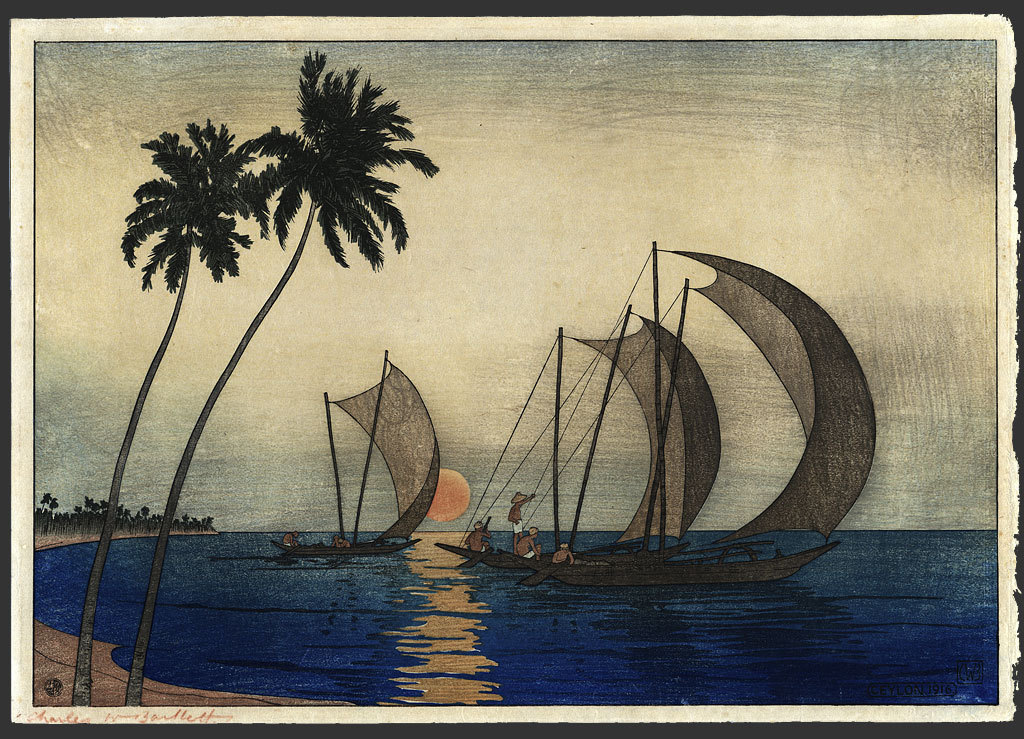
Celyon 1916
- Date:
- Not set
- Medium:
- Woodblock print
- Format:
- Oban
- Source:
- Japanese Art Open Database
Description
Ceylon 1916 records Bartlett's visit to the island now known as Sri Lanka, a stop on the maritime route between India and Southeast Asia that brought the artist through some of the most visually spectacular landscapes in the tropics. Ceylon's combination of palm-fringed coastlines, ancient Buddhist ruins, lush hill country, and richly diverse population offered Bartlett abundant subject matter.
This oban woodblock print translates the tropical intensity of the island into the controlled language of Japanese printmaking. The warm, saturated colors required to convey Ceylon's equatorial light and vegetation pushed the woodblock palette beyond its typical range of cool blues and muted greens. Bartlett's achievement in his Asian travel prints was to prove that the Japanese woodblock technique could accommodate subjects far from its cultural origins without losing the medium's essential qualities of precision, luminosity, and tonal subtlety.
More Prints by Charles W. Bartlett

More Landscapes Prints

Lake Kugushi in Wakasa Province (Wakasa Kugushiko), from the series Souvenirs of Travel I (Tabi miyage dai isshu)"
Wakasa Kugushiko
1920
Color woodblock print; oban
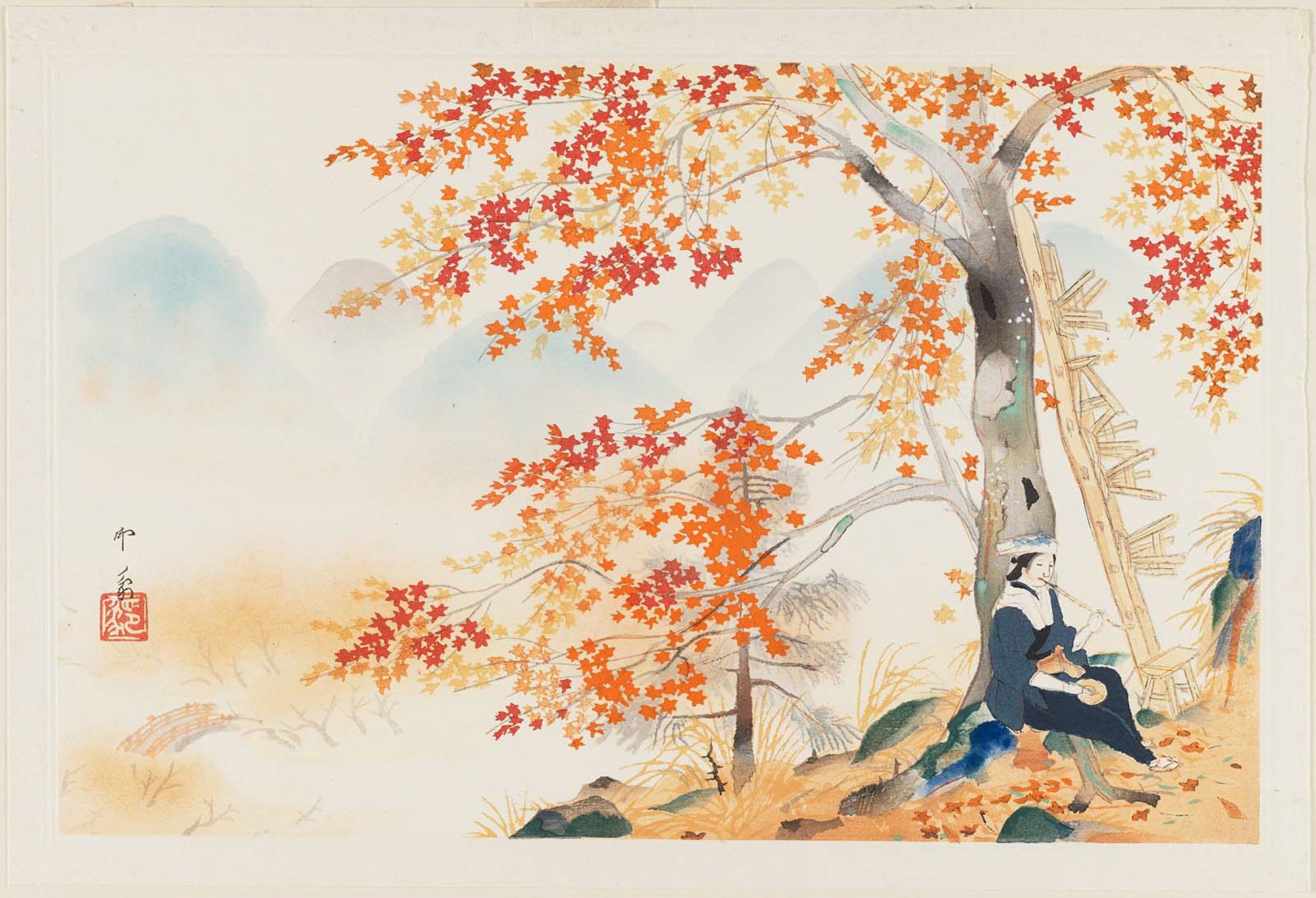
Autumn Maple Leaves at Takao, from the album Eight Views of Kyoto (Kyôto hakkei)
Woodblock print

The Beach at Kaiganji in Sanuki Province (Sanuki Kaiganji no hama), from the series "Collection of Views of Japan II, Kansai Edition (Nihon fukei shu II Kansai hen)"
1934
Color woodblock print; oban

Tea Kettle, section of a sheet from the series "Mirror of Stone Rubbings of Views of the Provinces" (Kohon meihitsu ishizuri kagami)
n.d.
Woodblock print; ishizuri-e, section of harimaze sheet
Featured in Collections
Curated cross-cuts that include this print.
Frequently Asked Questions
Celyon 1916 was created by Charles W. Bartlett in Not set.
Celyon 1916 depicts landscapes and travel scenes.