
The Snow Village at Lakeside
- Medium:
- Mokuhanga (Japanese woodblock)
- Image courtesy of
- Saru Gallery
Description
The Snow Village at Lakeside depicts a rural settlement during winter, snow-laden roofs ranged along the edge of a body of water. The subject sits within the long Japanese tradition of yuki-e (snow pictures), a category that includes Hiroshige's snowbound Tōkaidō stations and the winter scenes of Kawase Hasui, though Kawanishi's treatment is filtered through sosaku-hanga sensibilities. Rather than employing extensive bokashi gradient printing to suggest atmospheric haze, his snow surfaces tend to be rendered as flat areas of unprinted or lightly tinted washi, allowing the paper itself to carry the cold light. The composition sets dark structural elements—roof beams, tree trunks, distant ridges—against these reserves of paper white, with the lake providing a horizontal counter-rhythm. The print represents a comparatively rare departure from Kawanishi's signature Kobe urban subjects toward the wider Japanese landscape.
More Prints by Hide Kawanishi
More Snow Scenes Prints
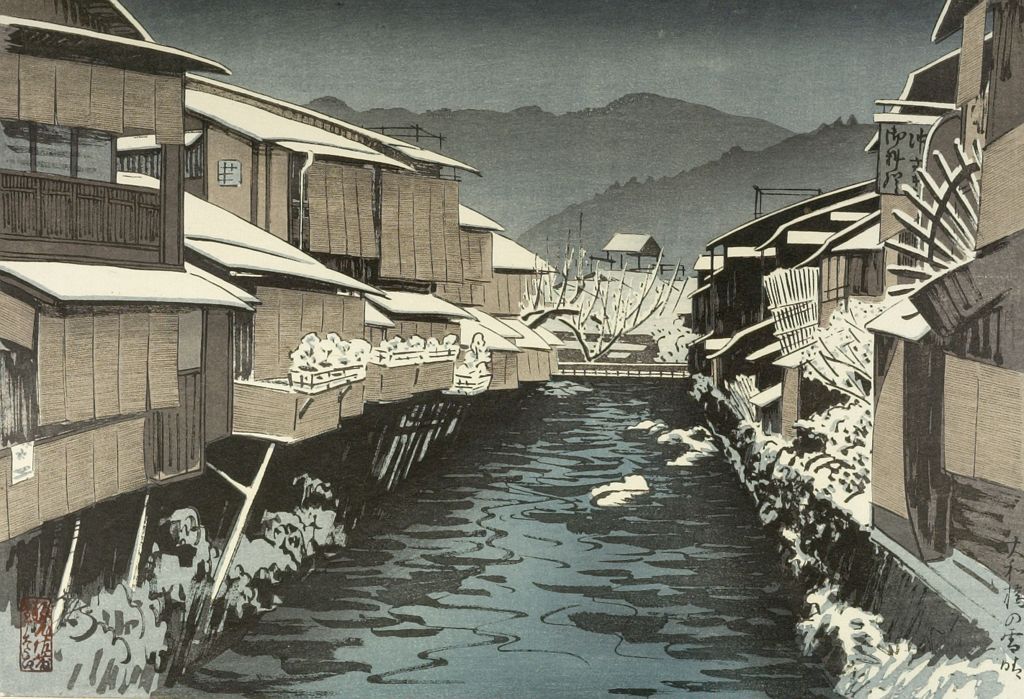
Fair Weather After Snow at Yamato Bridge, Kyoto (Yamato bashi no yukibare), Taishô period, dated 1924
Woodblock print

The Compound of the Tenman Shrine at Kameido in the Snow (Kameido Tenmangu keidai no yuki), from the series "Famous Places in the Eastern Capital (Toto meisho)"
c. 1832/38
Color woodblock print; oban

Miyajima in Snow (Yuki no Miyajima)
Yuki no Miyajima
1929
Color woodblock print; oban
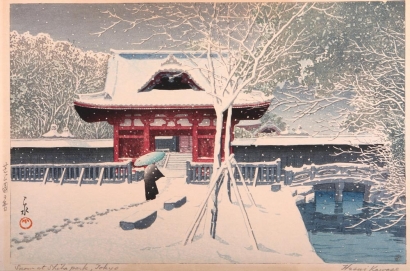
Evening Snow at Shiha Park, Tokyo
1932
Woodblock print
Featured in Collections
Curated cross-cuts that include this print.
Frequently Asked Questions
The Snow Village at Lakeside was created by Hide Kawanishi (川西英).
The Snow Village at Lakeside depicts snow scenes and village scenes.