
Snow side
- Medium:
- Mokuhanga (Japanese woodblock)
- Image courtesy of
- Saru Gallery
Description
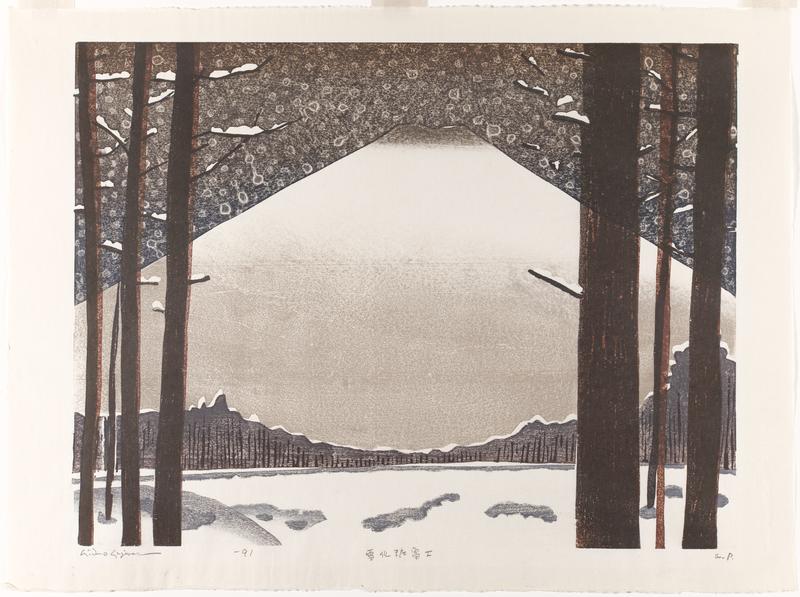
The title indicates a composition treating snowfall or a snowbound landscape through Hagiwara's abstract idiom. In his snow subjects, Hagiwara typically reserved areas of bare washi to register as untouched white, using the unprinted paper as positive form rather than passive ground. The reserved washi takes its character from the paper's own fibrous surface — kozo or gampi — so that the white in the composition carries texture comparable to actual snow. Bokashi gradients would establish the cool grays and blue-blacks that surround these reserved passages, brushed onto the block with a hake before each impression was pulled with the baren. The sosaku-hanga generation to which Hagiwara belonged set aside the calligraphic shorthand that earlier shin-hanga snow prints had inherited from Hiroshige, replacing pictorial convention with surface and material as the carriers of meaning.
More Prints by Hideo Hagiwara

More Snow Scenes Prints
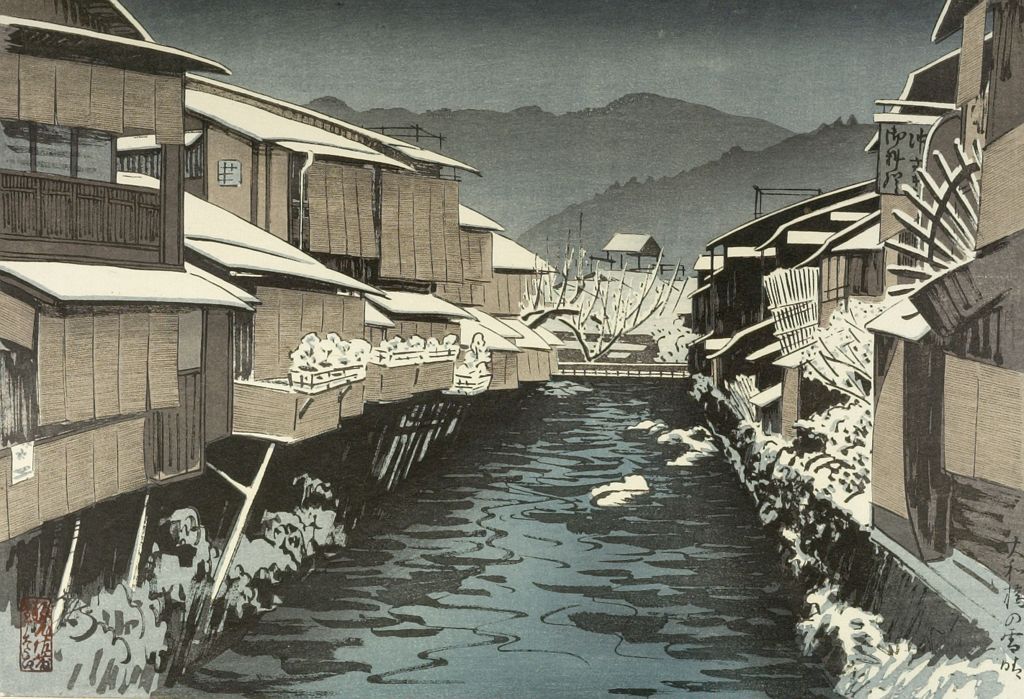
Fair Weather After Snow at Yamato Bridge, Kyoto (Yamato bashi no yukibare), Taishô period, dated 1924
Woodblock print

The Compound of the Tenman Shrine at Kameido in the Snow (Kameido Tenmangu keidai no yuki), from the series "Famous Places in the Eastern Capital (Toto meisho)"
c. 1832/38
Color woodblock print; oban

Miyajima in Snow (Yuki no Miyajima)
Yuki no Miyajima
1929
Color woodblock print; oban
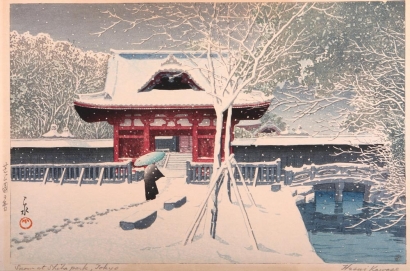
Evening Snow at Shiha Park, Tokyo
1932
Woodblock print
Featured in Collections
Curated cross-cuts that include this print.
Frequently Asked Questions
Snow side was created by Hideo Hagiwara (萩原英雄).
Snow side depicts snow scenes.