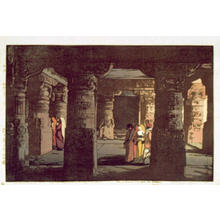
The Third Cave Temple in Ellora
- Medium:
- Woodblock print
- Source:
- Japanese Art Open Database
- Image courtesy of
- Japanese Art Open Database
Description
The Ellora Caves in Maharashtra, India, contain thirty-four rock-cut temples, monasteries, and chapels spanning Buddhist, Hindu, and Jain traditions, excavated between approximately the fifth and eleventh centuries. The Third Cave Temple likely refers to one of the early Buddhist viharas in the complex — a carved stone hall with columns, pilasters, and relief sculptures cut directly into the basalt hillside. Yoshida visited India multiple times and produced a sustained series of architectural prints documenting Mughal, Rajput, and earlier sacred architecture. The cave's interior — its carved columns receding into shadow, its bas-relief figures of the Buddha and bodhisattvas, and the dramatic contrast between lit stone near the entrance and deep darkness within — would have demanded careful organization of Yoshida's tonal range. He likely printed the interior using a limited palette of warm stone tones offset by cool grey shadow, relying on the fine key-block lines to preserve the architectural detail of the carved surfaces. The print belongs to his most archaeologically specific travel subjects.
More Prints by Hiroshi Yoshida
More Temples & Shrines Prints
Fushimi Inari Temple
伏見稲荷
Woodblock print

The Compound of the Tenman Shrine at Kameido in the Snow (Kameido Tenmangu keidai no yuki), from the series "Famous Places in the Eastern Capital (Toto meisho)"
c. 1832/38
Color woodblock print; oban
Temple with lanterns
Woodblock print

A Section of the Byodo Temple at Uji (Uji Byodoin no ichibu), from the series "Souvenirs of Travel, Second Series (Tabi miyage dai nishu)"
Uji Byodoin no ichibu
1921
Color woodblock print; oban
Featured in Collections
Curated cross-cuts that include this print.
Frequently Asked Questions
The Third Cave Temple in Ellora was created by Hiroshi Yoshida (吉田博).
The Third Cave Temple in Ellora depicts temples & shrines.