
Fushimi Inari shrine (Kyoto)
by Ito Nisaburo
- Medium:
- Mokuhanga (Japanese woodblock)
- Image courtesy of
- Saru Gallery
Description
Fushimi Inari Taisha, the head shrine of the Inari cult in southern Kyoto, is most often depicted through its tunnels of vermillion torii gates ascending Mount Inari, and Ito's print likely concentrates on this signature motif — a receding corridor of gates whose repeated forms compress the picture plane into rhythmic verticals. The vermillion (shu-iro) of the torii would have demanded careful registration across multiple cherrywood blocks, with the saturated red typically modulated by bokashi gradation where each gate meets the next to suggest depth in the dim woodland interior. Stone fox (kitsune) statues, paper offerings tied to wooden posts, or stone lanterns at the path's edge often serve as quieter focal points within such compositions. The print belongs to Ito's sustained documentation of Kyoto's sacred sites, a body of work that runs in parallel to Tokuriki Tomikichiro and the wider shin-hanga interest in meisho-e (famous-place pictures), produced for postwar collectors who valued the ancient capital's unhurried sense of time.
More Prints by Ito Nisaburo

More Temples & Shrines Prints

Fushimi Inari Temple
伏見稲荷
Woodblock print

The Compound of the Tenman Shrine at Kameido in the Snow (Kameido Tenmangu keidai no yuki), from the series "Famous Places in the Eastern Capital (Toto meisho)"
c. 1832/38
Color woodblock print; oban
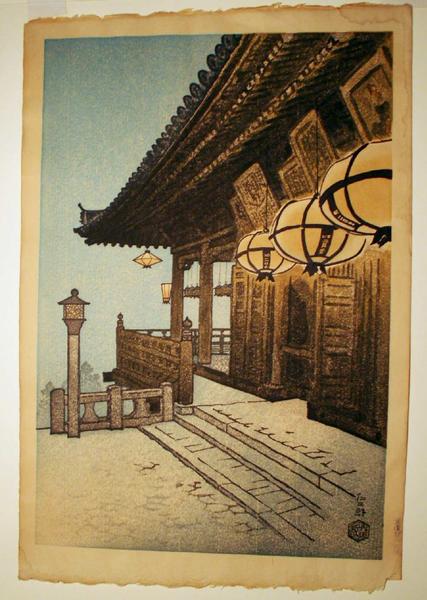
Temple with lanterns
Woodblock print

A Section of the Byodo Temple at Uji (Uji Byodoin no ichibu), from the series "Souvenirs of Travel, Second Series (Tabi miyage dai nishu)"
Uji Byodoin no ichibu
1921
Color woodblock print; oban
Featured in Collections
Curated cross-cuts that include this print.
Frequently Asked Questions
Fushimi Inari shrine (Kyoto) was created by Ito Nisaburo (伊藤仁三郎).
Fushimi Inari shrine (Kyoto) depicts temples & shrines.