
Spring snow
by Ito Shinsui
- Medium:
- Mokuhanga (Japanese woodblock)
- Image courtesy of
- Saru Gallery
Description
Spring snow (haru no yuki) names the late, soft snowfalls of February and March, a kigo long established in haiku and a recurring motif in Japanese prints. Shinsui's treatment most likely combines a figure — a young woman beneath an umbrella, or a solitary landscape passage — with falling flakes rendered as small reserves of unprinted washi against a graded sky. To achieve the muted, damp quality of spring snow rather than the harder light of midwinter, the printer relies on bokashi gradations through pale blues and warm greys, and on careful registration so the falling snow reads cleanly against figure and ground. Compositions of this type sit between Shinsui's bijin-ga and his quieter meisho-e landscape output, both produced for publisher Watanabe Shozaburo. The print extends the seasonal sensibility of Hiroshige and Hasui into the shin-hanga vocabulary, where atmospheric weather is treated as a subject in its own right rather than as setting, and where the woodblock medium is asked to render meteorological nuance.
More Prints by Ito Shinsui
More Snow Scenes Prints
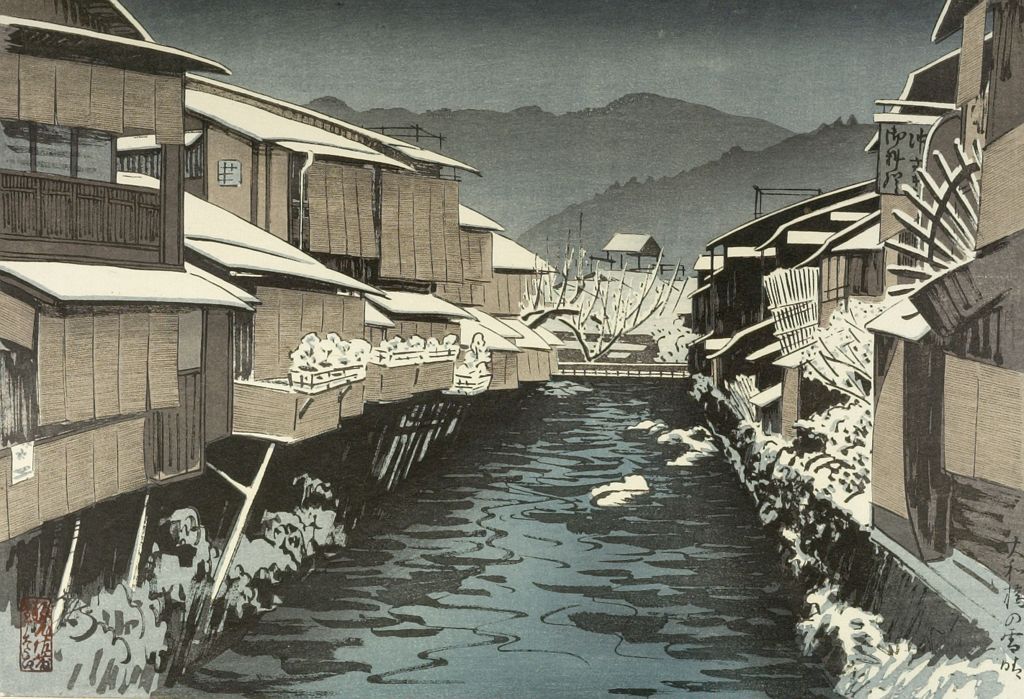
Fair Weather After Snow at Yamato Bridge, Kyoto (Yamato bashi no yukibare), Taishô period, dated 1924
Woodblock print

The Compound of the Tenman Shrine at Kameido in the Snow (Kameido Tenmangu keidai no yuki), from the series "Famous Places in the Eastern Capital (Toto meisho)"
c. 1832/38
Color woodblock print; oban

Miyajima in Snow (Yuki no Miyajima)
Yuki no Miyajima
1929
Color woodblock print; oban
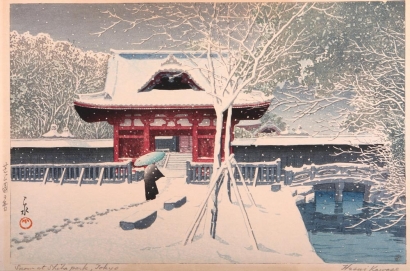
Evening Snow at Shiha Park, Tokyo
1932
Woodblock print
Featured in Collections
Curated cross-cuts that include this print.
Frequently Asked Questions
Spring snow was created by Ito Shinsui (伊東深水).
Spring snow depicts snow scenes and spring.