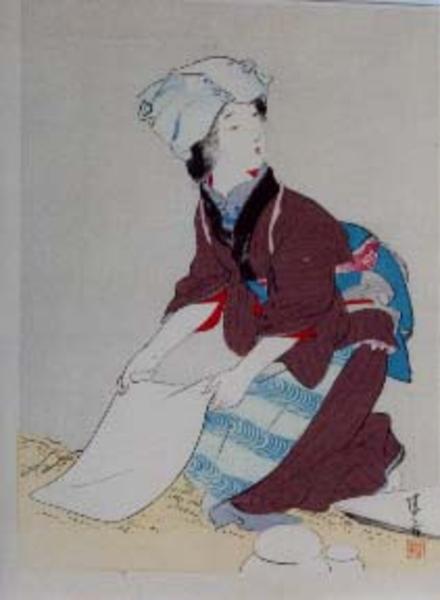
Mochi Mushiro — 餅むしろ
- Date:
- 1908
- Medium:
- Woodblock print
- Format:
- Oban
- Publisher:
- Watanabe Shozaburo
- Source:
- Japanese Art Open Database
Description
Dated 1908, Mochi Mushiro takes its title from mochi mushiro, the straw mat used for making rice cakes, a practice central to Japanese New Year celebrations. The preparation of mochi, in which steamed glutinous rice is pounded into a smooth paste and shaped on straw mats, is a communal activity that marks the transition from one year to the next. Kaburaki Kiyokata likely depicts a woman involved in or adjacent to this seasonal preparation, using the mochi-making context to anchor a bijin portrait in a specific cultural moment. The 1908 Meiji-period date places the scene in an era when these traditional practices were still central to household life. The oban woodblock rendering preserves both the figure's grace and the material details of the mochi-making process.
More Prints by Kaburaki Kiyokata


More Figures Prints
Featured in Collections
Curated cross-cuts that include this print.
Frequently Asked Questions
Mochi Mushiro — 餅むしろ was created by Kaburaki Kiyokata (鏑木清方) in 1908.
Mochi Mushiro — 餅むしろ was published by Watanabe Shozaburo (1908).
Mochi Mushiro — 餅むしろ depicts figures, food & drink, and daily life.