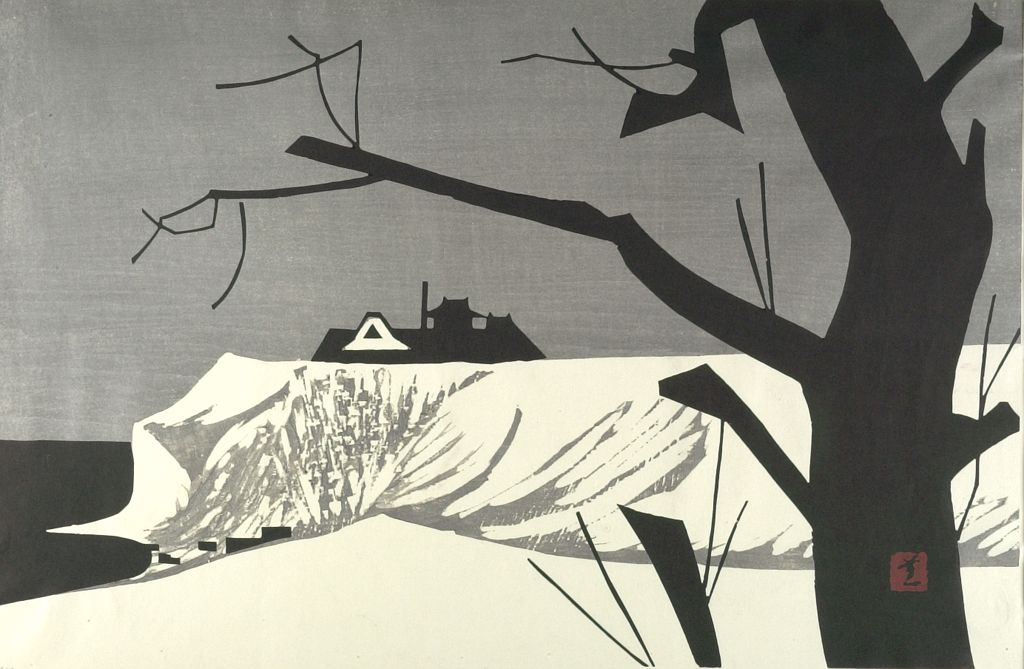
Winter Mansion (Girinsô), Shôwa period,
by Kaoru Kawano
- Medium:
- Woodblock print
- Source:
- Harvard Art Museum
- Image courtesy of
- Harvard Art Museum
Description
"Winter Mansion (Girinsô)" depicts a specific named building — Girinsô, possibly an inn, villa, or estate — in a snow-covered winter setting during the Shôwa period. Snow-scene prints in the Japanese tradition emphasize the compression of color toward near-monochrome: the white of snow defines itself against dark architectural forms, bare branches, and a heavy sky. Kawano would have used the unpainted washi paper surface to represent snow, relying on precise registration of surrounding color blocks to define the white areas by contrast — a demanding technique that leaves no margin for misalignment. The Shôwa period dating locates this work within postwar Japan, where landscape subjects remained popular alongside Kawano's more commercially prominent figurative prints. Girinsô as a named site suggests either a location of personal significance or a commission tied to the property. The composition likely balances the geometric weight of the building against organic forms of snow-laden trees, with a simplified sky achieved through flat or lightly graduated ink.
More Prints by Kaoru Kawano

More Snow Scenes Prints
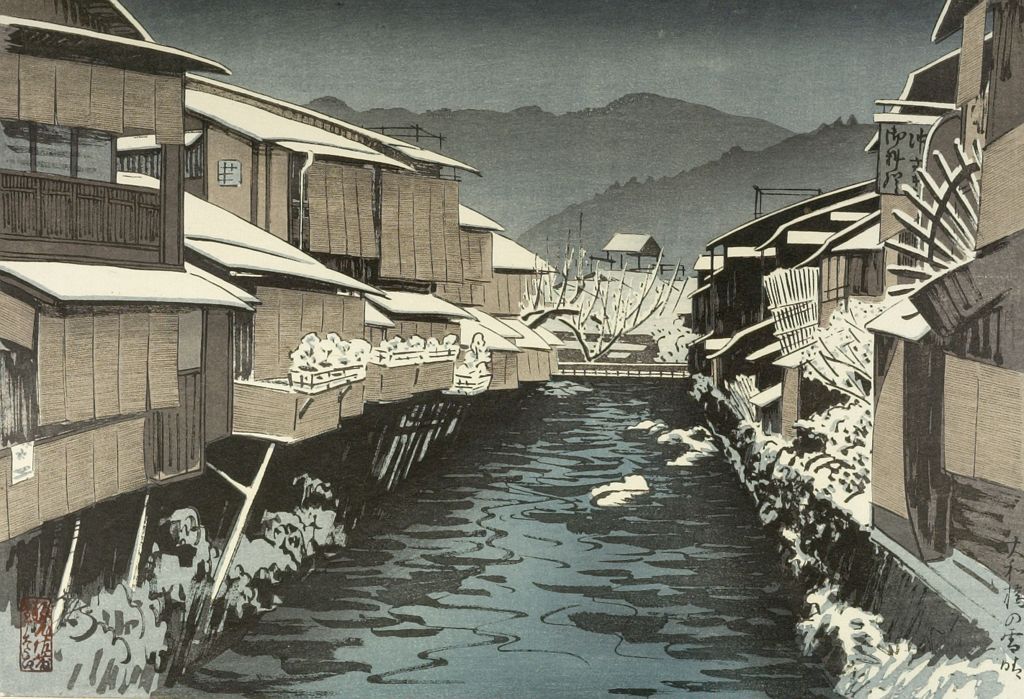
Fair Weather After Snow at Yamato Bridge, Kyoto (Yamato bashi no yukibare), Taishô period, dated 1924
Woodblock print

The Compound of the Tenman Shrine at Kameido in the Snow (Kameido Tenmangu keidai no yuki), from the series "Famous Places in the Eastern Capital (Toto meisho)"
c. 1832/38
Color woodblock print; oban

Miyajima in Snow (Yuki no Miyajima)
Yuki no Miyajima
1929
Color woodblock print; oban
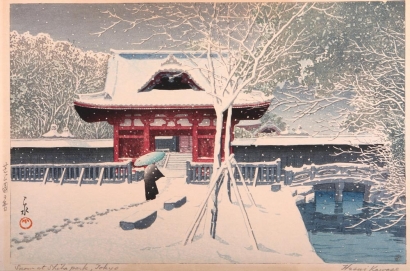
Evening Snow at Shiha Park, Tokyo
1932
Woodblock print
Featured in Collections
Curated cross-cuts that include this print.
Frequently Asked Questions
Winter Mansion (Girinsô), Shôwa period, was created by Kaoru Kawano (川野薫).
Winter Mansion (Girinsô), Shôwa period, depicts snow scenes, architecture, and winter.