
Genji Monogatari
by Saito Kaoru
- Medium:
- Etching
- Image courtesy of
- Saru Gallery
Description
The penultimate plate in Saito Kaoru's ten-volume Genji Monogatari mezzotint series, produced over the decade between 1982 and 1991. Although catalogued here as etching, the work is executed in mezzotint — the labor-intensive intaglio process in which a copper plate is first roughened uniformly with a rocker, then selectively burnished to lift areas back toward white. The continuous tonal range that mezzotint affords, with no visible line work, was central to Saito's vision of Murasaki Shikibu's eleventh-century novel: a world of curtained interiors, evening light, and shadowed gardens in which figures appear and recede rather than acting upon a clearly defined stage. Saito had worked toward this synthesis since 1968, when he abandoned abstract oil painting for intaglio. The Genji cycle, undertaken in his early fifties and completed in his sixtieth year, represents the focused application of that decision over a sustained literary subject — and the work for which his name is now principally cited.
More Prints by Saito Kaoru



More Literary Prints

Poem 69-8, Shôwa period, 1969
Woodblock print
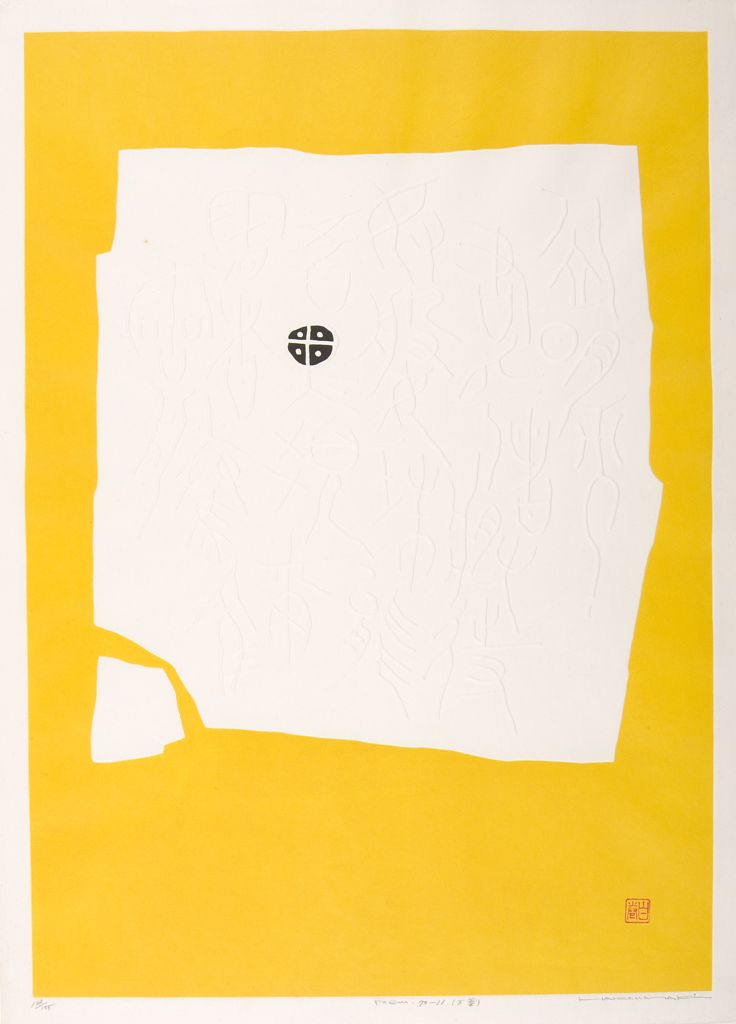
Poem 70-11, Shôwa period, 1970
Woodblock print

Poem 70-26, Shôwa period, 1970

Chiryu, from the series "Fifty-three Stations of the Tokaido (Tokaido gojusan tsugi)," also known as the Tokaido with Poem (Kyoka iri Tokaido)
c. 1837/42
Color woodblock print; chuban
Featured in Collections
Curated cross-cuts that include this print.
Frequently Asked Questions
Genji Monogatari was created by Saito Kaoru (斎藤薫).
Genji Monogatari depicts literary.