
Poem 70-26, Shôwa period, 1970
by Maki Haku
- Source:
- ukiyo-e.org
Description
Poem 70-26 is part of Maki Haku's long-running Poem series, the body of work for which he is best known internationally and which exemplifies his contribution to postwar Japanese abstract kanji prints. Created during the Showa period in 1970 and preserved in the Harvard Art Museums collection (recorded as HUAM-INV018417 and surfaced through ukiyo-e.org), the print belongs to a numbered sequence that Maki Haku produced over decades, each work titled simply "Poem" followed by a serial number that locates it within the cycle. The series treats the woodblock not as a vehicle for narrative or representation but as a meditative field in which a single enlarged Chinese character, or a fragment of calligraphic gesture, is set into a heavily textured ground built up from cement, sand, and pigment applied to the block before printing. The resulting surfaces carry a tactile, almost geological quality that distinguishes Maki Haku's prints from the flatter graphic vocabulary of many of his sosaku-hanga peers. Born Maejima Tadaaki in 1924 in Ibaraki Prefecture, Maki Haku worked outside the academic mainstream and was largely self-taught, embracing the sosaku-hanga (creative print) principle that the artist should design, carve, and print the work himself. The 1970 dating places Poem 70-26 within the most sought-after period of his output, when his international reputation was at its peak. Source: Harvard Art Museums via ukiyo-e.org, object record HUAM-INV018417.
More Prints by Maki Haku

More Literary Prints

Poem 69-8, Shôwa period, 1969
Woodblock print
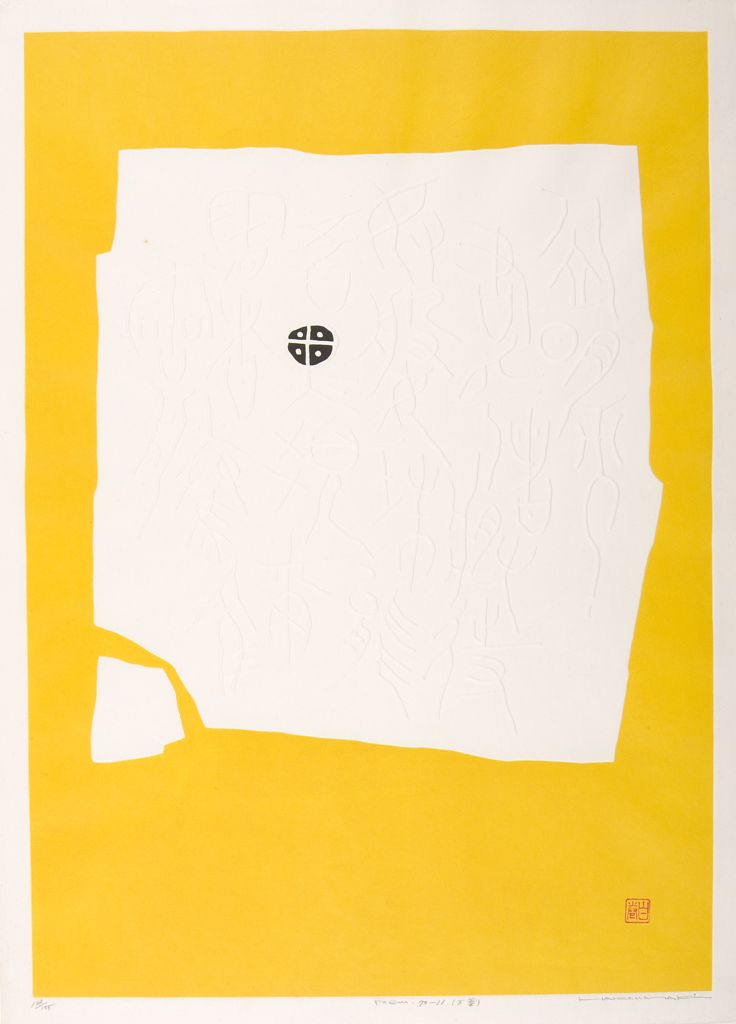
Poem 70-11, Shôwa period, 1970
Woodblock print

Chiryu, from the series "Fifty-three Stations of the Tokaido (Tokaido gojusan tsugi)," also known as the Tokaido with Poem (Kyoka iri Tokaido)
c. 1837/42
Color woodblock print; chuban

Arai, from the series "Fifty-three Stations of the Tokaido (Tokaido gojusan tsugi)," also known as the Tokaido with Poem (Kyoka iri Tokaido)
c. 1837/42
Color woodblock print; chuban
Featured in Collections
Curated cross-cuts that include this print.
Frequently Asked Questions
Poem 70-26, Shôwa period, 1970 was created by Maki Haku (巻白).
Poem 70-26, Shôwa period, 1970 depicts literary.