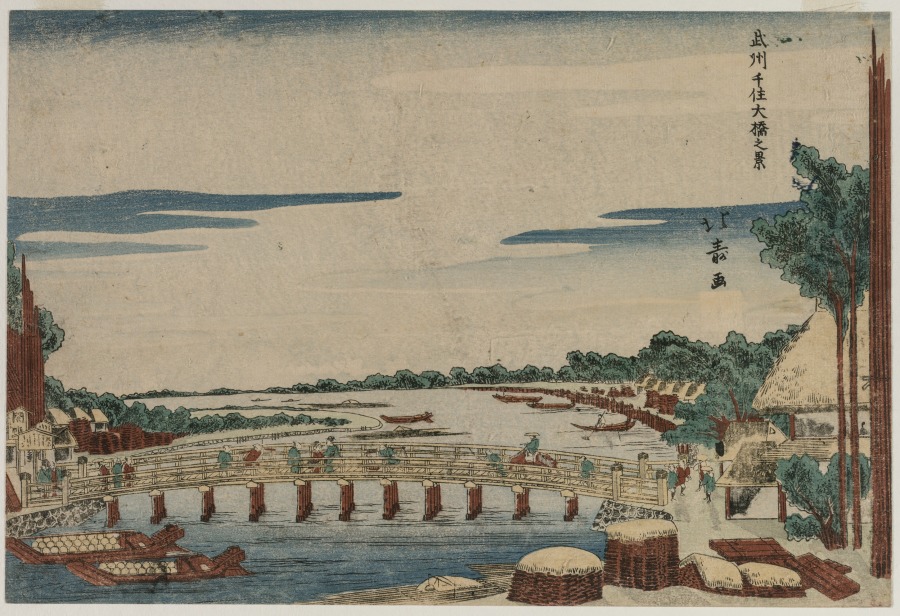
A View of the Great Bridge at Senju in Musashi Province
- Date:
- c. 1820s
- Medium:
- color woodblock print
- Source:
- Cleveland Museum of Art
Description
This color woodblock print, dated to circa the 1820s and held by the Cleveland Museum of Art, depicts the great bridge at Senju, the post station at the northern edge of Edo where the Sumida River was spanned by one of the city's largest timber bridges. Senju was the first stop on the Nikko and Oshu highways leading north from the shogunal capital, and the bridge marked a symbolic threshold between Edo and the provinces beyond. Hokuju arranges the composition around the strong horizontal recession of the bridge, its wooden trestles diminishing in carefully ruled perspective toward the far bank. Boats ply the water beneath, and travelers cross above with bundles and walking sticks. The sky is graded in his characteristic bokashi blue, and the architectural geometry of the bridge gives the print a structural rigor that distinguishes it from the more decorative figure prints of the same period. Senju Great Bridge subjects were treated by many later designers, including Hokusai and Hiroshige, but Hokuju's early version helped establish the bridge as a meisho (famous place) worthy of single-sheet landscape treatment, contributing to the visual canon of Edo that became one of the great subjects of nineteenth-century Japanese printmaking.
More Prints by Katsushika Hokuju


More Bridges Prints
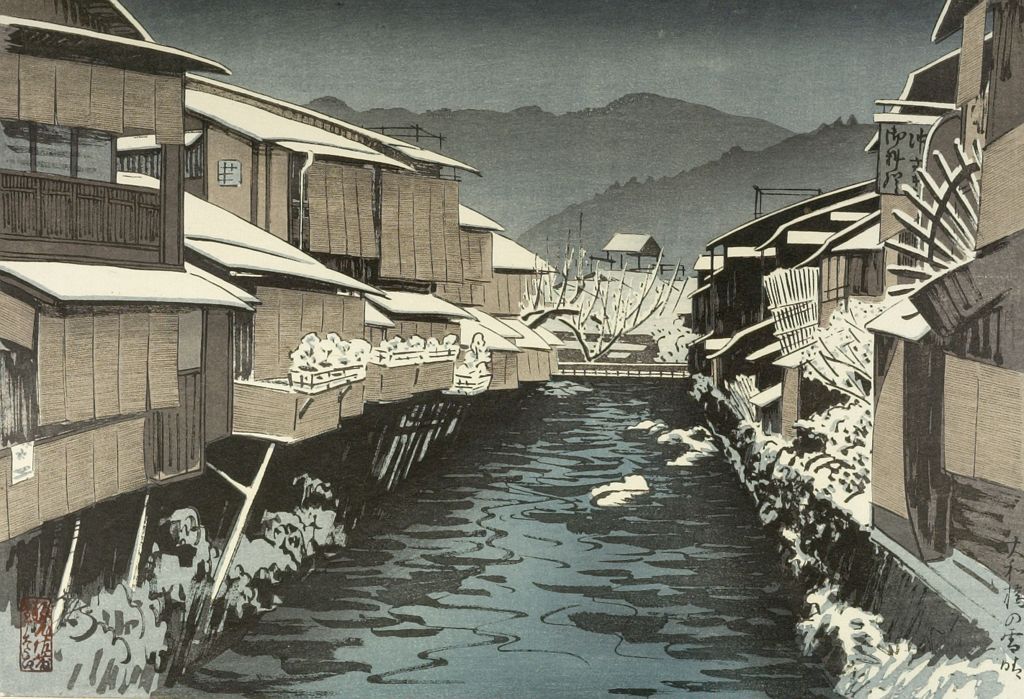
Fair Weather After Snow at Yamato Bridge, Kyoto (Yamato bashi no yukibare), Taishô period, dated 1924
Woodblock print
![Mount Fuji on a Moonlit Night, Kawai Bridge (Tsukiyo no Fuji [Kawaibashi]), from the series "Selection of Views of the Tokaido (Tokaido fukei senshu)" by Kawase Hasui](https://www.artic.edu/iiif/2/d0960668-1e73-339a-b182-fb995a54bff0/full/843,/0/default.jpg)
Mount Fuji on a Moonlit Night, Kawai Bridge (Tsukiyo no Fuji [Kawaibashi]), from the series "Selection of Views of the Tokaido (Tokaido fukei senshu)"
1947
Color woodblock print; oban

Shin Ohashi Bridge (Shin Ohashi), from the series "Twenty View of Tokyo (Tokyu nijukkei)"
1926
Color woodblock print; oban

Sacred Bridge in Nikko (Nikko Shinkyo)
1930
Color woodblock print; oban
Frequently Asked Questions
A View of the Great Bridge at Senju in Musashi Province was created by Katsushika Hokuju (葛飾北寿) in c. 1820s.
A View of the Great Bridge at Senju in Musashi Province depicts bridges.