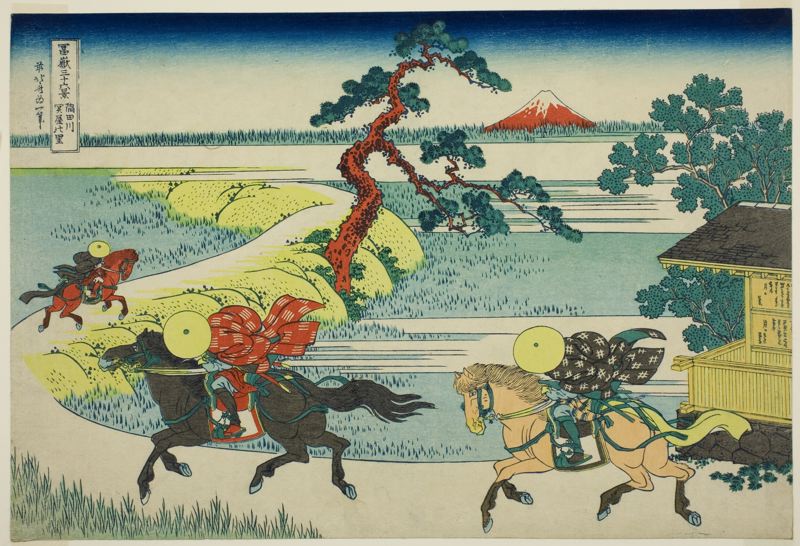
Sekiya Village on the Sumida River (Sumidagawa Sekiya no sato), from the series Thirty-six views of Mount Fuji (Fugaku sanjurokkei)
- Series:
- Thirty-Six Views of Mount Fuji
- Date:
- ca. 1831
- Medium:
- Woodblock print
- Source:
- Art Institute of Chicago
- Image courtesy of
- Art Institute of Chicago
Description
Sekiya, a village on the eastern bank of the Sumida River in the Musashino plain north of Edo, is depicted here in one of the Fugaku sanjurokkei series' most dynamic compositions. Three mounted samurai on horseback gallop at full speed along the river embankment, their mounts' hooves raised and robes streaming in a composition that conveys rapid lateral motion across the picture plane. Beyond the embankment and the open fields, Fuji rises on the far left, serene against a clear sky. The galloping riders and the static mountain create a studied compositional tension between kinetic energy and permanence. The Sumida's broad expanse is suggested in the middle ground, with distant shore vegetation rendered in pale tones. The willows along the bank — a seasonal marker — add organic diagonal lines that counter the horizontal of the embankment. The print is notable for its treatment of equestrian motion.
More Prints by Katsushika Hokusai
Hokusai manga (Hokusai Sketchbooks)
19th century
Woodblock-printed book; ink and light color on paper
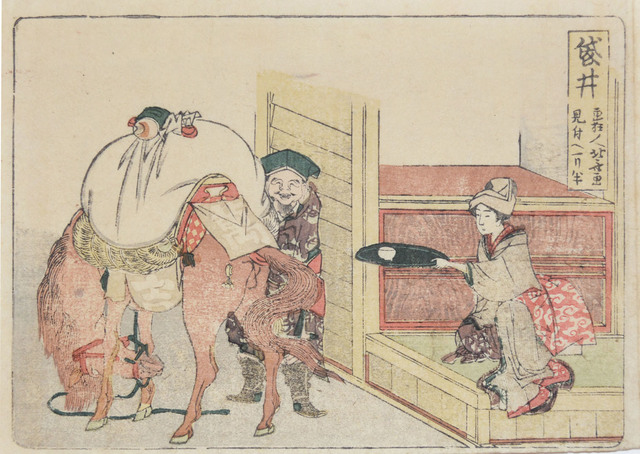
Fukuroi
1804
Japanese woodblock print

The Fishermen of Katase Hauling in Their Nets: The Purple Shell (Murasakigai)
1821
Color woodblock print with metallic pigments; surimono shikishiban

Burdock Root (Kurama gobo), from the series "A Selection of Horses (Uma-zukushi)"
1822
Color woodblock print; shikishiban, surimono
More Landscapes Prints

Lake Kugushi in Wakasa Province (Wakasa Kugushiko), from the series Souvenirs of Travel I (Tabi miyage dai isshu)"
Wakasa Kugushiko
1920
Color woodblock print; oban
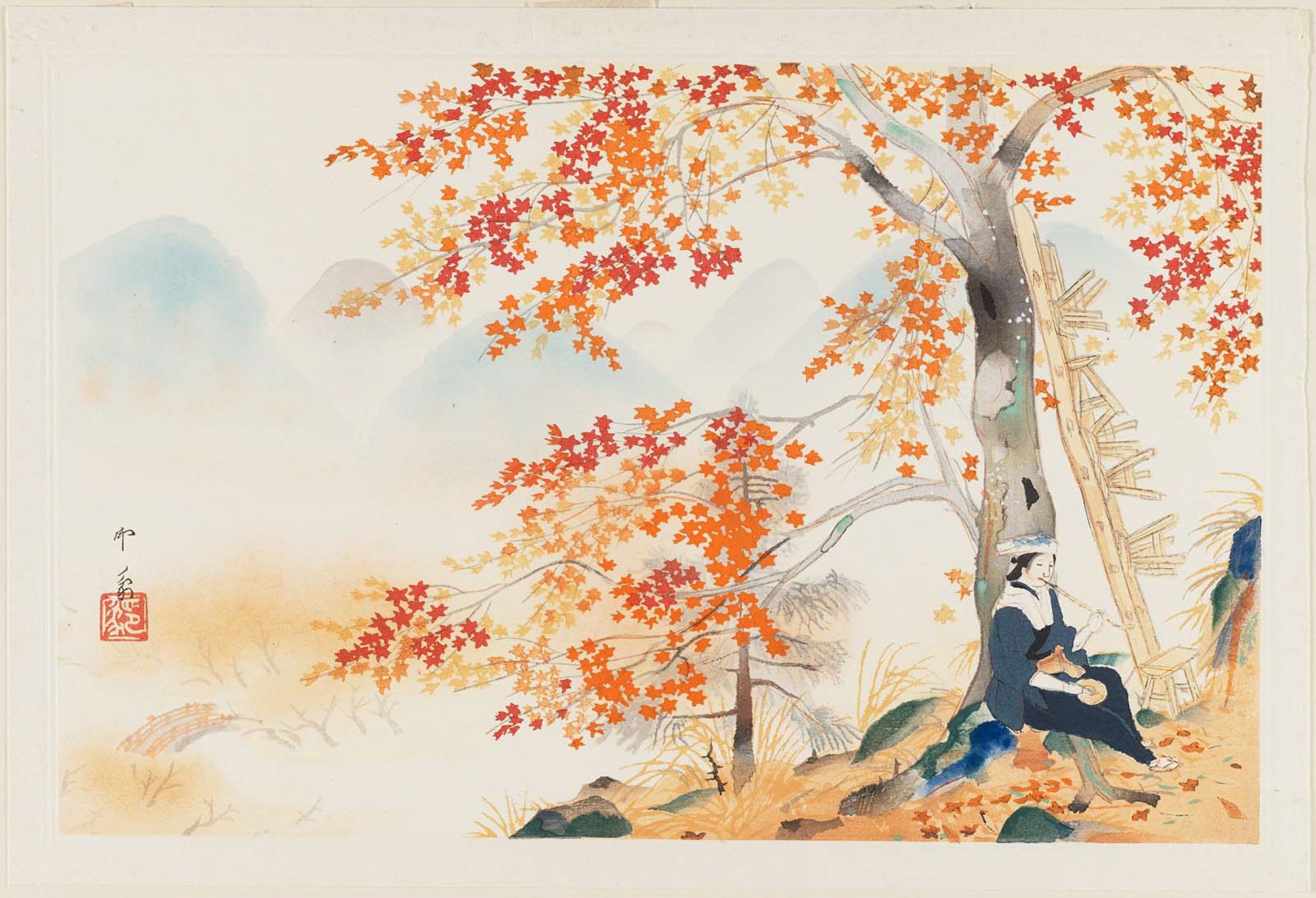
Autumn Maple Leaves at Takao, from the album Eight Views of Kyoto (Kyôto hakkei)
Woodblock print

The Beach at Kaiganji in Sanuki Province (Sanuki Kaiganji no hama), from the series "Collection of Views of Japan II, Kansai Edition (Nihon fukei shu II Kansai hen)"
1934
Color woodblock print; oban

Tea Kettle, section of a sheet from the series "Mirror of Stone Rubbings of Views of the Provinces" (Kohon meihitsu ishizuri kagami)
n.d.
Woodblock print; ishizuri-e, section of harimaze sheet
Featured in Collections
Curated cross-cuts that include this print.
Frequently Asked Questions
Sekiya Village on the Sumida River (Sumidagawa Sekiya no sato), from the series Thirty-six views of Mount Fuji (Fugaku sanjurokkei) was created by Katsushika Hokusai (葛飾北斎) in ca. 1831.
Yes — Sekiya Village on the Sumida River (Sumidagawa Sekiya no sato), from the series Thirty-six views of Mount Fuji (Fugaku sanjurokkei) is part of the Thirty-Six Views of Mount Fuji series by Katsushika Hokusai.
Sekiya Village on the Sumida River (Sumidagawa Sekiya no sato), from the series Thirty-six views of Mount Fuji (Fugaku sanjurokkei) depicts landscapes, rivers & lakes, and mount fuji, set at Mount Fuji, Sumida River.