
Matoba, Takehara (Takehara Matoba (Hiroshima ken))
by Kawase Hasui
- Date:
- 1948
- Medium:
- Color woodblock print
- Format:
- Oban
- Publisher:
- Watanabe Shozaburo
- Edition:
- Published by Watanabe Shozaburo
- Source:
- Art Institute of Chicago
Description
Matoba at Takehara in Hiroshima Prefecture, published in 1948, depicts a district of Takehara city on the Seto Inland Sea coast of Hiroshima — a port town known for its preserved Edo-period merchant townhouse district (one of Japan's best-preserved) and for the salt industry that made it prosperous. Takehara's Matoba area likely captures the historic commercial district with its traditional machiya streetscape and the peaceful Inland Sea visible beyond. The 1948 date, just three years after Hiroshima's destruction, gives this documentation of a nearby Inland Sea town a quietly restorative quality.
More Prints by Kawase Hasui

More Urban Scenes Prints
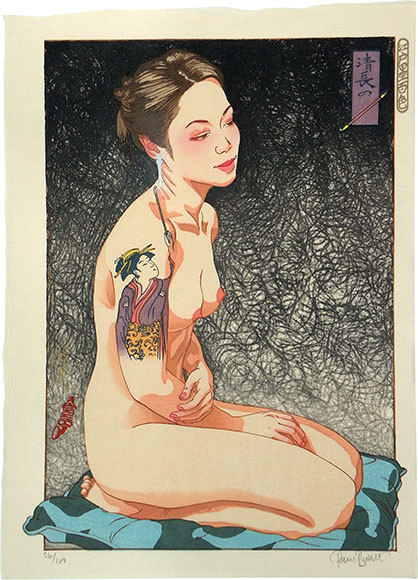
A Hundred Shades of Ink of Edo: Kiyonaga's Pipe (Edo zumi hyaku shoku: Kiyonaga no kiseru)
Woodblock print

View of Kabuki Theater from Matsuya (Ginza Matsuya yori Kabukiza), no. 3 from the series "Pictures of Ginza, First Series (Gashu Ginza dai isshu)"
1928
Color lithograph

Distant View of Mitsukoshi Movie Theater in Shinjuku from the Sixth Floor of Hoteiya (Hoteiya rokkai kara Shinjuku Mitsukoshi Musashi no kan enbo zu), no. 1 from the series "Scenery of Shinjuku (Gashu Shinjuku fukei)"
1930
Color lithograph
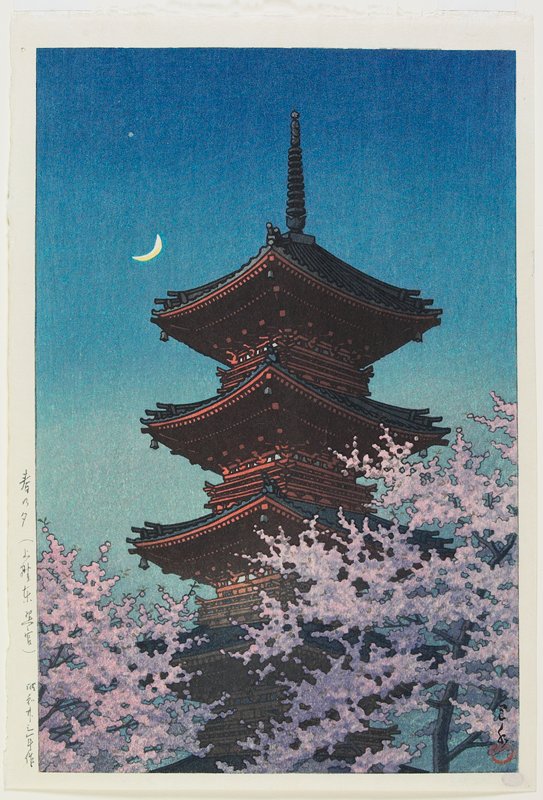
Spring Dusk at the Tōshō Shrine in Ueno
1948
Woodblock print, ink and color on paper
Featured in Collections
Curated cross-cuts that include this print.
Frequently Asked Questions
Matoba, Takehara (Takehara Matoba (Hiroshima ken)) was created by Kawase Hasui (川瀬巴水) in 1948.
Matoba, Takehara (Takehara Matoba (Hiroshima ken)) was published by Watanabe Shozaburo (1948).
Matoba, Takehara (Takehara Matoba (Hiroshima ken)) depicts urban scenes, seascapes, and architecture, set at Hiroshima.