
Shiba Benten ike
by Kawase Hasui
- Date:
- 1929
- Medium:
- Color woodcut
- Publisher:
- Watanabe Shozaburo
- Edition:
- Published by Watanabe Shozaburo
- Source:
- Library of Congress
Description
Two women in kimono stand on a wooden bridge crossing a pond thick with lotus leaves and pink lotus blossoms, seen from behind as they pause mid-span. Dense dark-green foliage rises behind them against a deep blue-green sky, with the artist's round red seal stamped at the lower left. *Shiba Benten ike*, a color woodcut by Kawase Hasui, 1929.
More Prints by Kawase Hasui


More Urban Scenes Prints

A Hundred Shades of Ink of Edo: Kiyonaga's Pipe (Edo zumi hyaku shoku: Kiyonaga no kiseru)
Woodblock print

View of Kabuki Theater from Matsuya (Ginza Matsuya yori Kabukiza), no. 3 from the series "Pictures of Ginza, First Series (Gashu Ginza dai isshu)"
1928
Color lithograph

Distant View of Mitsukoshi Movie Theater in Shinjuku from the Sixth Floor of Hoteiya (Hoteiya rokkai kara Shinjuku Mitsukoshi Musashi no kan enbo zu), no. 1 from the series "Scenery of Shinjuku (Gashu Shinjuku fukei)"
1930
Color lithograph
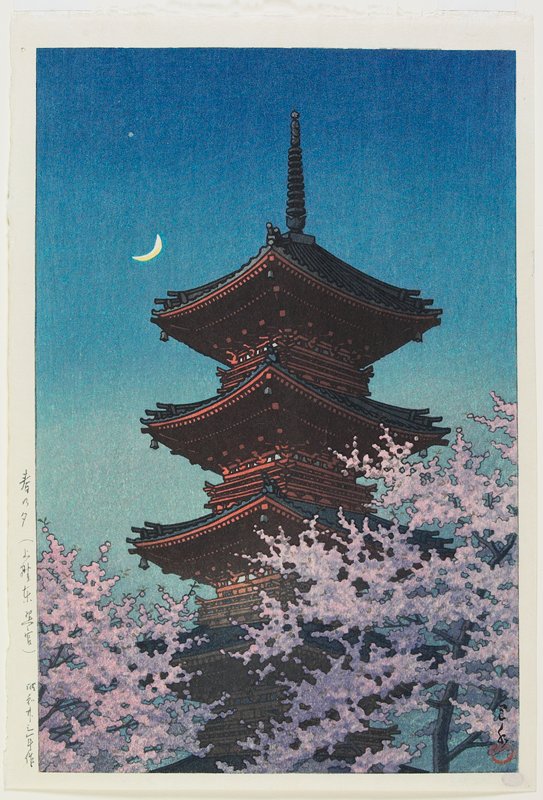
Spring Dusk at the Tōshō Shrine in Ueno
1948
Woodblock print, ink and color on paper
Featured in Collections
Curated cross-cuts that include this print.
Frequently Asked Questions
Shiba Benten ike was created by Kawase Hasui (川瀬巴水) in 1929.
Shiba Benten ike was published by Watanabe Shozaburo (1929).
Shiba Benten ike depicts urban scenes, temples & shrines, and rivers & lakes.