
Spring Evening at the Otemon Gate (Otemon no haru no yugure)
by Kawase Hasui
- Date:
- 1952
- Medium:
- Color woodblock print; oban
- Format:
- Oban
- Publisher:
- Watanabe Shozaburo
- Edition:
- Published by Watanabe Shozaburo
- Source:
- Art Institute of Chicago
Description
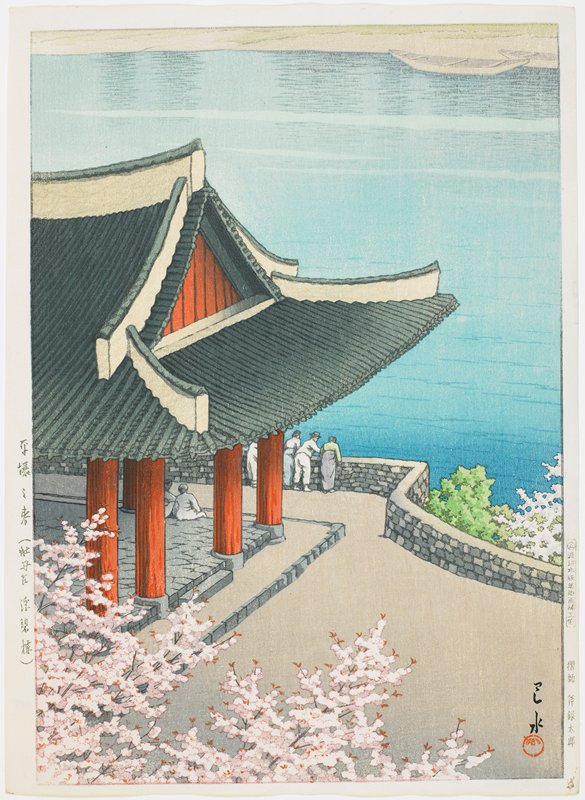
Spring Evening at the Otemon Gate, published in 1952, depicts the main outer gate of Osaka Castle — the Otemon, rebuilt in 1628 as the castle's ceremonial western entrance — in the warmth of a spring evening when the gate's stone walls and massive wooden doors are softened by the ambient glow of late-day light and, likely, the presence of nearby cherry blossoms. The Otemon of Osaka Castle is one of Japan's most imposing surviving castle gate structures, and the spring evening setting gives Hasui an opportunity to combine historical architecture with the season's characteristic golden-hour warmth. The oban format provides space for both the gate's mass and the evening sky.
More Prints by Kawase Hasui

More Spring Prints

Featured in Collections
Curated cross-cuts that include this print.
Frequently Asked Questions
Spring Evening at the Otemon Gate (Otemon no haru no yugure) was created by Kawase Hasui (川瀬巴水) in 1952.
Spring Evening at the Otemon Gate (Otemon no haru no yugure) uses Bokashi, on color woodblock print; oban.
Spring Evening at the Otemon Gate (Otemon no haru no yugure) was published by Watanabe Shozaburo (1952).
Spring Evening at the Otemon Gate (Otemon no haru no yugure) depicts spring, night scenes, and architecture.