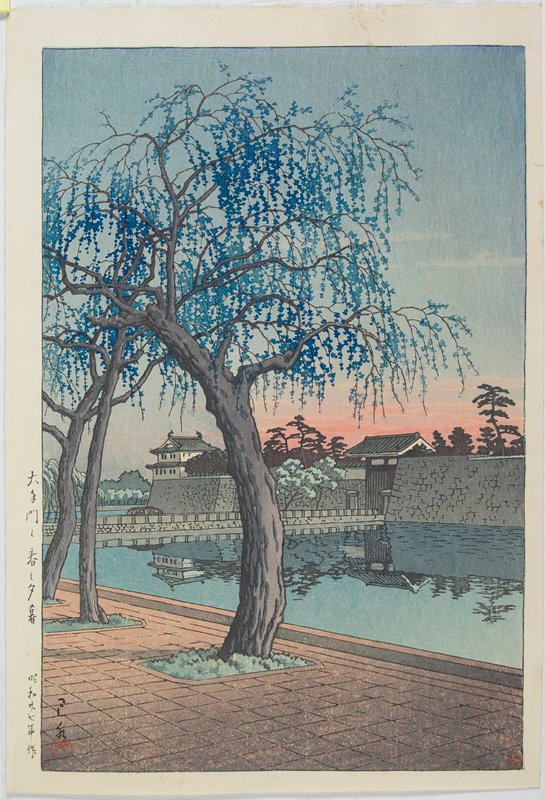
Springtime Evening, Ōte Gate
by Kawase Hasui
- Date:
- 1952
- Medium:
- Woodblock print, ink and color on paper
- Format:
- Oban
- Dimensions:
- 36.4 × 24.3 cm
- Publisher:
- Watanabe Shozaburo
- Edition:
- Published by Watanabe Shozaburo
- Source:
- Minneapolis Institute of Art
Description
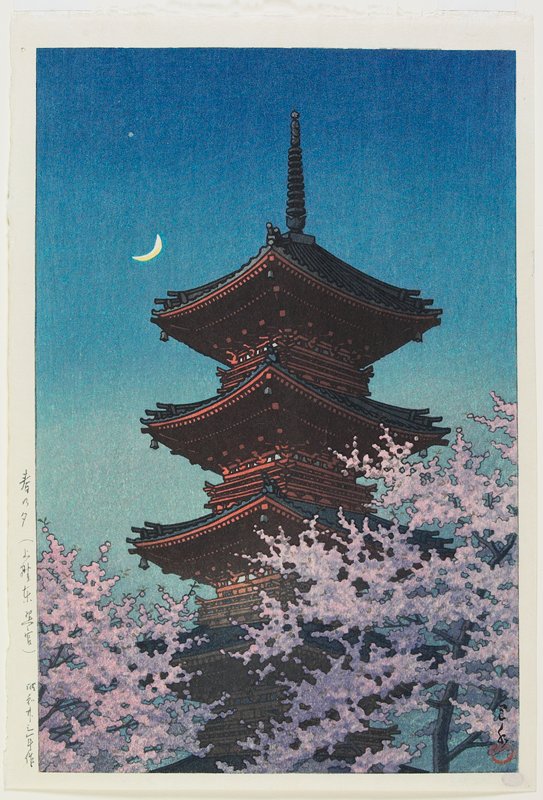
The Ote Gate — the main gate of Edo Castle on the eastern side of the palace complex — appears here at springtime evening in this 1952 print, the stone walls and the gate's wooden structure in the warm amber light of late spring dusk. Cherry blossoms may be visible in the castle grounds beyond the gate, the spring evening bringing together two of the season's most characteristic elements. Bokashi gradations carry the sky from a warm spring blue to the first tones of evening.
More Prints by Kawase Hasui

More Spring Prints

Featured in Collections
Curated cross-cuts that include this print.
Frequently Asked Questions
Springtime Evening, Ōte Gate was created by Kawase Hasui (川瀬巴水) in 1952.
Springtime Evening, Ōte Gate uses Bokashi, on woodblock print, ink and color on paper.
Springtime Evening, Ōte Gate was published by Watanabe Shozaburo (1952).
Springtime Evening, Ōte Gate depicts spring, night scenes, and architecture.
Springtime Evening, Ōte Gate measures 36.4 × 24.3 cm (Oban format).