
Mt Fuji from Lake Suwa
- Medium:
- Mokuhanga (Japanese woodblock)
- Image courtesy of
- Saru Gallery
Description
Lake Suwa sits in Nagano Prefecture, offering a distant view of Mount Fuji across its waters. This print places Fuji as a small but dominant element in the far distance, with the lake's surface providing a horizontal counterweight. The composition likely employs bokashi gradation in the sky—a graded wash achieved by wiping pigment from the block before printing—to suggest atmospheric depth between viewer and mountain. Koizumi's approach, in which he designed, carved, and printed each block himself in line with the sosaku-hanga ethic, gave him control over the subtle tonal transitions characteristic of his landscapes. While Mount Fuji is more closely associated with shin-hanga topographic series like those of Hasui and Yoshida, Koizumi treated it on his own terms: simplified massing, quiet palettes, and a deliberate avoidance of theatrical weather effects. The print sits outside his celebrated One Hundred Views of Great Tokyo (Dai Tokyo Hyakkei) series of 1928–1940, instead belonging to a smaller body of provincial views in which he applied the same disciplined self-carved technique to scenes beyond the capital.
More Prints by Kishio Koizumi
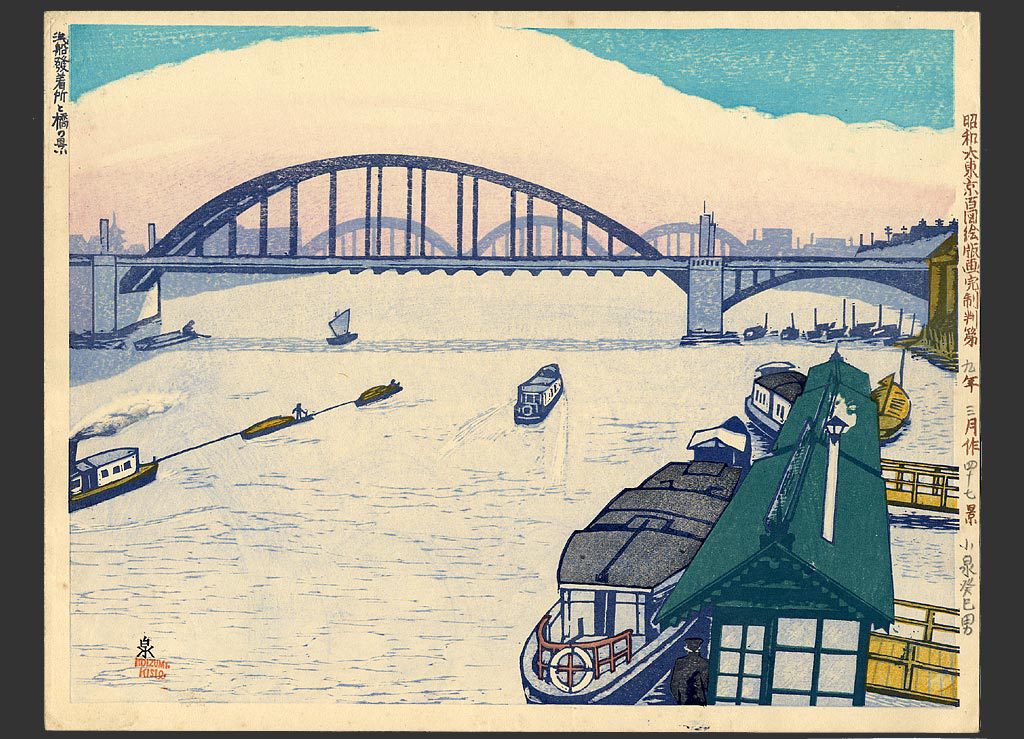
Untitled (kishio-koizumi)
Woodblock print
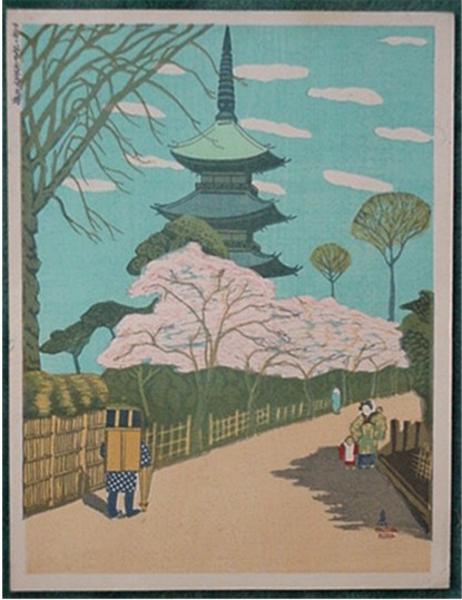
Unknown, spring scene
Woodblock print

Raft In Yoryoko River
Mokuhanga (Japanese woodblock)

Autumn Color along the Moat at Hanzo Gate (Hanzomon go-horihata no aki iro), from the series "One Hundred Views of Great Tokyo in the Showa Era (Showa dai Tokyo fukei hyaku zue hanga)"
1934
Color woodblock print; oban
More Rivers & Lakes Prints

Lake Chuzenji, Nikko (Nikko Chuzenjiko)
Nikko Chuzenjiko
1930
Color woodblock print; oban

Lake Kugushi in Wakasa Province (Wakasa Kugushiko), from the series Souvenirs of Travel I (Tabi miyage dai isshu)"
Wakasa Kugushiko
1920
Color woodblock print; oban

Gosai Canal in Niigata (Niigata Gosaibori), from the series "Souvenirs of Travel, Second Series (Tabi miyage dai nishu)"
Niigata Gosaibori
1921
Color woodblock print; oban

The Hori River at Obama (Obama Horikawa), from the series "Souvenirs of Travel, First Series (Tabi miyage dai isshu)"
Obama Horikawa
1920
Color woodblock print; oban
Featured in Collections
Curated cross-cuts that include this print.
Frequently Asked Questions
Mt Fuji from Lake Suwa was created by Kishio Koizumi (小泉癸巳男).
Mt Fuji from Lake Suwa depicts rivers & lakes and mount fuji.