
River Scene
- Medium:
- Mokuhanga (Japanese woodblock)
- Image courtesy of
- Saru Gallery
Description
Tokyo's identity as a river city -- crossed by the Sumida and laced with canals before postwar reclamation -- runs through Koizumi's One Hundred Views of Great Tokyo. A general river scene within that project records working waterway life: barges and small boats, embankment trees, low warehouses or tea-stall awnings along the bank. Compositionally, mokuhanga river views typically use the water as a horizontal band of bokashi-graded blue or grey, with reflected light suggested by carefully reserved white paper. Koizumi's status as designer, carver, and printer let him push the water tones through multiple subtle impressions rather than the standard two or three passes. Within his oeuvre, river views functioned as connective tissue between named landmark prints, asserting that Tokyo's character lay equally in its everyday waterways. The subject descends from the Edo meisho-e tradition of Sumida-bashi and Ryōgoku views by Hiroshige and Kuniyoshi.
More Prints by Kishio Koizumi
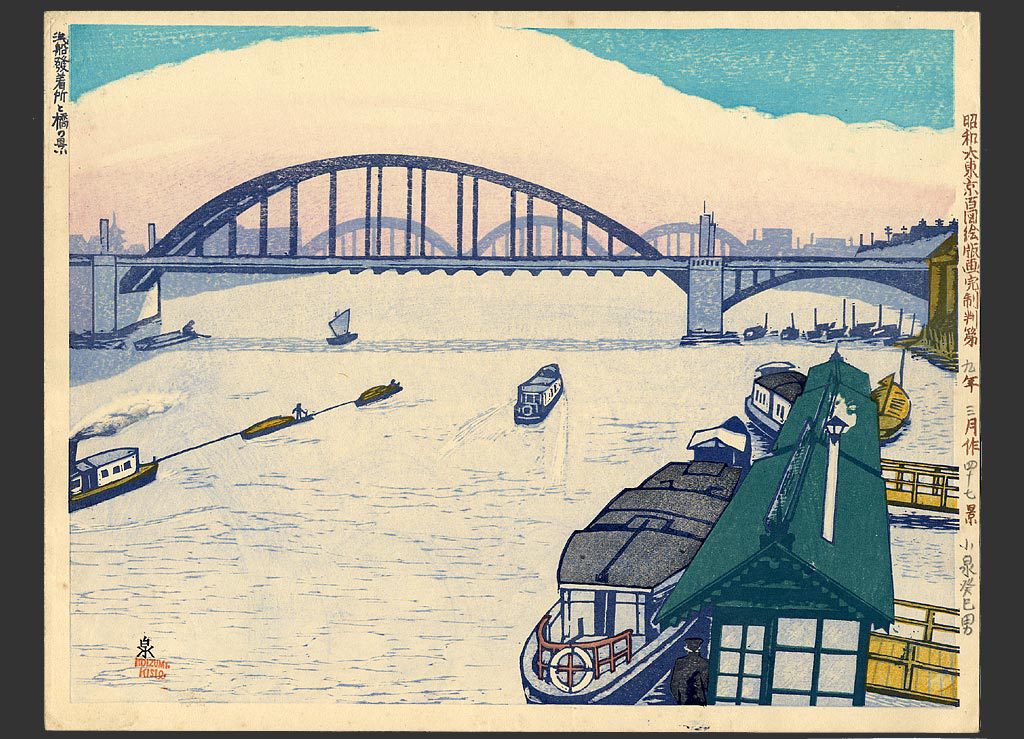
Untitled (kishio-koizumi)
Woodblock print
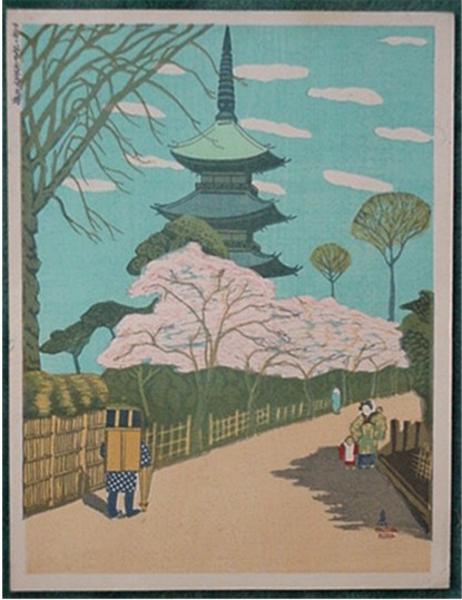
Unknown, spring scene
Woodblock print

Raft In Yoryoko River
Mokuhanga (Japanese woodblock)

Autumn Color along the Moat at Hanzo Gate (Hanzomon go-horihata no aki iro), from the series "One Hundred Views of Great Tokyo in the Showa Era (Showa dai Tokyo fukei hyaku zue hanga)"
1934
Color woodblock print; oban
More Rivers & Lakes Prints

Lake Chuzenji, Nikko (Nikko Chuzenjiko)
Nikko Chuzenjiko
1930
Color woodblock print; oban

Lake Kugushi in Wakasa Province (Wakasa Kugushiko), from the series Souvenirs of Travel I (Tabi miyage dai isshu)"
Wakasa Kugushiko
1920
Color woodblock print; oban

Gosai Canal in Niigata (Niigata Gosaibori), from the series "Souvenirs of Travel, Second Series (Tabi miyage dai nishu)"
Niigata Gosaibori
1921
Color woodblock print; oban

The Hori River at Obama (Obama Horikawa), from the series "Souvenirs of Travel, First Series (Tabi miyage dai isshu)"
Obama Horikawa
1920
Color woodblock print; oban
Featured in Collections
Curated cross-cuts that include this print.
Frequently Asked Questions
River Scene was created by Kishio Koizumi (小泉癸巳男).
River Scene depicts rivers & lakes.