
The third Lake Toya print continues Maeda's sustained meditation on the caldera, suggesting either a seasonal counterpart to the earlier versions or a closer study of a particular feature — perhaps Nakajima, the wooded island at the lake's center, or one of the volcanic peaks along its rim. Working serially in mokuhanga rewards this kind of patient revisiting: each new state can adjust palette, registration, and the depth of [bokashi](/glossary/bokashi) transitions without rebuilding the entire matrix. In Hokkaido subjects, Maeda often reduces his color count and lets the grain of the cherrywood block read through thin pigment, a technique that gives stone and weathered timber a tactile presence on the [washi](/glossary/washi). The cumulative effect of the Lake Toya group is a portrait of a place across conditions, an approach that recalls the [meisho-e](/glossary/meisho-e) tradition of named-place imagery while substituting the modern printmaker's interest in sustained observation for the Edo-period catalogue of stations and views.

Nikko Chuzenjiko
1930
Color woodblock print; oban

Wakasa Kugushiko
1920
Color woodblock print; oban

Niigata Gosaibori
1921
Color woodblock print; oban
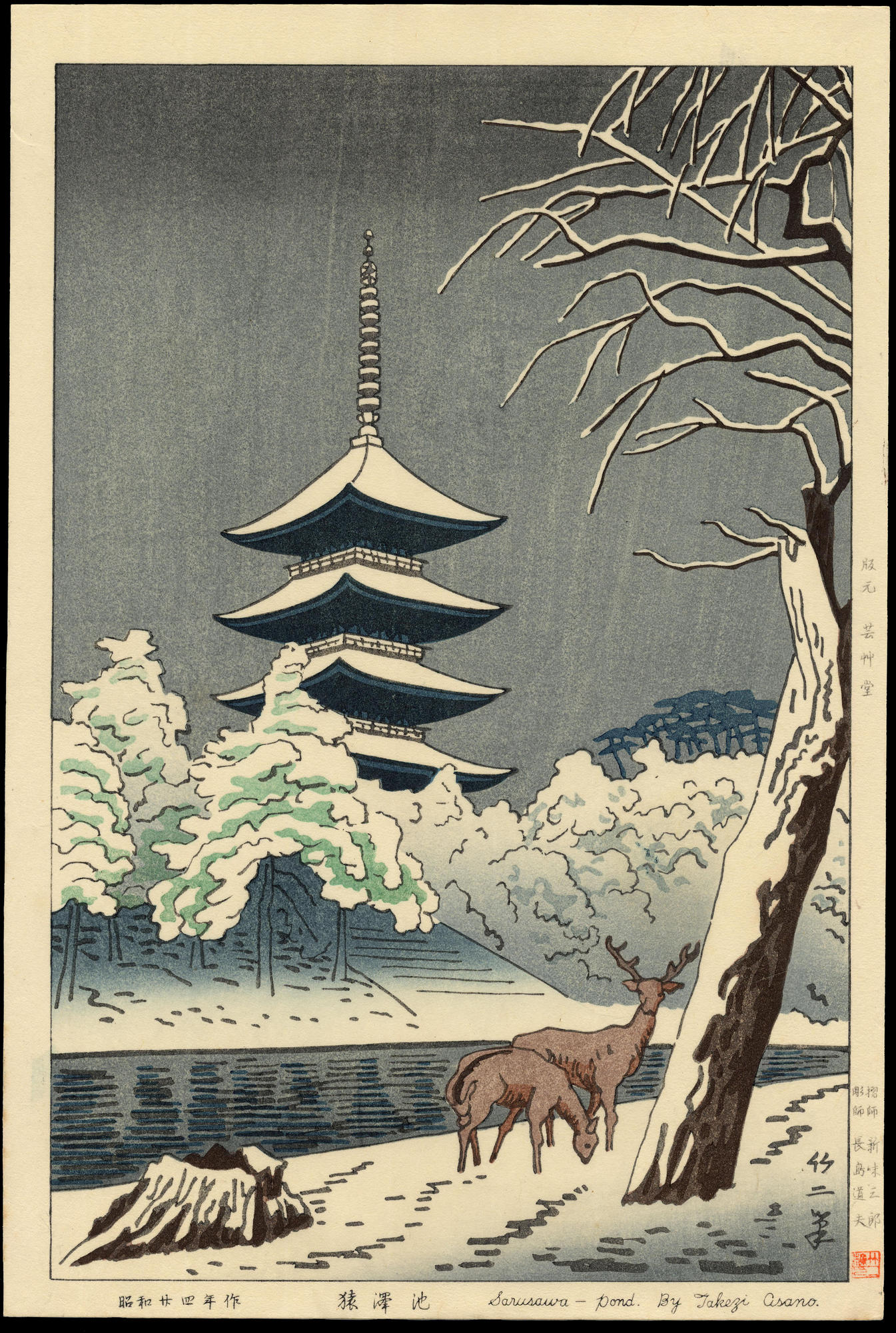
Woodblock print
Curated cross-cuts that include this print.
Lake Toya was created by Maeda Masao (前田政雄).
Lake Toya depicts rivers & lakes.


