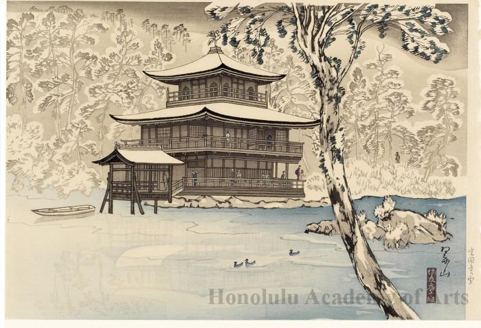
Snow at Kinkaku-ji (Kinkaku-ji no yuki)
by Miki Suizan
- Medium:
- Woodblock print
- Format:
- Oban
- Publisher:
- Watanabe Shozaburo
- Source:
- Honolulu Museum of Art
Description
Kinkakuji, the Golden Pavilion, stands at the edge of its mirror pond under a heavy mantle of snow. Suizan captures what may be Kyoto's single most photographed winter scene and translates it into the woodblock medium with a sensitivity to tonal values that photography of his era could not match. The gold-leafed pavilion, normally a warm beacon against green pines, becomes a complex interplay of white snow, dark timber framing, and subdued golden surfaces viewed through a scrim of falling flakes. The pond, partially frozen or stilled by cold, reflects the pavilion and surrounding pines in muted tones. Suizan's intimate knowledge of this subject across seasons gave him the confidence to strip the composition to essentials: pavilion, pond, pines, snow, and the grey sky binding them together into a single winter mood.
More Prints by Miki Suizan

More Snow Scenes Prints
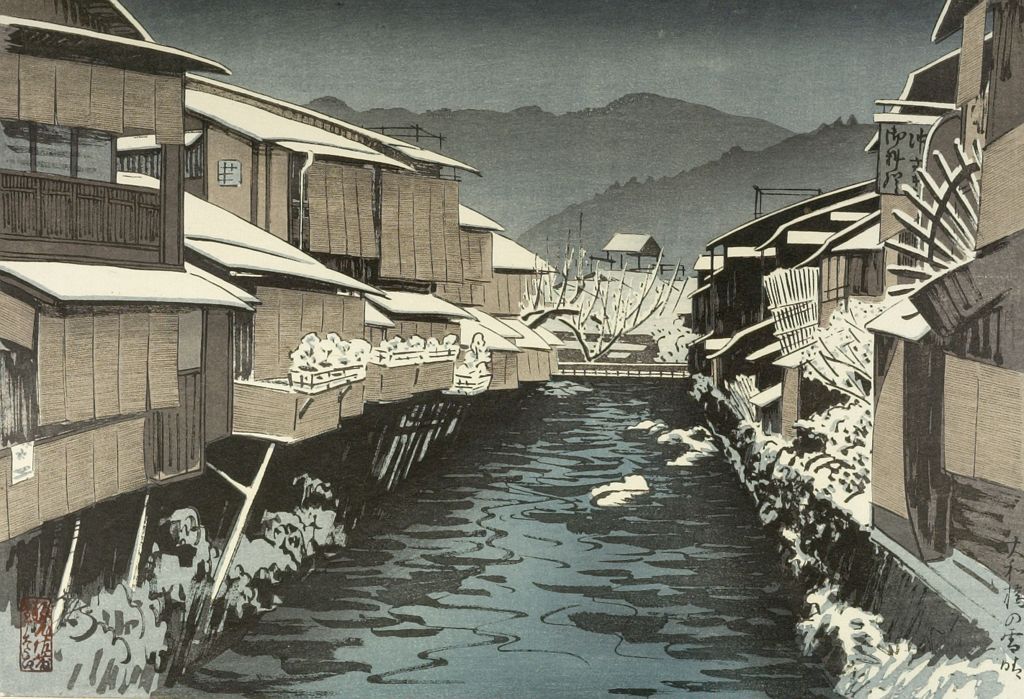
Fair Weather After Snow at Yamato Bridge, Kyoto (Yamato bashi no yukibare), Taishô period, dated 1924
Woodblock print

The Compound of the Tenman Shrine at Kameido in the Snow (Kameido Tenmangu keidai no yuki), from the series "Famous Places in the Eastern Capital (Toto meisho)"
c. 1832/38
Color woodblock print; oban

Miyajima in Snow (Yuki no Miyajima)
Yuki no Miyajima
1929
Color woodblock print; oban
Evening Snow at Shiha Park, Tokyo
1932
Woodblock print
Featured in Collections
Curated cross-cuts that include this print.
Frequently Asked Questions
Snow at Kinkaku-ji (Kinkaku-ji no yuki) was created by Miki Suizan (三木翠山).
Snow at Kinkaku-ji (Kinkaku-ji no yuki) was published by Watanabe Shozaburo.
Snow at Kinkaku-ji (Kinkaku-ji no yuki) depicts snow scenes.