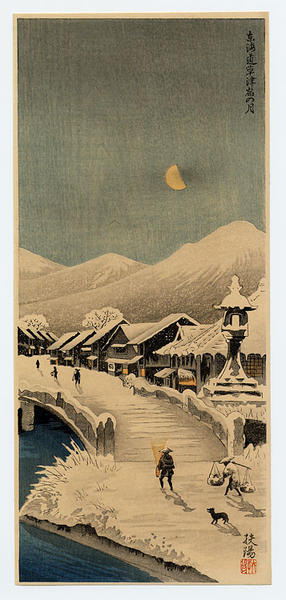
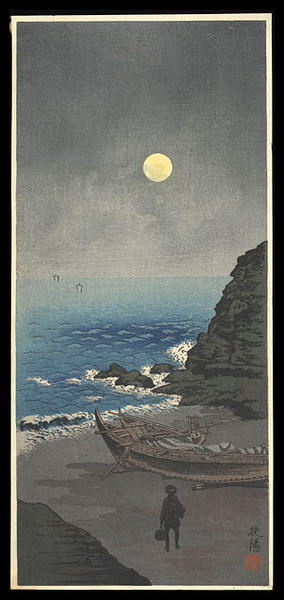
Tokaido Kusatsu Night Moon
- Date:
- 1930
- Medium:
- Woodblock print
- Source:
- Japanese Art Open Database
Description
This 1930 woodblock print depicts a night scene at Kusatsu, one of the fifty-three stations along the historic Tokaido road connecting Edo (Tokyo) to Kyoto. The Tokaido has been one of the most celebrated subjects in Japanese printmaking since Hiroshige's famous series of the 1830s, and Narazaki Eisho's 20th-century interpretation updates that tradition. Kusatsu, near Lake Biwa in Shiga Prefecture, was the junction where the Tokaido met the Nakasendo, another major highway, making it a busy crossroads for travelers. The moonlit setting bathes the scene in cool, silvery light, transforming the familiar post-town landscape into something mysterious and still. Narazaki's night scene required the printer to build up deep, dark tones for the sky and shadows while preserving the luminous glow of moonlight on rooftops, water, and the road surface.
More Prints by Narazaki Eisho
More Moonlight Prints
![Mount Fuji on a Moonlit Night, Kawai Bridge (Tsukiyo no Fuji [Kawaibashi]), from the series "Selection of Views of the Tokaido (Tokaido fukei senshu)" by Kawase Hasui](https://www.artic.edu/iiif/2/d0960668-1e73-339a-b182-fb995a54bff0/full/843,/0/default.jpg)
Mount Fuji on a Moonlit Night, Kawai Bridge (Tsukiyo no Fuji [Kawaibashi]), from the series "Selection of Views of the Tokaido (Tokaido fukei senshu)"
1947
Color woodblock print; oban

Evening Moon at Nakanoshima, Sapporo (Sapporo Nakanoshima no yuzuki), from the series "Collection of Views of Japan, Eastern Japan Edition (Nihon fukei shu higashi Nihon hen)"
March 1933
Color woodblock print; oban

Matsushima in Moonlight (Tsuki no Matsushima)
1919
Color woodblock print

Kiyozumi Garden in Moonlight
January 1938
Woodblock print, ink and color on paper
Featured in Collections
Curated cross-cuts that include this print.
Frequently Asked Questions
Tokaido Kusatsu Night Moon was created by Narazaki Eisho (楢崎栄昌) in 1930.
Tokaido Kusatsu Night Moon depicts moonlight, night scenes, and travel scenes.