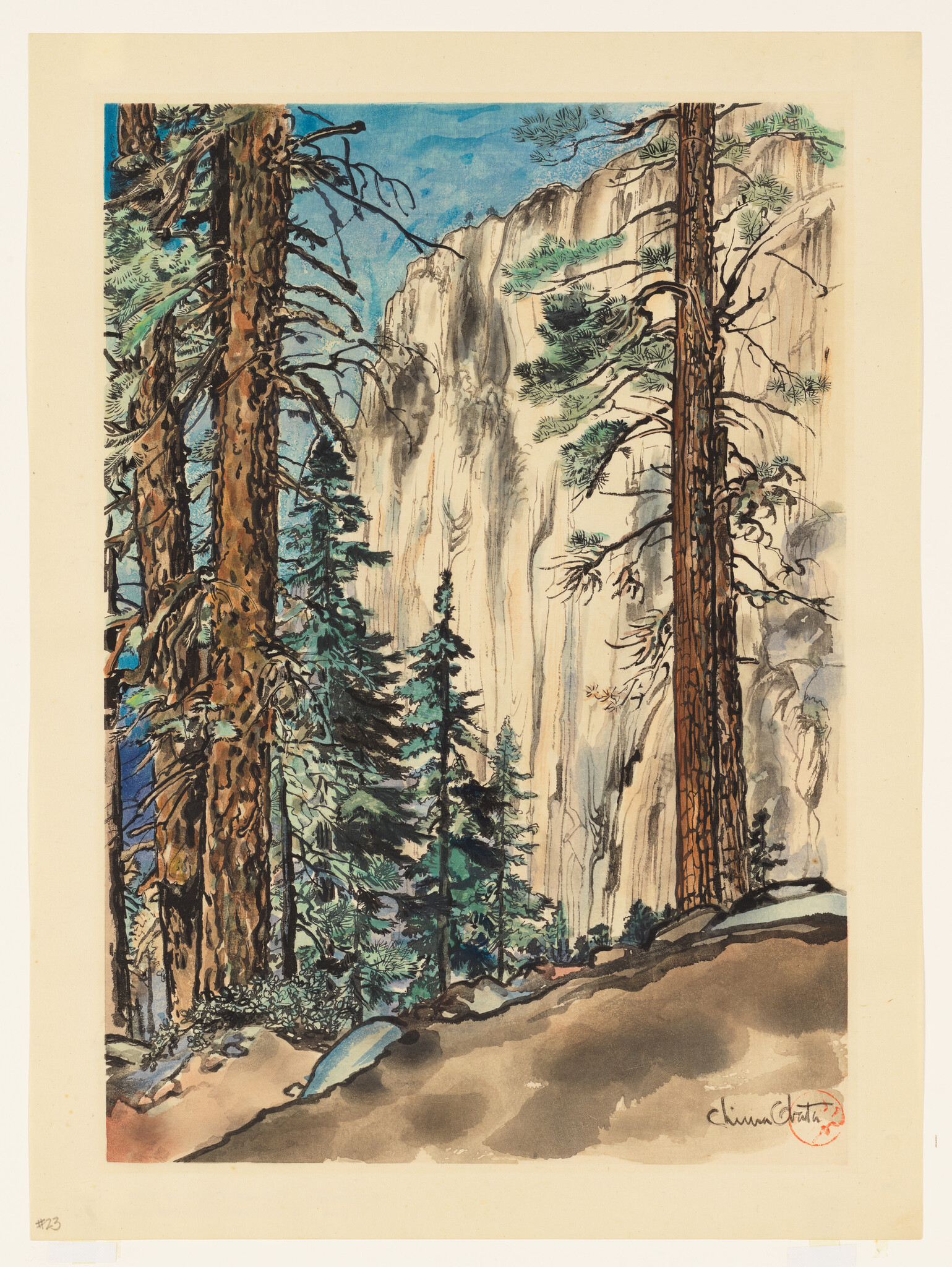
Eagle Peak Trail
by Obata Chiura
- Date:
- 1930
- Medium:
- Color woodblock print
- Source:
- Whitney Museum of American Art
Description
Eagle Peak Trail (1930), from Obata Chiura's World Landscape Series 'America,' is a vertical composition that captures the experience of looking up through the conifers toward the granite walls of Yosemite Valley. Tall pine trees frame the sheet on left and right, their dark trunks and feathery needles silhouetted against a pale sky; beyond them, a steep granite cliff rises across the upper two-thirds of the image with a slender waterfall threading down its face. The print's structure recalls the way Japanese landscape painting often uses framing trees to organize a distant view — a device Obata would have absorbed during his early training in nihonga in Sendai and Tokyo — but the subject is unmistakably American: Eagle Peak is on the northern rim of Yosemite Valley, accessible by trail from Yosemite Falls. The image originated in watercolors Obata produced during his 1927 expedition through Yosemite and the High Sierra with the painter Worth Ryder, during which the party hiked, camped, and sketched across the park. Between 1928 and 1930 Obata returned to Tokyo to oversee production of the World Landscape Series at the Takamizawa Print Works, working with thirty-two carvers and eighteen printers and approving between 120 and 205 progressive proofs of each image so that the printed sheets could preserve the subtle brush gradations of the original watercolors. The Whitney Museum of American Art holds this impression (accession 2015.12, https://whitney.org/collection/works/46352) as part of its substantial gift from the Obata family, and shows the print among more than twenty Obata woodblocks in its collection. For students of Obata and of Japanese-American art, Eagle Peak Trail is a particularly clean demonstration of how he applied the structural devices of Japanese landscape — framing trees, vertical format, restrained color — to the granite geography of Yosemite, producing prints that read as natural extensions of both traditions at once.
More Prints by Obata Chiura
Featured in Collections
Curated cross-cuts that include this print.
Frequently Asked Questions
Eagle Peak Trail was created by Obata Chiura (小圃千浦) in 1930.