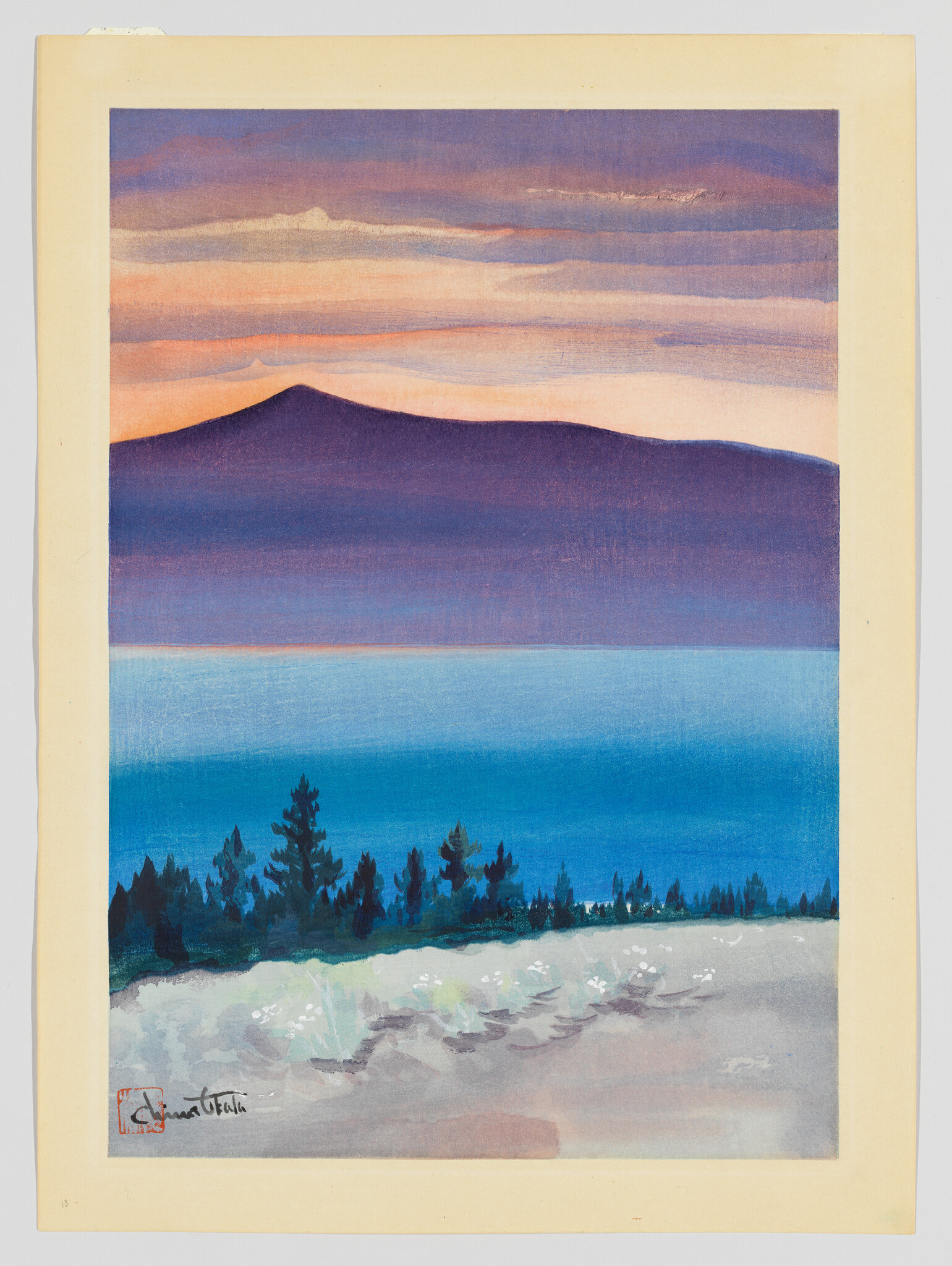
Evening Glow at Mono Lake, from Mono Mills
by Obata Chiura
- Date:
- 1930
- Medium:
- Color woodblock print
- Source:
- Whitney Museum of American Art
Description
Evening Glow at Mono Lake, from Mono Mills (1930) is among the most atmospheric prints in Obata Chiura's portfolio World Landscape Series 'America,' and a clear demonstration of how the artist translated the strange alkaline basin of California's Mono Lake into Japanese woodblock vocabulary. The composition is built around an extended horizontal stillness: the lake stretches across the center of the sheet in soft purples and silvered blues, a distant ridge holds the upper register, and a low foreground of pale sand and brush opens the foreground. The whole image is suffused with the warm light of dusk — pinks and apricots layered into the sky, reflected weakly in the water — producing the effect of a long, suspended moment in the high desert. Obata had visited Mono Lake during his 1927 expedition through the Sierra with the painter and Berkeley professor Worth Ryder, and on that trip he wrote to his wife that the lake's appearance was so overwhelming it transcended verbal expression. To carry that experience into print, Obata returned to Tokyo between 1928 and 1930 and oversaw production at the Takamizawa Print Works, employing thirty-two carvers and eighteen printers and approving between 120 and 205 progressive proofs per image so that the printed sheet would retain the gradations and subtle brush marks of his original watercolor. The Whitney Museum of American Art holds this impression as part of its substantial Obata family gift (accession 2015.26, https://whitney.org/collection/works/46355), and curators have positioned it within the Whitney's broader engagement with early twentieth-century Japanese-American art. For collectors of Japanese woodblock and of California landscape, Evening Glow at Mono Lake is a key sheet: it shows how Obata's hybrid training — Japanese sumi and nihonga foundations crossed with American landscape ambitions — could produce a quietly radical kind of print in which the meisho-e tradition of celebrated views is rerouted from Edo-period Tokaido stations to the alkaline lakes of the American West.
More Prints by Obata Chiura
Featured in Collections
Curated cross-cuts that include this print.
Frequently Asked Questions
Evening Glow at Mono Lake, from Mono Mills was created by Obata Chiura (小圃千浦) in 1930.