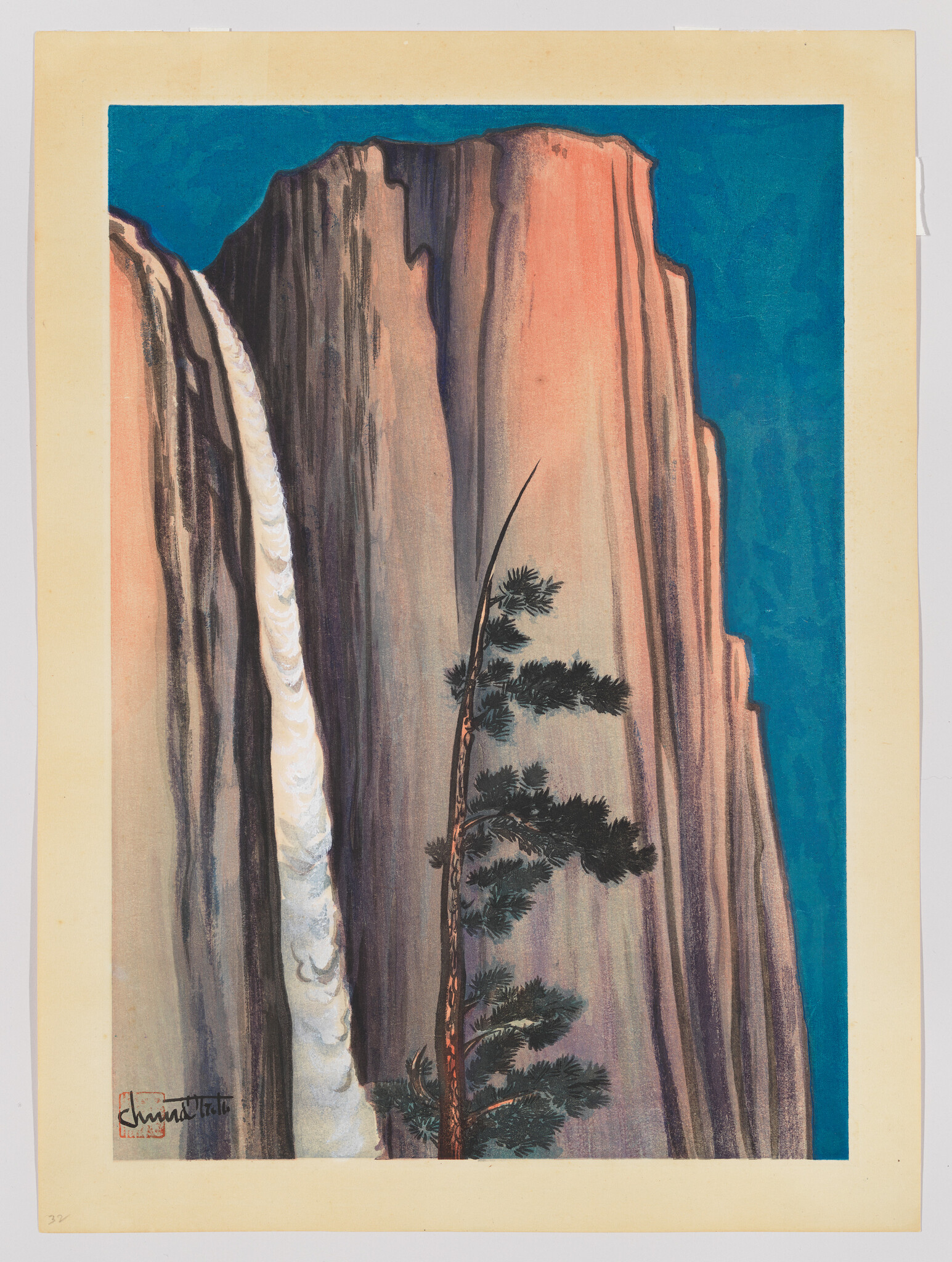
Evening Glow of Yosemite Fall
by Obata Chiura
- Date:
- 1930
- Medium:
- Color woodblock print
- Source:
- Whitney Museum of American Art
Description
Evening Glow of Yosemite Fall (1930) is one of the most luminous prints in Obata Chiura's World Landscape Series 'America,' and an example of how the artist used Japanese color woodblock technique to capture the specific atmosphere of light on granite in California's Sierra. The composition is dominated by a steep pinkish cliff face descending the center of the sheet, with a slender waterfall threading down its length and a lone pine tree silhouetted in the foreground; warm sunset reds and ambers wash across the rock, contrasted against deeper blues and violets at the cliff base. Obata had hiked to the foot of the Yosemite Falls during his 1927 expedition through the park, sketching and painting in plein air, and the print preserves both the immediate experience of standing beneath the falling water and the formal restraint of the Japanese landscape tradition he had trained in. Between 1928 and 1930 Obata returned to Tokyo to oversee production of the series at the Takamizawa Print Works, where he employed thirty-two wood carvers and eighteen printers and approved between 120 and 205 progressive proofs per image — a level of supervision that allowed every brush mark of his original watercolor to be preserved in the carved blocks. The result is a print that vibrates between watercolor and woodcut, holding the softness of pigment on paper inside the disciplined registration of color blocks. The Whitney Museum of American Art holds this impression (accession 2014.280, https://whitney.org/collection/works/46361) as a gift from Gyo Obata, the artist's son, and has shown the print in multiple collection exhibitions including 'America Is Hard to See' (2015) as evidence of its commitment to a more inclusive twentieth-century American canon. For students of Obata and of Japanese-American print culture, Evening Glow of Yosemite Fall is a foundational image — it demonstrates how a Japanese-trained printmaker working between Tokyo and California could remake the celebrated-view tradition for the granite landscape of Yosemite, and how the resulting prints helped establish his international reputation.
More Prints by Obata Chiura
More Autumn Foliage Prints

A Farmhouse in Autumn, Ayashi, Miyagi Prefecture (Noka no aki (Miyagi ken Ayashi)
Noka no aki (Miyagi ken Ayashi
1946
Color woodblock print
Yoro Waterfall in Mino Province (Mino no kuni Yoro no taki), from the series Tour of the Waterfalls in Various Provinces (Shokoku Takimeguri)
Woodblock print

Tengui Rock, Autumn in Shiobara (Shiobara no aki (Tenguiwa))
1950
Color woodblock print

Autumn at the Arayu Hot Spring, Shiobara
Autumn 1920
Woodblock print, ink and color on paper
Featured in Collections
Curated cross-cuts that include this print.
Frequently Asked Questions
Evening Glow of Yosemite Fall was created by Obata Chiura (小圃千浦) in 1930.
Evening Glow of Yosemite Fall depicts autumn foliage.