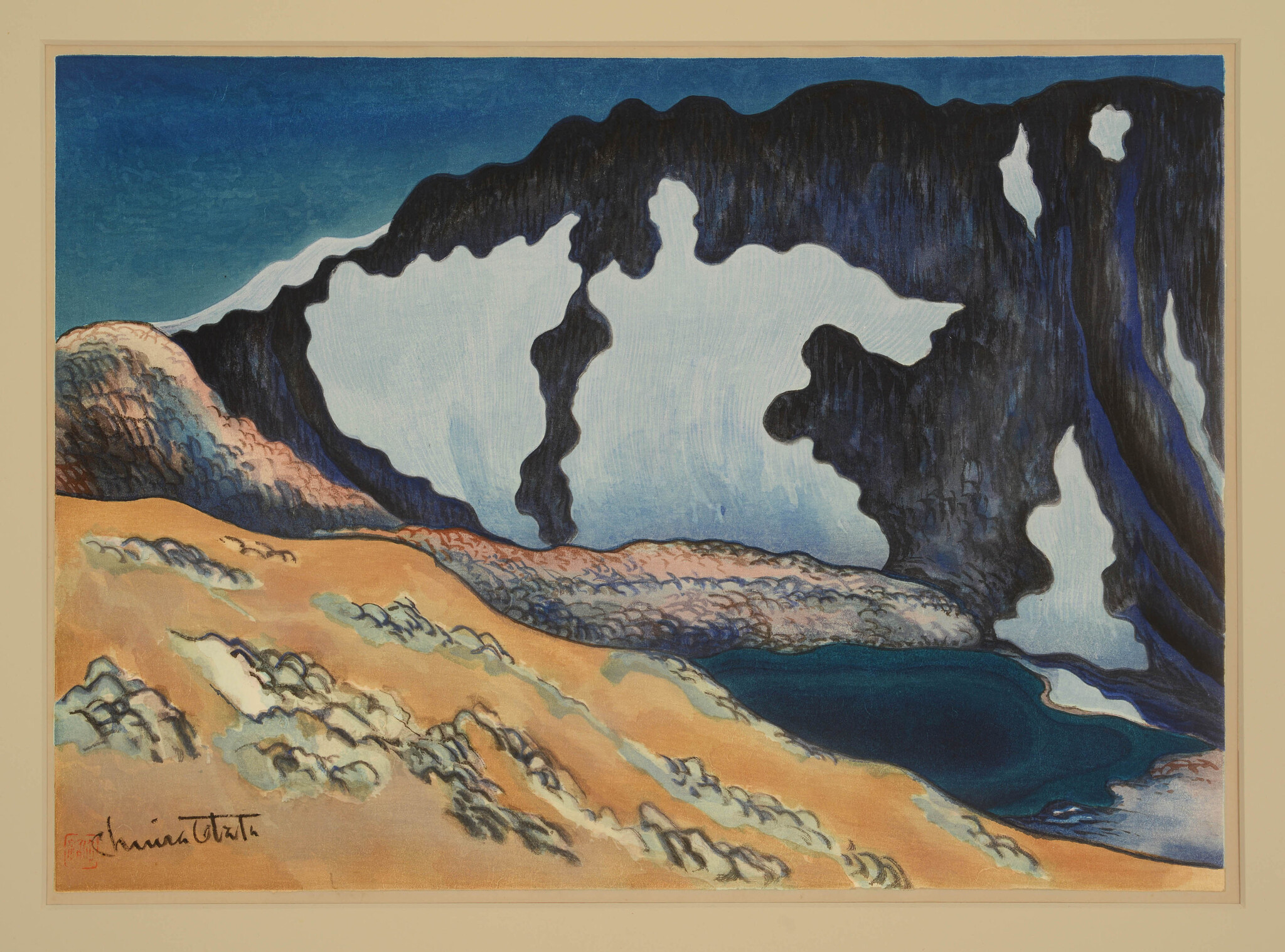
Lake Basin in the High Sierra
by Obata Chiura
- Date:
- 1930
- Medium:
- Color woodblock print
- Source:
- Smithsonian American Art Museum
Description
Lake Basin in the High Sierra (1930) is one of the most widely reproduced sheets in Obata Chiura's World Landscape Series 'America,' a horizontal composition that distills the experience of standing above an alpine lake into a calm, almost diagrammatic view. The print shows a tarn cradled in a granite basin: dark, jagged peaks rise across the back of the image, a band of conifers ringed the lower slopes, and the foreground water lies perfectly still, holding inverted reflections of the mountains in slightly cooler tones. The palette is restrained — slate blues, deep greens, charcoal grays — with a thin band of warmer sky to register early or late light. Obata had hiked into the high country during his two-month 1927 Sierra expedition with the painter Worth Ryder, producing roughly a hundred sketches and watercolors that would become the visual basis for the series. To turn the watercolors into prints, he returned to Tokyo between 1928 and 1930 and oversaw production at the Takamizawa Print Works, where he employed thirty-two carvers and eighteen printers and approved between 120 and 205 progressive proofs of each image, with master printer Tadeo Takamizawa pulling the final editions. The Smithsonian American Art Museum holds this impression as part of a major gift from the Obata family (accession 2000.76.25, https://americanart.si.edu/artwork/lake-basin-high-sierra-54549), and the work has been central to the museum's pair of major Obata retrospectives — Obata's Yosemite (2008) and Chiura Obata: American Modern (2018-19) — that helped establish his standing within the American canon. For students of Obata and of Japanese-American printmaking, Lake Basin in the High Sierra is a foundational image: it shows how the Japanese meisho-e tradition of celebrated views, when transposed to the American West by a bilingual, bicultural artist, could produce prints that read simultaneously as Sierra landscape and as Japanese composition.
More Prints by Obata Chiura
Featured in Collections
Curated cross-cuts that include this print.
Frequently Asked Questions
Lake Basin in the High Sierra was created by Obata Chiura (小圃千浦) in 1930.