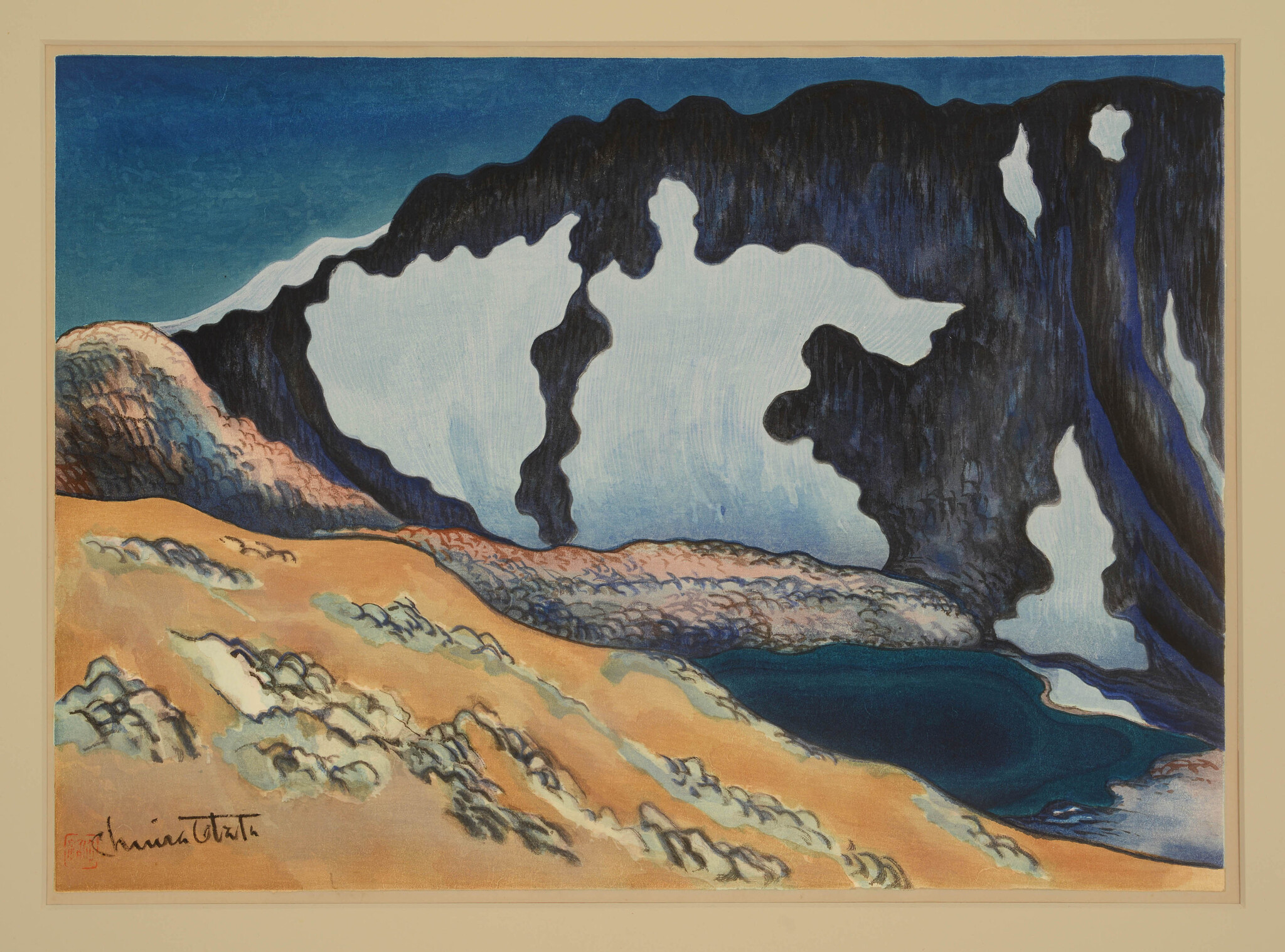
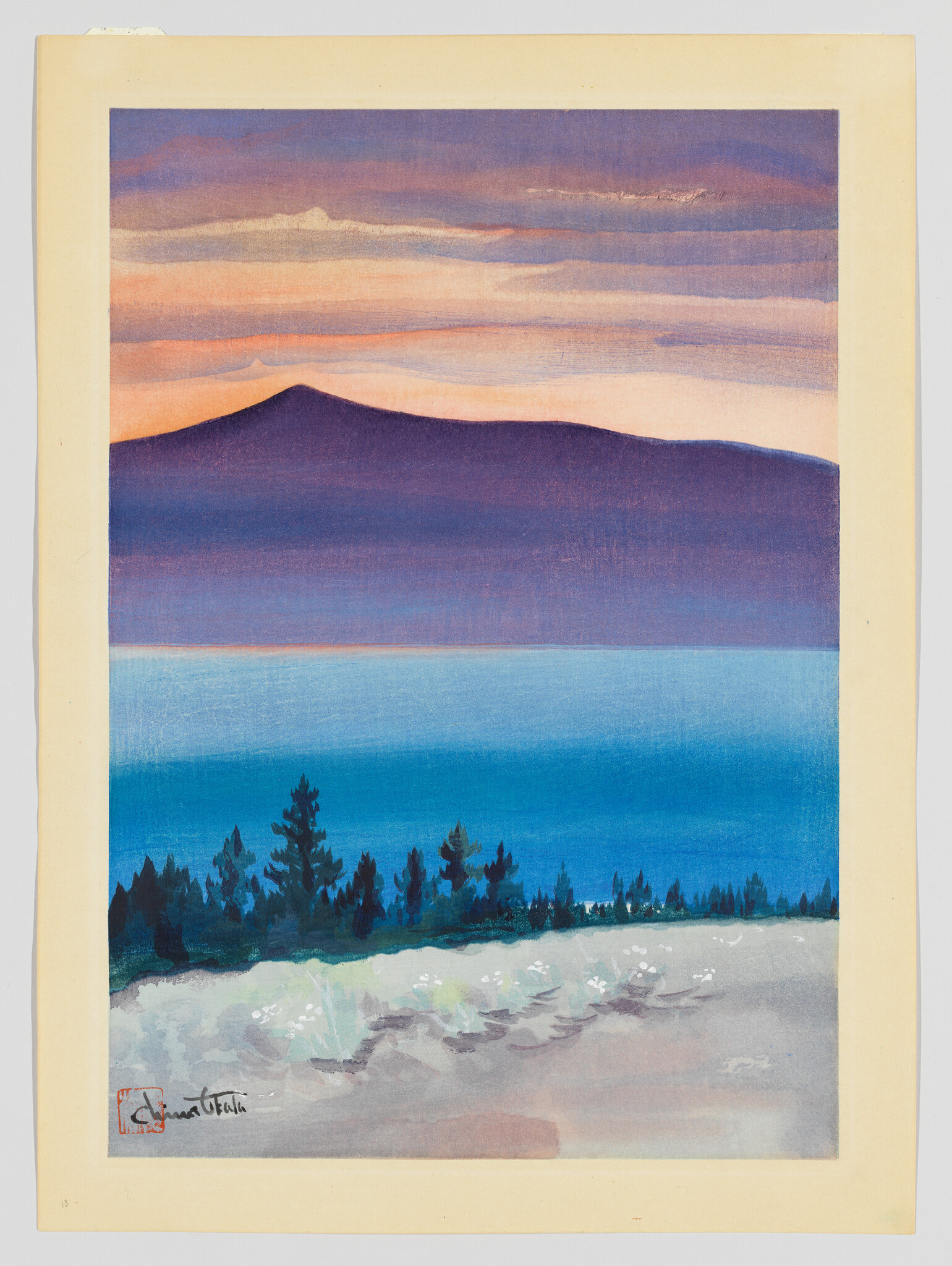
Silence, Last Twilight on an Unknown Lake, Johnson Peak
by Obata Chiura
- Date:
- 1930
- Medium:
- Color woodblock print
- Source:
- Whitney Museum of American Art
Description
Silence, Last Twilight on an Unknown Lake, Johnson Peak (1930) is one of the most contemplative prints in Obata Chiura's World Landscape Series 'America,' and a clear example of how he carried the Japanese landscape tradition of stillness into the American West. The horizontal composition centers on a glassy alpine lake, its surface holding the reflected silhouette of a high peak; soft purples, deep blues, and a thin band of pale apricot at the horizon describe the very last light of day. There is no human figure, no narrative — only the long, suspended quality of a moment in which the mountains, the water, and the sky have come into perfect tonal balance. The print derives from a watercolor Obata made during his 1927 Sierra expedition with the painter and Berkeley professor Worth Ryder; on that trip the party hiked into remote backcountry and Obata produced roughly a hundred sketches and studies. Between 1928 and 1930 he returned to Tokyo to oversee production of the World Landscape Series at the Takamizawa Print Works, employing thirty-two carvers and eighteen printers and approving between 120 and 205 progressive proofs of each image so that the printed sheets could carry the subtle gradations of his original watercolors. The title's emphasis on 'silence' and 'last twilight' aligns the print with a long tradition of Japanese poetic landscape in which weather, season, and time of day carry more weight than topography, and the unknown lake reads as much as a state of mind as a specific place. The Whitney Museum of American Art holds this impression (accession 2015.17, https://whitney.org/collection/works/46358) as part of its substantial Obata family gift, and the Art Institute of Chicago holds a related working-proof monotype version of the same image, allowing scholars to trace Obata's transition from sketch to print. For students of Obata and of Japanese-American printmaking, Silence is a foundational sheet: it shows how a Japanese-trained landscape painter could remake the meisho-e tradition for the Sierra Nevada without sacrificing its essential quietness.
More Prints by Obata Chiura
Featured in Collections
Curated cross-cuts that include this print.
Frequently Asked Questions
Silence, Last Twilight on an Unknown Lake, Johnson Peak was created by Obata Chiura (小圃千浦) in 1930.