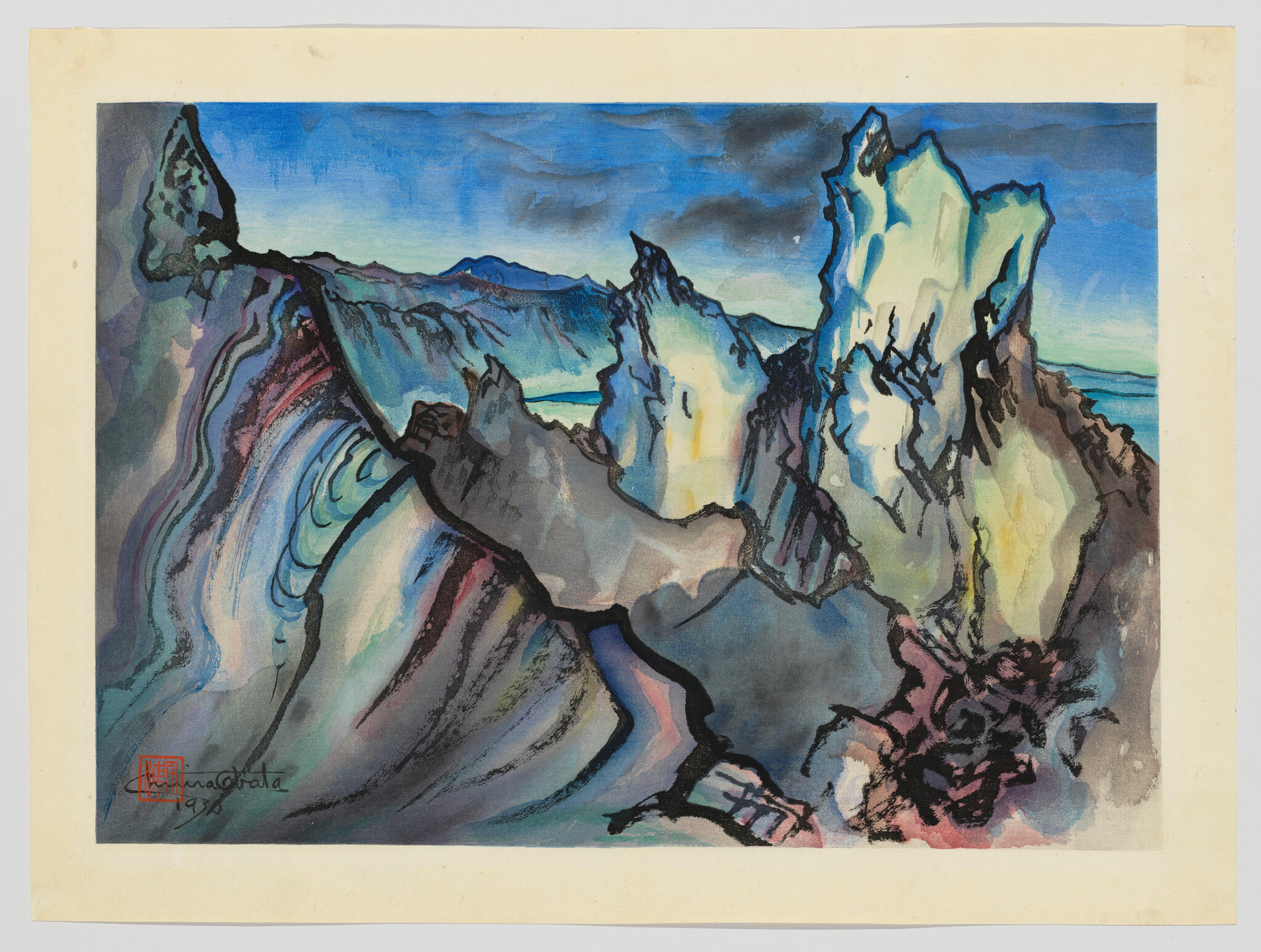
Mono Crater
by Obata Chiura
- Date:
- 1930
- Medium:
- Color woodblock print
- Source:
- Whitney Museum of American Art
Description
Mono Crater (1930), from Obata Chiura's portfolio World Landscape Series 'America,' is a compact, intensely colored print in which the artist condenses the volcanic landscape east of Yosemite into a near-fantastical image. The composition is horizontal: jagged rock formations rise in the middle distance in warm reds, ochres, and rusty browns, set against a clear blue sky and grounded by a band of swirling, layered terrain in the foreground that suggests both lava flow and sage scrub. The bright palette and pattern-like treatment of the rock owe as much to Obata's earlier nihonga training as to plein-air observation: the crater is rendered with the decorative clarity of a Japanese hanging scroll, but the subject is unmistakably the Eastern Sierra. During his 1927 expedition, Obata had crossed from Yosemite eastward into the Mono Basin with the painter Worth Ryder and his party, sketching and painting at each stop, and Mono Crater preserves the strangeness of that volcanic terrain for a viewer raised on the Japanese tradition of imagined or distant 'famous views.' Production took place in Tokyo between 1928 and 1930 at the Takamizawa Print Works, where Obata oversaw thirty-two carvers and eighteen printers and approved between 120 and 205 progressive proofs of each image to ensure that the resulting sheets carried the visual quality of his watercolors into the printed edition. The Whitney Museum of American Art holds this impression as part of its Obata family gift (accession 2015.21, https://whitney.org/collection/works/46363), among more than twenty Obata woodblocks the museum acquired in the 2010s. For collectors of Obata and students of Japanese-American art, Mono Crater is a particularly vivid example of how the World Landscape Series imported the visual conventions of meisho-e — celebrated, identifiable places, isolated against minimal grounds — and applied them to the unfamiliar geography of the American West.
More Prints by Obata Chiura
Featured in Collections
Curated cross-cuts that include this print.
Frequently Asked Questions
Mono Crater was created by Obata Chiura (小圃千浦) in 1930.