
Mt. Fuji
- Medium:
- Mokuhanga (Japanese woodblock)
- Image courtesy of
- Saru Gallery
Description
Mount Fuji sits at the center of a long visual tradition in Japanese printmaking, from Hokusai's Thirty-Six Views to Hiroshige's serial treatments, and Onchi's engagement with the mountain was inevitably shaped by that lineage even as he worked against many of its conventions. Where the Edo masters typically located Fuji within a populated foreground — travellers on the Tokaido, fishermen on the bay — Onchi's Fuji prints tend to strip out narrative incident and present the mountain as a tonal mass against a simplified ground. The composition reflects the sosaku-hanga commitment to formal economy: the silhouette of Fuji becomes a vehicle for color and atmosphere rather than a topographic record. As with all of Onchi's mature work, the print would have been designed, carved, and printed by the artist himself on washi, and the visible traces of the cutting tools and the irregular saturation of pigment register the autographic process Onchi made central to the sosaku-hanga ethic.
More Prints by Onchi Koshiro

More Mount Fuji Prints
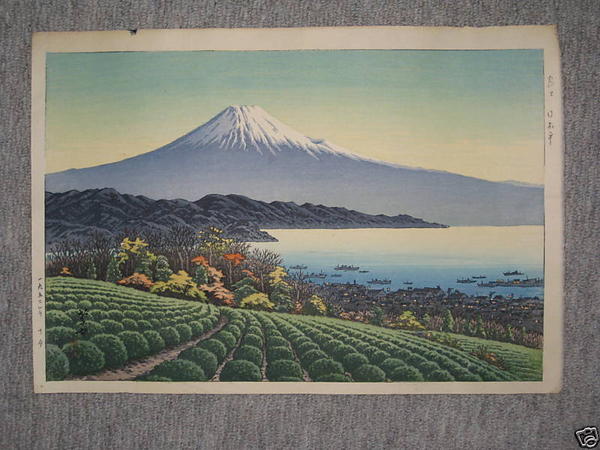
Fuji from tea farm
Woodblock print

Akasaka, Fujikawa, Okazaki, Chiryu, and Narumi, from the series "Famous Places on the Fifty-three Stations of the Tokaido, Five Stations (Tokaido gojusan eki goshuku meisho)"
c. 1830/35
Color woodblock print; oban
![Mount Fuji on a Moonlit Night, Kawai Bridge (Tsukiyo no Fuji [Kawaibashi]), from the series "Selection of Views of the Tokaido (Tokaido fukei senshu)" by Kawase Hasui](https://www.artic.edu/iiif/2/d0960668-1e73-339a-b182-fb995a54bff0/full/843,/0/default.jpg)
Mount Fuji on a Moonlit Night, Kawai Bridge (Tsukiyo no Fuji [Kawaibashi]), from the series "Selection of Views of the Tokaido (Tokaido fukei senshu)"
1947
Color woodblock print; oban

Mt. Fuji in Rain (Ame no Fuji)
n.d.
Color woodblock print
Featured in Collections
Curated cross-cuts that include this print.
Frequently Asked Questions
Mt. Fuji was created by Onchi Koshiro (恩地孝四郎).
Mt. Fuji depicts mount fuji.