
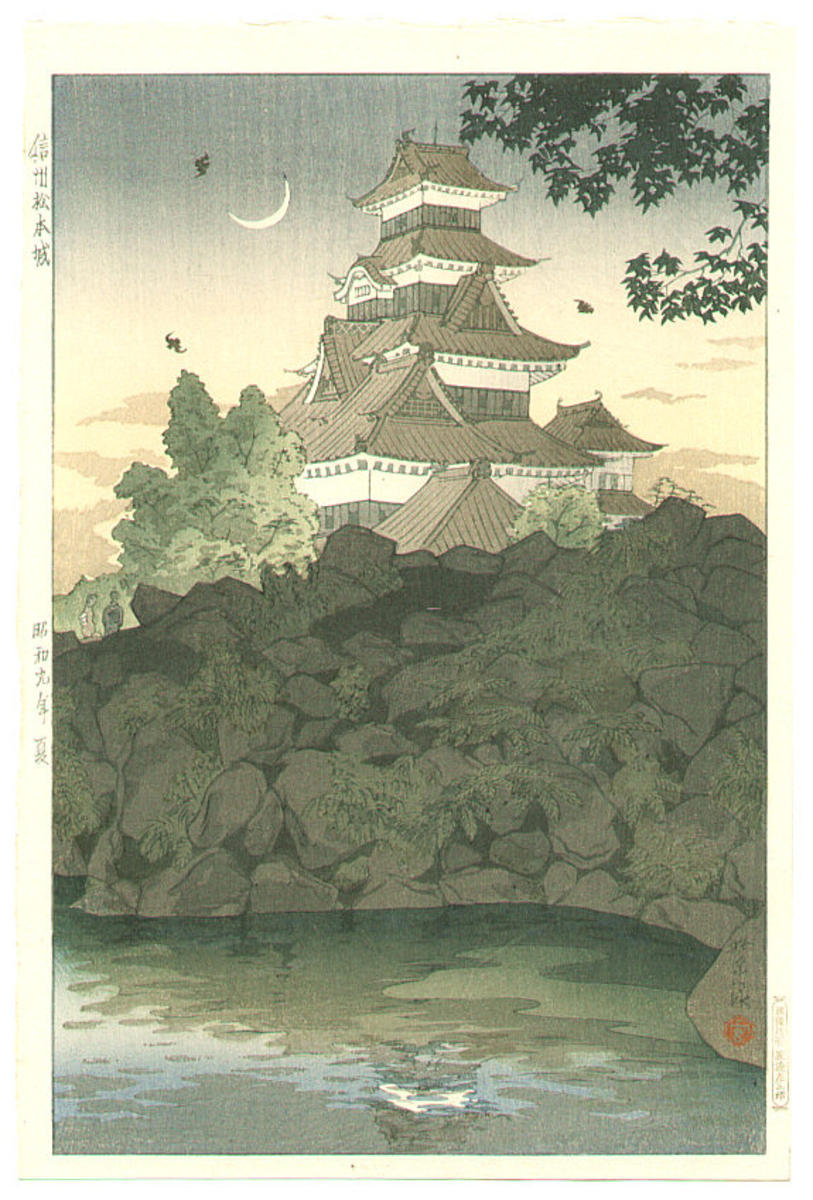
Mastumoto Castle, Shinshu
- Date:
- 1934
- Medium:
- Color woodblock print
- Source:
- Art Institute of Chicago
Description
Matsumoto Castle rises on a dark, rock-faced embankment above a still moat, its stacked black-and-white tiered roofs silhouetted against a grey-blue evening sky with a thin crescent moon and a few birds in flight. Foreground foliage frames the upper right and left corners, with green trees clustered at the base of the castle mound and their reflection, along with the castle's, blurred in the water below. The palette is muted—slate greys, deep greens, and soft ochre—giving the scene a quiet, dusky atmosphere. Shiro Kasamatsu, 1934, color woodblock print.
More Prints by Shiro Kasamatsu

More Castles Prints


Featured in Collections
Curated cross-cuts that include this print.
Frequently Asked Questions
Mastumoto Castle, Shinshu was created by Shiro Kasamatsu (笠松紫浪) in 1934.
Mastumoto Castle, Shinshu depicts castles.